


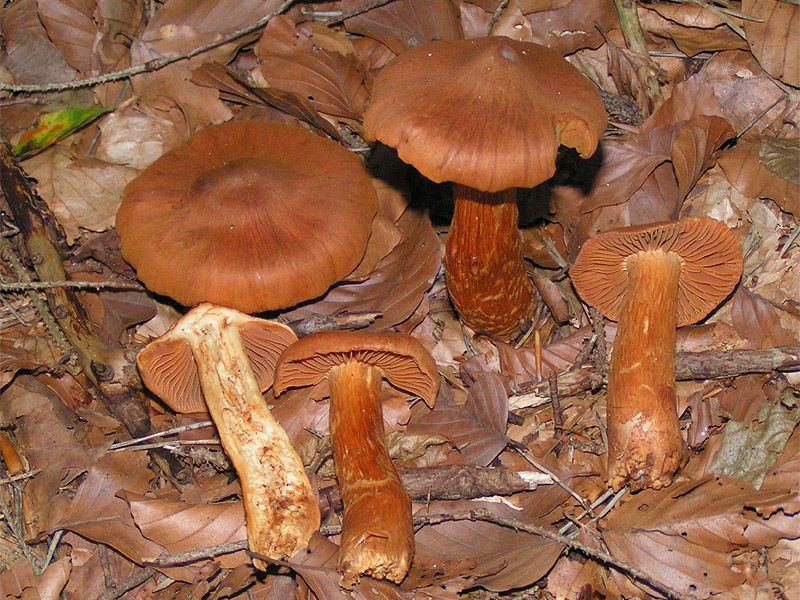
Purple mushrooms are rare enough that many people assume any violet mushroom must be the wood blewit, Lepista nuda (also listed as Clitocybe nuda), a well-known late-season species. That assumption is risky. The large genus Cortinarius, known as webcaps, includes several purple or lilac species that overlap with blewits in size, colour and season, and the same genus contains some of the most dangerous mushrooms in Europe and North America. Smaller lilac species such as the lilac fibrecap (Inocybe lilacina, sometimes treated as Inocybe geophylla var. lilacina) and the lilac bonnet (Mycena pura) add further confusion. Learning the differences between blewits and purple webcaps is a good exercise in careful identification, but it is not a shortcut to deciding what is edible.
The wood blewit is a medium to large gilled mushroom with a smooth, slightly greasy cap that starts lilac or bluish-violet and often fades to tan or buff with age, sometimes keeping a purple tinge only at the margin. The gills are crowded, lilac when young, and usually notched where they meet the stem rather than running down it. The stem is stout, often violet-streaked or fibrous, and may be somewhat swollen at the base, but it has no ring, no cobweb veil and no rusty fibres. Blewits commonly fruit late in the season, from autumn into early winter in many regions, in leaf litter, compost heaps, gardens, hedgerows and woodland edges. Many people describe a fragrant, perfumed smell, but smell is subjective and is never a reliable identification test on its own.
Purple webcaps share that general shape and colour, which is exactly why they are confused with blewits. Examples include the violet webcap (Cortinarius violaceus), a deep, dark violet species with a finely scaly cap; the gassy webcap (Cortinarius traganus) and Cortinarius camphoratus, pale lilac species with distinctive strong odours; and the slimy, small viscid violet cortinarius (Cortinarius iodes) found in eastern North America. Webcaps are mostly mycorrhizal, so they tend to grow on soil near living trees such as conifers, oaks and birches, but they can easily appear in the same woods and at the same time of year as blewits. Habitat therefore helps build a picture, but it cannot separate the two groups by itself.
The single most useful feature is the cortina, the delicate cobweb-like partial veil that gives webcaps their name. On young Cortinarius specimens, fine silky threads stretch from the cap edge to the stem, covering the gills. As the cap opens, the cortina collapses into a faint fibrous ring zone on the stem, and falling spores often stain those fibres rusty brown. Blewits never have a cortina. Because the veil can be fragile and may vanish on older or rain-washed specimens, it is worth looking at several mushrooms of different ages from the same patch. Webcaps also frequently have a bulbous or abruptly swollen stem base, which is another reason to dig out the whole mushroom rather than cutting it at ground level.
Spore print colour is the other key difference. Wood blewits produce a pale pinkish or pinkish-buff print, while Cortinarius species produce a rusty brown to cinnamon-brown print. Mature webcap gills often turn rusty brown as spores ripen, so a purple mushroom with brownish gills is a strong warning sign. To take a print, place the cap gills-down on white and dark paper or glass, cover it, and leave it for several hours. Even so, a pinkish print does not prove you have a blewit: Entoloma species, which include toxic mushrooms such as the livid entoloma (Entoloma sinuatum), also drop pinkish spores. And the small lilac fibrecap, which contains muscarine, has a brown spore print but can be overlooked when people focus on colour alone. Spore print colour narrows the options rather than settling the question.
The stakes are real. Some webcaps, including the deadly webcap (Cortinarius rubellus) and the fool's webcap (Cortinarius orellanus), contain orellanine, a toxin that can cause severe and sometimes permanent kidney damage, with symptoms that may not appear for days. The purple webcaps most often mistaken for blewits are not the best-known orellanine species, but the toxicity of many Cortinarius species is poorly studied, and the genus is notoriously difficult to identify even for specialists. Folk tests are worthless here: peeling the cap, a pleasant smell, a silver spoon not tarnishing or slugs and animals eating the mushroom say nothing about safety. Wood blewits themselves are also known to cause stomach upset in some people. Only an expert who has examined the actual specimen can confirm edibility, and some deadly species closely resemble popular edible ones. If anyone may have eaten a wild mushroom, call poison control or emergency services immediately and keep a sample of the mushroom for identification.
If you find a purple mushroom and want to know what it is, record the features that matter. Photograph the top of the cap, the gills from below and the side, the whole stem, and the stem base after carefully lifting it from the soil, and look closely for any cobweb threads or rusty fibres on young specimens. Note nearby trees and the substrate, and take a spore print if you can. Shroomly can then suggest likely species and highlight toxic look-alikes such as webcaps, fibrecaps and entolomas, helping you understand what to check next. Treat any app result as a starting point rather than an answer, and confirm the identification with a local mycological society or an experienced expert who can examine the mushroom in person.