


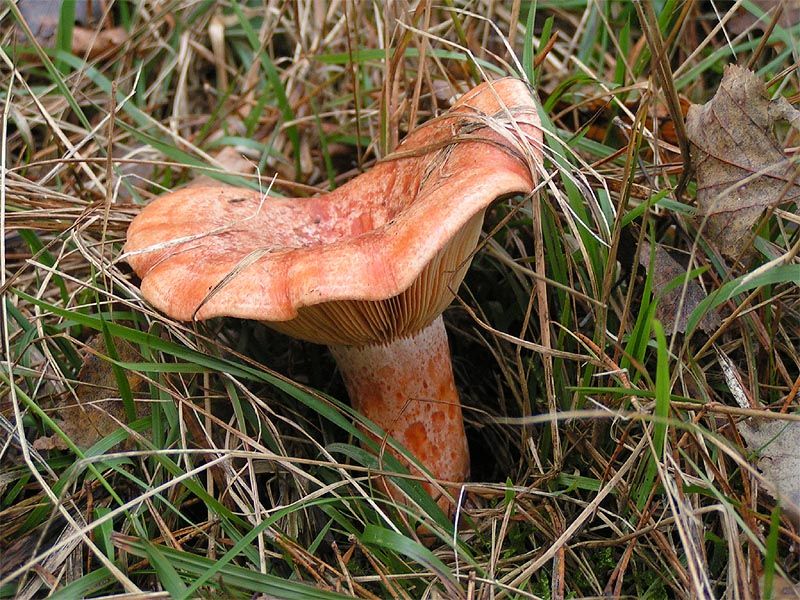
If you have ever snapped a wild mushroom and watched droplets of white, orange or even blue fluid bead along the broken gills, you have almost certainly met a milk cap. This fluid is called latex, and it comes from specialized hyphae called laticifers that run through the flesh of the fruiting body. When the tissue is damaged, the pressurized latex leaks out. In mushrooms the habit is most strongly associated with two closely related genera, Lactarius and Lactifluus, which belong to the family Russulaceae alongside the brittlegills (Russula). The latex is thought to help deter insects, slugs and other grazers, partly because in many species it is intensely acrid or bitter.
For identification, latex is valuable because it is easy to check and fairly distinctive. Most experienced foragers test it by gently nicking the edge of a gill or the cap flesh with a clean knife and watching what appears. Three things matter: the color of the latex as it first emerges, whether that color changes over the next several minutes, and whether the surrounding flesh or gills stain a different color where the latex dries. A small, clear photograph taken immediately after cutting, and another taken ten to thirty minutes later, records both stages and is far more useful than a description from memory.
Latex color varies more than most people expect. Many milk caps produce white or cream latex, including the peppery milk cap (Lactifluus piperatus) and the weeping milk cap (Lactifluus volemus), whose abundant white latex slowly browns. The saffron milk cap (Lactarius deliciosus) exudes carrot-orange latex, and its bruised flesh gradually develops green stains. The closely related false saffron milk cap (Lactarius deterrimus), which grows under spruce, has orange latex that turns wine-red within roughly half an hour. Lactarius sanguifluus, found in parts of Europe, produces latex that is wine-red from the start. In North America the indigo milk cap (Lactarius indigo) famously bleeds dark blue. Some species with white latex change quickly, such as Lactarius chrysorrheus, whose latex turns sulfur yellow on exposure to air.
These differences matter because milk caps are a large group with many look-alikes, and not all of them are harmless. The woolly milk cap (Lactarius torminosus), with a pinkish zoned cap and a shaggy, inrolled margin, resembles the saffron milk cap at a glance but has white latex and is known to cause gastrointestinal poisoning. The ugly milk cap (Lactarius turpis), a dull olive-brown species common under birch, has raised concern because it contains a compound reported to be mutagenic. Many white-latexed species are so acrid that they cause digestive upset. Checking latex color helps narrow the field, but it does not separate every species, and some toxic mushrooms simply share a latex color with edible ones.
Latex can also mislead you if you rely on it too heavily. Old, dried-out, frosted or waterlogged specimens may produce little or no fluid, so a milk cap can appear latex-free. Weather, age and handling all affect how quickly colors change. Milk caps are not the only fungi that bleed, either: the bleeding fairy helmet (Mycena haematopus) leaks a dark red juice, and the milking bonnet (Mycena galopus) releases white drops from its slender stem. Brittlegills look very similar to milk caps in shape and crumbly texture but have no latex at all, so the absence of fluid is itself a clue rather than a guarantee of anything about safety.
It is worth stressing what latex cannot tell you. There is no rule that orange latex means edible or that white latex means poisonous, and you should never taste latex or flesh as a test. Folk methods such as checking whether a silver spoon darkens, whether the cap peels, whether animals have nibbled it, or whether it smells pleasant are all unreliable and have contributed to serious poisonings. Edibility can only be confirmed by an expert who has examined the actual specimen in person, and it is important to remember that some deadly species, including Amanitas, closely resemble popular edible mushrooms. Latex is a tool for narrowing down identification, not a shortcut to a safe meal.
If you find a mushroom that oozes when cut, the best approach is to document it carefully. Photograph the top of the cap, the gills underneath, the stem and the very base of the stem, plus a close-up of the latex right after cutting and again after it has had time to change color. Note the nearby trees, since many milk caps partner with specific hosts such as pine, spruce, birch or oak. You can then use Shroomly to suggest likely species and highlight toxic look-alikes, and take your photos and specimen to a local mycological society or experienced expert for confirmation. If anyone has eaten a wild mushroom and you are worried, call poison control or emergency services immediately and keep a sample of the mushroom to help them identify it.