


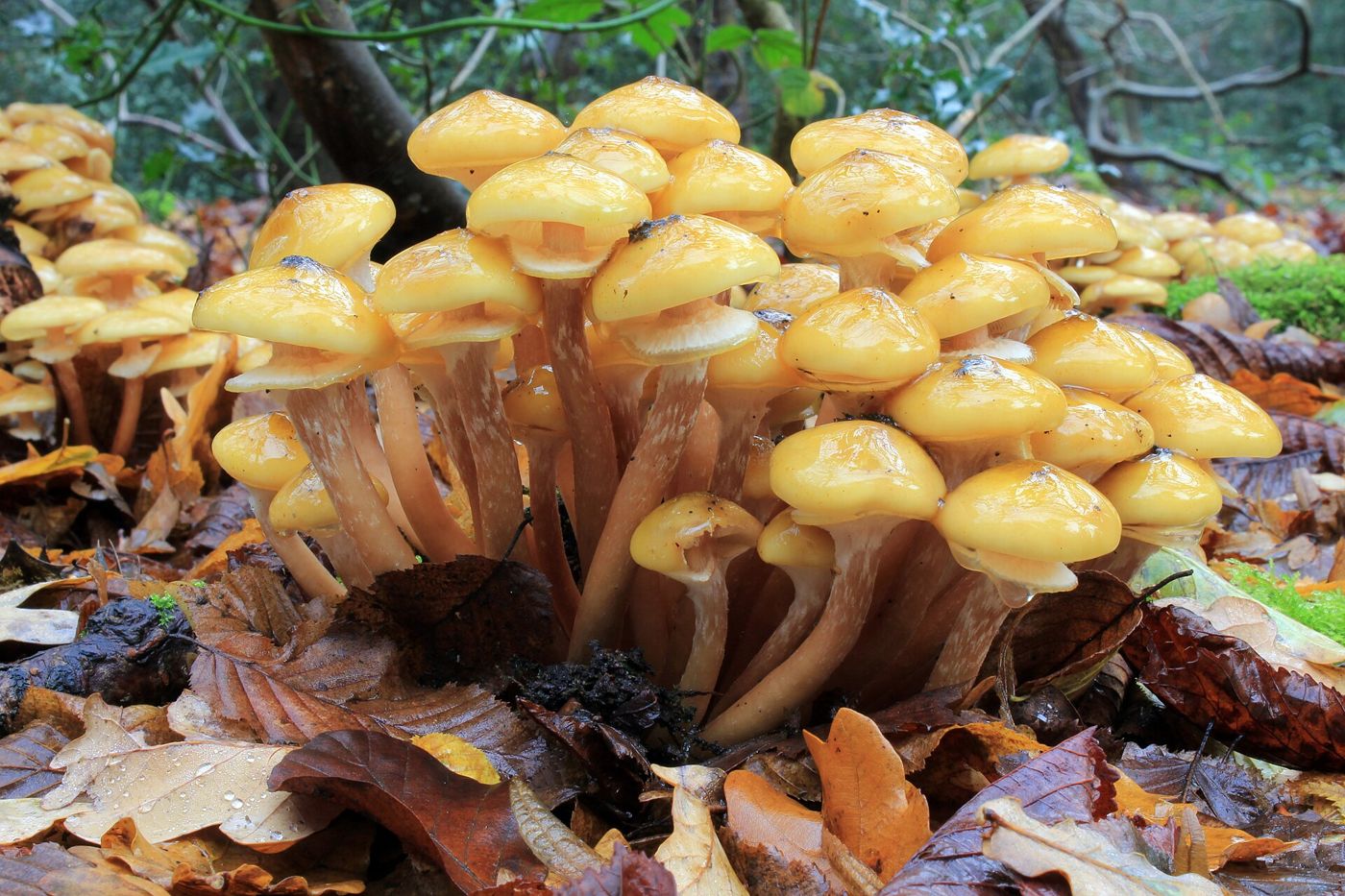
If you have ever found a stump crowned with dozens of mushrooms, or a tight bouquet of caps pushing up from the base of a tree, you have seen one of the most striking growth habits in the fungal world. Some mushrooms appear singly, some are scattered in loose groups across a lawn or woodland floor, and others burst out in dense clumps with their stems pressed together or even fused at the base. Mycologists describe these habits with specific words: solitary for single mushrooms, gregarious or scattered for loose groups, and caespitose or tufted for tight clusters where the stems join. These are not random patterns. They reflect how and where the hidden fungus is feeding.
The key to understanding clusters is remembering that a mushroom is only the fruiting body of a much larger organism. The main body of the fungus is the mycelium, a network of fine threads called hyphae that grows through wood, soil, leaf litter or roots. When conditions are right, usually after a combination of moisture, suitable temperature and enough stored energy, the mycelium forms tiny knots of tissue called primordia that expand into mushrooms. If the mycelium has concentrated its resources in one place, it can produce many primordia close together, and they swell into a cluster that shares the same food supply and often the same base.
Wood is the classic setting for this. A stump, fallen log or dying trunk is a large, concentrated parcel of food, and a wood-decay fungus that has colonised it can channel a great deal of energy to a few exit points, such as cracks in the bark, cut surfaces or the root flare. That is why so many familiar clustered mushrooms are wood dwellers, including honey fungus (Armillaria species), sulphur tuft (Hypholoma fasciculare), oyster mushrooms (Pleurotus ostreatus), the jack-o'-lantern (Omphalotus olearius in Europe and Omphalotus illudens in North America) and the glistening ink cap (Coprinellus micaceus). Clusters that seem to grow from open ground are often attached to buried wood or roots, which is worth remembering when you look at a specimen, because the true substrate is part of its identity.
Ground-dwelling mushrooms more often appear scattered or in troops rather than fused tufts, because their food is spread more evenly through soil and litter. In grass, a single mycelium expanding outward can produce an arc or ring of separate mushrooms, as in fairy rings, rather than one tight clump. Mycorrhizal species, which partner with tree roots, frequently fruit in loose groups around their host tree. There are exceptions on every side, and some species can grow either singly or in clusters depending on conditions, so growth habit is a supporting clue rather than a deciding one. A cluster of mushrooms is also usually, though not always, the product of one individual mycelium, so the caps in it tend to be at slightly different stages of development, which can help you see the full range of features from young buttons to mature, flattened caps.
Clustered growth is one of the places where a rule of thumb can turn dangerous. There is a persistent idea that mushrooms growing on wood, or in big healthy clumps, must be safe, and it is simply false. Sulphur tuft is toxic, the jack-o'-lantern causes severe vomiting and diarrhoea, and honey fungus has made many people ill. Most seriously, the funeral bell (Galerina marginata) grows in groups and clusters on wood and contains amatoxins, the same liver-destroying toxins found in the death cap. It can grow on the same logs as the sheathed woodtuft (Kuehneromyces mutabilis), a species some foragers seek, and the two can be extremely hard to separate without close examination of the stem, spores and other details. Different species can also fruit side by side on one stump, so you cannot assume every mushroom in a patch is the same kind. Only an expert who has examined the actual specimens can confirm what a mushroom is and whether it is edible, and no photo, app result, single trait or folk test such as peeling the cap, smell or animals nibbling it can do that.
When you find a cluster, it pays to record it carefully. Note what it is growing from, whether that is a stump, a living tree, buried roots or open soil, and which tree species is involved if you can tell. Look at whether the stems are fused at the base, whether there is a ring on the stem, and how the gills attach, and check the colour of the spore deposit if you can make a spore print. If anyone, including a child or pet, may have eaten part of a wild mushroom, call poison control or emergency services immediately and keep a sample of the mushroom for identification; do not wait for symptoms to appear.
If you want to put a name to a cluster you have found, take clear photos of the tops of the caps, the gills or pores underneath, and the stem base, including where the stems join and what they are attached to. Shroomly can use those images to suggest likely species and flag toxic look-alikes, such as funeral bell among small brown wood-loving mushrooms, so you know what to check next. Treat any app result as a starting point for learning, never as permission to eat, and confirm identifications with a local mycological society or an experienced expert who can examine the specimen in person.