


When a tree is cut down, the stump that remains is a large store of food that nothing else in the garden can easily use. Wood is made mostly of cellulose, hemicellulose and lignin, tough materials that few organisms can digest. Fungi are among the main decomposers that can, and their spores are almost everywhere in the air and soil. Once spores land on exposed wood, or once fungi already living inside the tree take advantage of its death, thread-like mycelium begins spreading through the stump. The mushrooms you eventually see are only the reproductive fruiting bodies of that hidden network, pushed out to release spores when temperature and moisture are right, which is why they often appear suddenly in damp autumn weather.
In most cases, mushrooms on a stump are simply a sign that recycling is under way. Wood-decay fungi release enzymes that break down the wood, softening it over time until it crumbles into soil and returns its nutrients to the ground. Depending on the size of the stump, the type of wood and the climate, this can take anywhere from a few years to well over a decade. Some fungi cause white rot, leaving the wood pale, soft and stringy, while others cause brown rot, leaving it dark and cracked into cube-like pieces. Either way, the fungi are doing what they evolved to do, and a stump bristling with mushrooms is often a stump that will eventually disappear on its own.
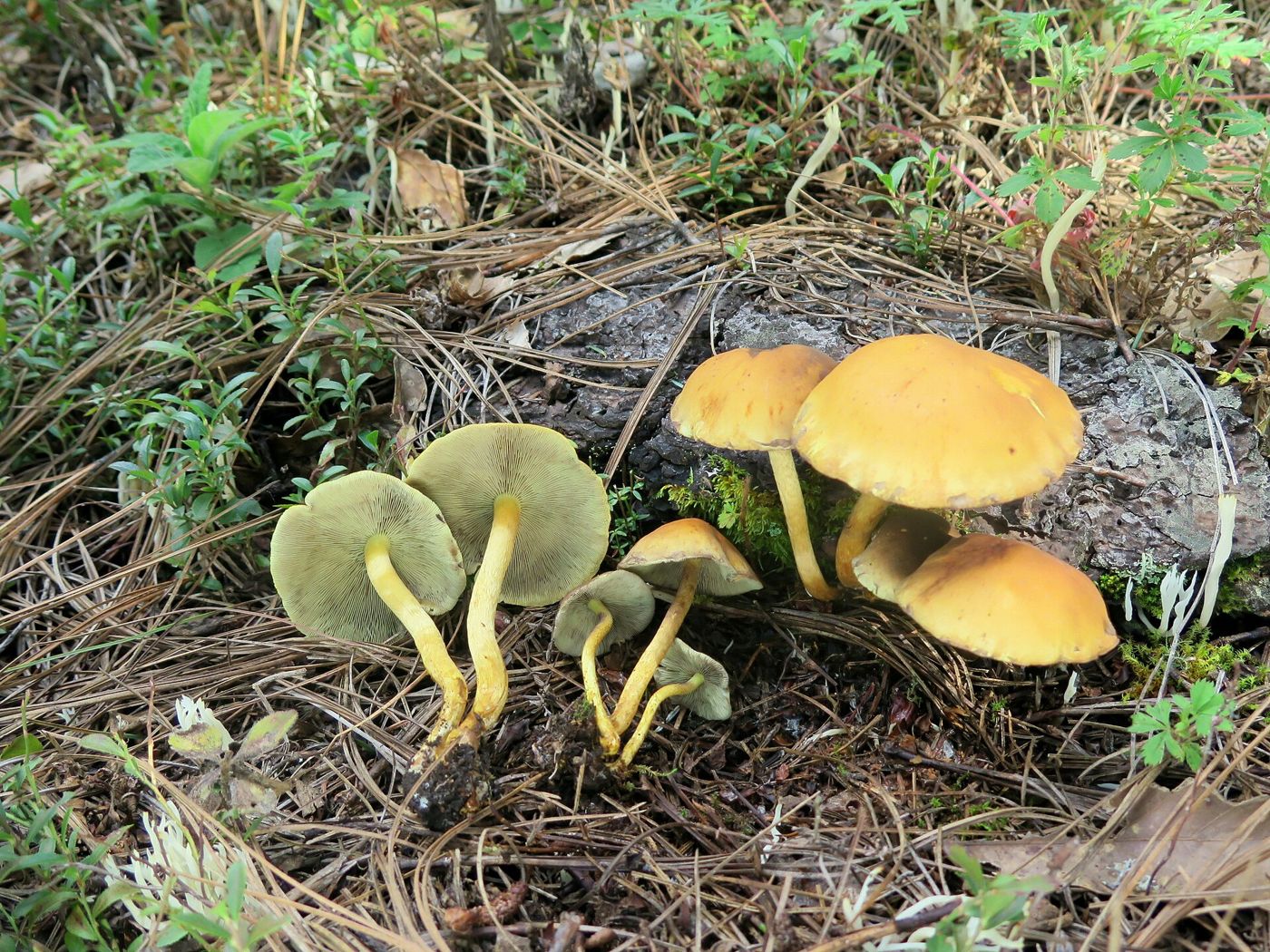
Several familiar species turn up on stumps across the United States, the United Kingdom, Canada and Australia. Sulphur tuft (Hypholoma fasciculare) forms dense yellow clusters on rotting wood and is poisonous. Turkey tail (Trametes versicolor) and hairy curtain crust (Stereum hirsutum) form thin, banded brackets. Shaggy scalycap (Pholiota squarrosa) grows in clumps at the base of trees and stumps, and oyster mushrooms (Pleurotus species) form fan-shaped shelves. Larger woody brackets such as artist's conk (Ganoderma applanatum) may persist for years. Most worrying of all, the funeral bell (Galerina marginata), a small, ordinary-looking brown mushroom that grows on wood, contains the same amatoxins found in the death cap and can be fatal if eaten.
The one stump fungus gardeners genuinely need to think about is honey fungus, the common name for several Armillaria species, including Armillaria mellea. Unlike most stump fungi, honey fungus can act as a parasite as well as a decomposer. It can use a dead stump as a food base and spread through the soil by tough, dark, bootlace-like strands called rhizomorphs, infecting the roots of nearby living trees, shrubs and hedges. Signs include clusters of honey-colored mushrooms at the stump base in autumn, a creamy white sheet of mycelium under loose bark that may smell of mushrooms, and black bootlace strands in the soil. If you suspect honey fungus, an arborist or local horticultural advisory service can confirm it, and removing or grinding out the stump and as many large roots as practical is the usual recommendation.
For other stump mushrooms, picking or knocking off the caps does not stop the fungus, because the mycelium inside the wood is unaffected and will fruit again when conditions suit it. Fungicides are not an effective fix for a stump full of mycelium either. If the mushrooms are not causing a problem, many gardeners simply leave them, since rotting stumps support beetles, woodlice and other wildlife. If children or pets use the garden, though, it makes sense to remove the fruiting bodies regularly, wearing gloves, and put them in the household waste. Touching most mushrooms is not dangerous, but washing your hands afterwards is a sensible habit, and grinding the stump out removes the food source entirely.
It is tempting to assume that mushrooms growing on wood are safer than ground-growing ones, or that a stump mushroom is edible because squirrels or slugs nibble it. Neither is true. Animals can tolerate toxins that harm people, and toxic species such as the funeral bell, sulphur tuft and the jack-o'-lantern (Omphalotus species) all grow on or around wood. Several of these closely resemble popular edible mushrooms, including honey fungus and velvet shank. No single trait, folk test or rule of thumb can tell you whether a stump mushroom is safe, and only an expert who has examined the actual specimen can confirm edibility. If anyone, including a pet, eats a mushroom from a stump, call poison control or emergency services immediately and keep a sample of the mushroom for identification.
If you want to know what is growing on your stump, Shroomly can help you narrow it down. Photograph the top of the cap, the gills or pores underneath, and the stem where it meets the wood, and note whether the mushrooms grow singly or in clusters. Shroomly will suggest likely species and flag toxic look-alikes such as the funeral bell, which is especially useful for deciding whether a stump needs closer attention. Treat the result as a starting point rather than a final answer, and for anything that matters, from suspected honey fungus to any question about edibility, confirm it with a local mycological society, arborist or fungi expert.