


If you walk through a pine wood after autumn rain, the mushrooms you meet are often quite different from those under oaks or birches a few hundred metres away. That is because many forest fungi are mycorrhizal: their underground mycelium wraps around and penetrates tree roots, trading water and mineral nutrients for sugars the tree makes through photosynthesis. Some of these partnerships are broad, but others are tightly tied to a single tree genus. Pines (Pinus species) have a particularly loyal group of fungal partners, and when pines were planted far outside their native range, in places like Australia, New Zealand, South Africa and parts of South America, several of these fungi travelled with them in the soil and roots of nursery seedlings. As a result, a pine plantation in Victoria can produce many of the same mushrooms as a Scots pine forest in Scotland or a pine stand in Ontario.
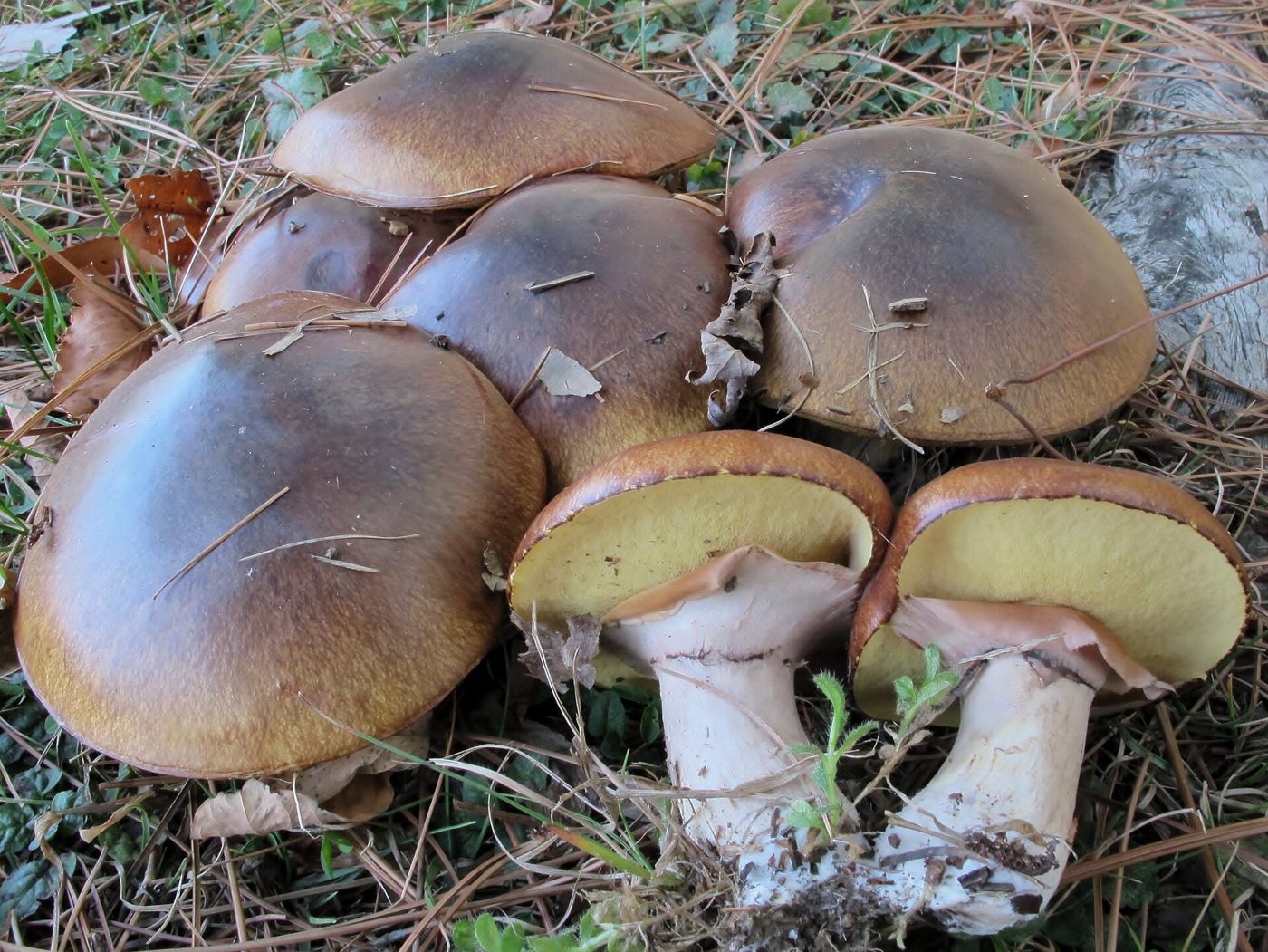
The most characteristic pine mushrooms are the slippery jacks and their relatives in the genus Suillus. Suillus luteus, the slippery jack itself, has a chestnut-brown cap that is slimy when wet and glossy when dry, yellow pores rather than gills underneath, and a stem with a distinct membranous ring that is often purplish-brown on its lower side. Suillus granulatus, the weeping bolete, is similar but lacks a ring and often has tiny milky droplets on the pores and upper stem in young specimens. Suillus bovinus, the Jersey cow bolete, has a paler buff cap and broad, angular, compound pores, and it is frequently found alongside the pinkish-spotted Gomphidius roseus, which is now understood to be parasitic on it. Closely related to these partners are the pine spikes, such as Chroogomphus rutilus, a copper-coloured mushroom with thick, decurrent gills and a stem base that is often yellowish inside. Suillus species typically fruit in troops among the needle litter from late summer through autumn, and in plantations they can appear in very large numbers.
Milk caps are another important pine group. Lactarius deliciosus, the saffron milk cap, is strongly associated with pines and has an orange cap with darker concentric zones, crowded orange gills and orange latex that slowly turns green; the whole mushroom often bruises green with age. It has close relatives on other conifers, such as Lactarius deterrimus under spruce, and a confusing group of orange and pinkish milk caps that includes the woolly milkcap, Lactarius torminosus, which has a shaggy, hairy cap margin and white latex and is usually found with birch. Because milk caps are told apart by latex colour, colour change, cap texture and the host tree, a photo of the cap alone is rarely enough. In Australia and New Zealand, the saffron milk cap is commonly reported in pine plantations in autumn, but so are other Lactarius species that are not well documented there.
Pine woods are also prime habitat for some notoriously toxic or problematic species. The fly agaric, Amanita muscaria, forms partnerships with pines, birches and spruces, and it has become widespread in Southern Hemisphere pine plantations; its red cap with white warts is unmistakable when fresh, but rain can wash the warts off and fade the colour. The panther cap, Amanita pantherina, also grows with conifers and broadleaf trees and is more dangerous because its brown cap is easily mistaken for other species. The yellow knight, Tricholoma equestre, likes sandy soils under pines; it was long regarded as a choice edible in parts of Europe until repeated meals were linked to serious muscle damage (rhabdomyolysis), including deaths, in reports from France and Poland, and it is now considered unsafe in many countries. In spring, conifer woods can produce the false morel, Gyromitra esculenta, whose brain-like, reddish-brown cap contains gyromitrin, a compound that breaks down into a toxin capable of causing severe liver and nervous system poisoning.
Not every pine mushroom grows from the soil. Sparassis crispa, the cauliflower fungus, forms a large, pale, frilly mass resembling a sea sponge or a brain at the base of pine trunks and stumps, and it is a root parasite rather than a mycorrhizal partner. The dyer's polypore, Phaeolus schweinitzii, produces dark yellow-brown, velvety brackets or rosettes near the base of conifers and causes a brown rot in the heartwood. On conifer stumps you may also find the conifer tuft, Hypholoma capnoides, which resembles the bitter, toxic sulphur tuft, Hypholoma fasciculare, but has greyish to lilac-brown gills rather than greenish-yellow ones. The deadly funeral bell, Galerina marginata, grows on rotting conifer and hardwood wood too, and its small brown caps contain the same amatoxins found in the death cap. Clustered brown mushrooms on pine wood are exactly the kind of find that should never be assumed safe.
Timing matters as much as location. In most of the Northern Hemisphere, pine mushrooms peak from late August to November, with a smaller spring flush that includes false morels and, in North America, some early Suillus species. In southern Australia and New Zealand, the main season usually runs from roughly March to June, after the first substantial autumn rains cool the soil. Dry spells can delay fruiting by weeks, and a single soaking rain can bring up dozens of species at once. It is also worth remembering that a pine tree nearby does not mean a mushroom is a pine partner: many fungi grow with several tree types, and mixed woods blur the picture. Habitat narrows the possibilities, but it never confirms a species on its own, and it says nothing reliable about edibility. Folk tests such as whether a cap peels, whether a silver spoon tarnishes, whether slugs or squirrels have nibbled it, or whether it smells pleasant are all known to fail with deadly species. Only an expert who has examined the actual specimen can confirm whether a mushroom is edible, and some deadly species, including Amanitas and Galerina, look like popular edible ones.
If you find mushrooms under pines and want to know what they are, start by recording the details that separate these groups. Photograph the top of the cap, the underside to show whether it has gills or pores, the stem including any ring, and the very base of the stem after gently digging it out of the needle litter, since a volva or bulb can point toward Amanita. Note the trees around it, whether it was on soil or wood, and whether any latex or colour change appears when it is cut. Shroomly can use those photos to suggest likely species and flag toxic look-alikes, which helps you know what to look for next. Treat any app result as a starting point only, and confirm your identification with a local mycological society or an experienced expert who can examine the mushroom in person. If anyone has eaten a wild mushroom and you are worried, call poison control or emergency services immediately and keep a sample of the mushroom for identification.