


Oaks are among the most fungus-friendly trees in the Northern Hemisphere. A single mature oak can host dozens of fungal species. Some live in partnership with its roots, some feed on its dead wood, and a few attack the living tree. If you have noticed mushrooms appearing under an oak in a park, garden or woodland, they usually belong to one of two broad groups. The first group is mycorrhizal species, which grow from the soil and are linked underground to the tree's roots. The second group is wood-decay species, which grow directly on the trunk, roots, stumps or fallen branches. Knowing which group a mushroom belongs to is one of the most useful first steps in working out what it might be.
The most important oak-associated mushroom to know is the death cap, Amanita phalloides. It forms mycorrhizal partnerships mainly with oaks, along with beech, chestnut and some other broadleaf trees. It appears mostly from late summer through autumn. Typical death caps have a smooth cap in olive, yellowish-green or bronze tones, white free gills, and a white ring on the stem. They also have a sac-like volva at the base, which is often hidden below the soil or leaf litter. Death caps have spread with planted oaks to parts of North America and Australia. In Australia they are best known from Canberra and Melbourne, where they grow under introduced European oaks, and they have caused fatal poisonings. In North America, white destroying angels such as Amanita bisporigera are also often found in mixed woods that include oak. These amatoxin-containing species cause the majority of fatal mushroom poisonings worldwide. They are a clear reason why the host tree alone tells you nothing about safety.
Many other mycorrhizal mushrooms come up in the soil around oaks. In Britain and Europe, the oakbug milkcap, Lactarius quietus, is one of the most reliable oak specialists. It is a dull reddish-brown milk cap with faintly zoned colouring, a milky latex and an oily, bug-like smell. It is found almost exclusively with oak in late summer and autumn. Brittlegills (Russula species) are abundant under oaks in a range of reds, purples, greens and yellows. Webcaps (Cortinarius species), fibrecaps (Inocybe species) and various Amanitas are also common. Several of these groups contain seriously toxic members, and many fibrecaps contain muscarine.
Boletes are another familiar sight under oaks. These are mushrooms with a spongy layer of pores instead of gills. In Europe, the summer bolete, Boletus reticulatus, often fruits under oak and beech from early summer. It is a close relative of the porcini, Boletus edulis, which also associates with oak among other trees. On chalky soils in southern England and continental Europe, the devil's bolete, Rubroboletus satanas, grows with oak and beech. It has a pale cap, red pores and a red-netted, bulbous stem, and it causes severe gastrointestinal poisoning. North American oak woods host many bolete species, including Boletus variipes and a number of bitter or toxic species. Telling boletes apart relies on pore colour, stem patterning, bruising reactions and habitat taken together, never on one feature alone.
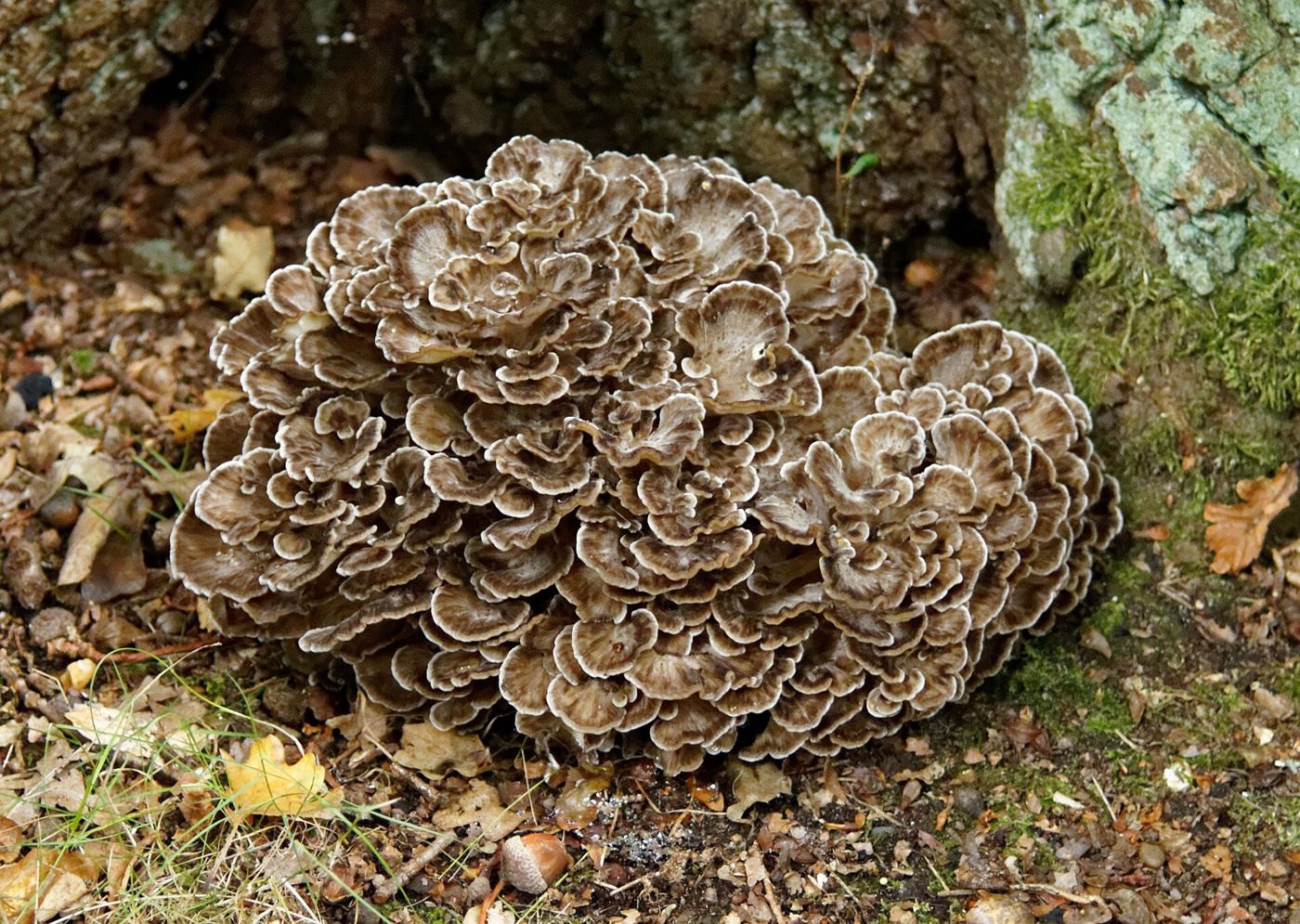
Oak wood supports its own distinctive set of fungi. Hen of the woods, Grifola frondosa, forms large grey-brown rosettes of overlapping fronds at the base of oaks, usually from late summer to autumn. It often returns to the same tree for years. Chicken of the woods, Laetiporus sulphureus, produces bright orange and sulphur-yellow shelves on oak trunks and stumps from late spring through summer. The beefsteak fungus, Fistulina hepatica, is a reddish, tongue-shaped bracket that is strongly linked to oak and sweet chestnut. When cut, its flesh looks surprisingly like raw meat. In eastern North America, the orange jack-o'-lantern mushroom, Omphalotus illudens, clusters at the base of oak stumps and buried roots. Because of its colour it is easily confused with chanterelles or chicken of the woods, and it causes severe vomiting and diarrhoea. Honey fungus (Armillaria species) and bracket fungi such as Ganoderma also attack oaks. These are worth noting if you are concerned about the health of a tree.
Timing helps you narrow things down, but it does not settle an identification. In temperate parts of the US, UK and Canada, most oak-associated mushrooms fruit from mid-summer to late autumn, especially after warm, wet weather. Chicken of the woods and summer boletes can start earlier. In Australia the seasons are reversed, so death caps under introduced oaks are usually reported in autumn, roughly March to June. Experienced foragers know that deadly and popular edible species fruit side by side under the same trees in the same weeks. That is why no rule of thumb is reliable. Growing under an oak, being nibbled by slugs or squirrels, peeling easily, smelling pleasant or failing to tarnish a silver spoon are all useless as safety tests. Only an expert who has examined the actual specimen can confirm whether a wild mushroom is edible. Even then, deadly look-alikes such as the death cap and destroying angels are a constant concern. If anyone, including a child or pet, may have eaten a mushroom from under an oak, call poison control or emergency services immediately. Keep a sample of the mushroom for identification.
If you want to know what is growing under your oak, start by recording it carefully. Photograph the top of the cap and the underside, showing the gills, pores or spines. Take a side view of the whole stem, and carefully dig out the very base so that any volva or bulb is visible. Also note whether it grows from soil or wood, and how far it is from the trunk. Shroomly can use those photos to suggest likely species and flag toxic look-alikes, such as the death cap or jack-o'-lantern, that are known to share the oak's habitat. Treat that result as a starting point for learning, not a verdict on edibility. Confirm any identification with a local mycological society or an experienced expert who can examine the mushroom in person.