


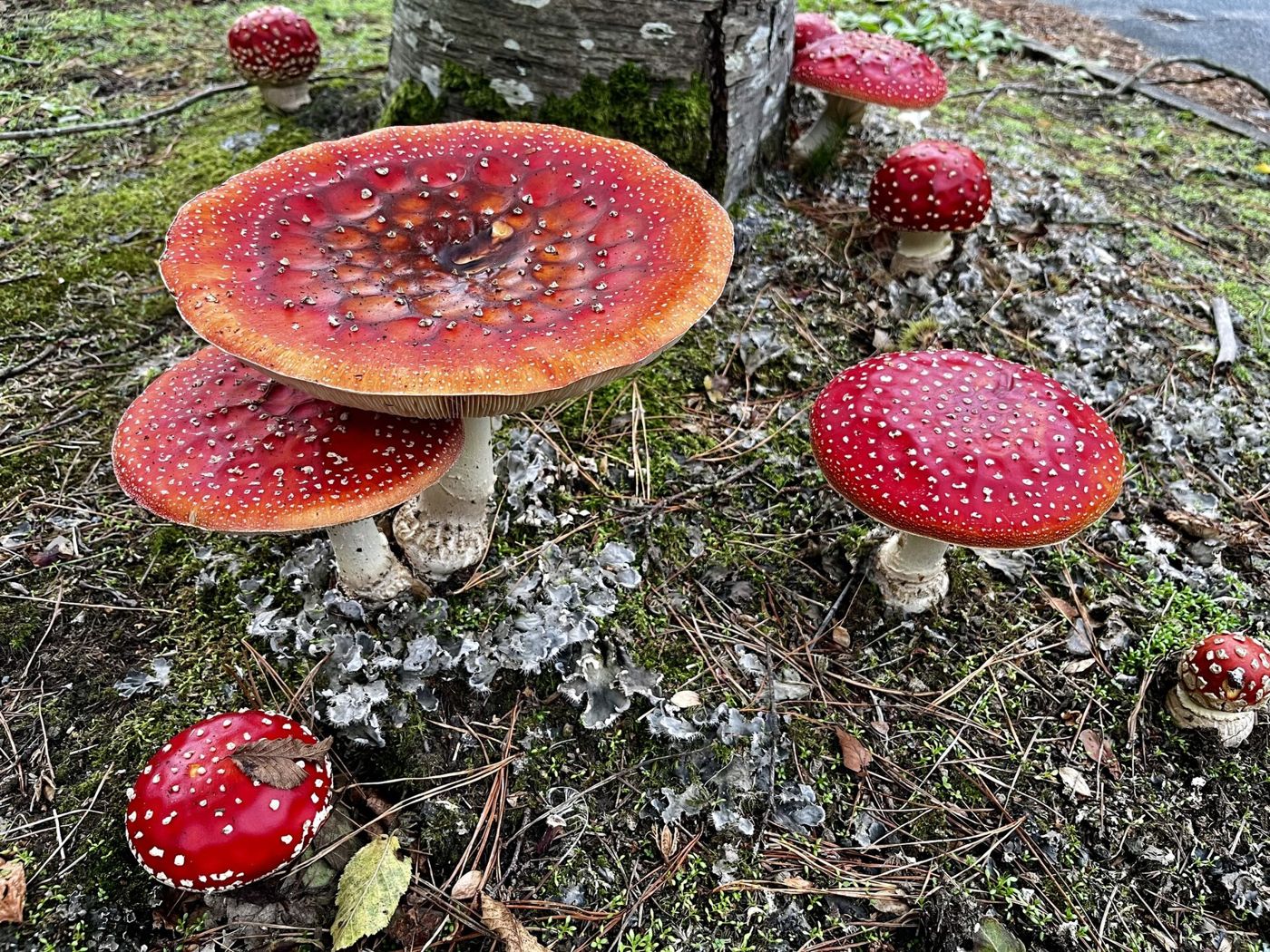
If you have ever noticed that the same mushrooms keep turning up around the birches in a park, garden or woodland, you are not imagining it. Birches (Betula species) form close partnerships with particular fungi, and those fungi fruit near their host tree year after year. Most of these relationships are mycorrhizal: the fungus wraps the tree's fine roots in a network of mycelium, trading water and soil minerals for sugars the tree makes through photosynthesis. Because the fungus depends on its living partner, its mushrooms appear within reach of the roots, which can extend well beyond the edge of the canopy. Other birch fungi are decomposers or parasites that grow directly on the trunk, branches or fallen logs. Knowing which group you are looking at is a useful first clue, but it is only a clue, because most of these fungi can also grow with other trees and many unrelated species share the same ground.
The most famous birch companion is the fly agaric, Amanita muscaria. Its red or orange cap dotted with white warts is unmistakable in picture books, yet in the field the warts can wash off in rain and the colour can fade to orange or yellow in some regions and varieties. It forms partnerships with birch, pine and spruce, and in Britain and much of northern Europe and North America it is often the first mushroom people notice under birches in late summer and autumn. It is poisonous, containing ibotenic acid and muscimol, which affect the nervous system. Close relatives that also turn up under birch include the tawny grisette (Amanita fulva), which has no ring and a sack-like volva at the stem base. That volva is a reminder of why the whole Amanita genus demands caution: the deadly death cap (Amanita phalloides) and destroying angels can grow in mixed woodland too, and a missed volva hidden in leaf litter has led to fatal mistakes.
Birch boletes are the other headline group. These are Leccinum species, which have pores rather than gills under the cap and a stem covered in small dark scales called scabers. The brown birch bolete (Leccinum scabrum) has a dull brown cap and a pale stem flecked with dark scabers, while the orange birch bolete (Leccinum versipelle) has a striking orange cap and flesh that darkens to grey or blackish when cut. The taxonomy of Leccinum is complicated, with many similar species that are hard to separate without microscopes, and some Leccinum species, particularly orange-capped ones in North America, have been linked to gastrointestinal poisonings. That is one reason a confident-looking match in a field guide or app is not enough to judge edibility.
Milk caps and brittlegills are also common under birch. The woolly milkcap (Lactarius torminosus) has a pinkish-salmon cap with darker concentric zones and a shaggy, woolly inrolled margin, and it oozes white milk when the gills are cut. It is a known gastrointestinal irritant, and its paler relative Lactarius pubescens grows in similar places. Small pale Russula species, such as Russula betularum, appear in damp birch woods, while the brown roll-rim (Paxillus involutus) is frequently found under birch as well. Paxillus deserves special mention because it was once eaten in parts of Europe and is now known to cause a rare but potentially fatal immune reaction that can develop after repeated exposure.
On the tree itself you are likely to meet the birch polypore, Fomitopsis betulina (formerly Piptoporus betulinus). It forms smooth, pale, kidney-shaped brackets with a rounded rolled edge on dead or dying birches, and it grows only on birch, which makes it one of the easier host-specific fungi to recognise. It is famous for having been found among the possessions of Ötzi, the roughly 5,000-year-old iceman discovered in the Alps. Hoof-shaped tinder fungus (Fomes fomentarius) is another common birch bracket. Chaga (Inonotus obliquus) looks quite different: a black, cracked, charcoal-like mass on living birches in cold northern forests. What people call chaga is actually a sterile growth of the fungus rather than a typical mushroom, and it is easily confused with burls, burnt wood or other dark cankers. Popularity in supplements has driven heavy harvesting, and published case reports have linked large, long-term consumption to kidney problems, so it is not as harmless as its marketing suggests.
Timing follows the general pattern for temperate woodland fungi. Mycorrhizal species such as fly agarics, birch boletes and milk caps mostly fruit from late summer through autumn, often in flushes a few days after a good soaking rain, and they tend to stop after hard frosts. Bracket fungi like the birch polypore can persist for months, and chaga is present year-round. Because the fungal partner must be alive, mushrooms around a newly planted birch may take years to appear, while an old birch in a lawn can produce rings of fly agarics every autumn. None of this tells you whether something is edible. Folk tests such as checking whether slugs or squirrels have eaten it, whether the cap peels, whether it tarnishes a silver spoon or whether it smells pleasant are all unreliable, and the host tree is no safer a guide. Only an expert who has examined the actual specimen can confirm what it is, and some deadly species look like popular edible ones.
If you want to know what is growing under your birches, start with good photographs: the top of the cap, the gills or pores underneath, the full stem, and the base after carefully digging around it so any volva or bulb is visible. Note whether it was on wood or soil and which trees were nearby. Shroomly can use those photos to suggest likely species and flag toxic look-alikes, which helps you learn the features that matter, but treat the result as a starting point rather than a verdict. For confirmation, take the specimen to a local mycological society or an experienced expert. If anyone, including a child or pet, may have eaten a wild mushroom, call poison control or emergency services immediately and keep a sample of the mushroom to show them.