


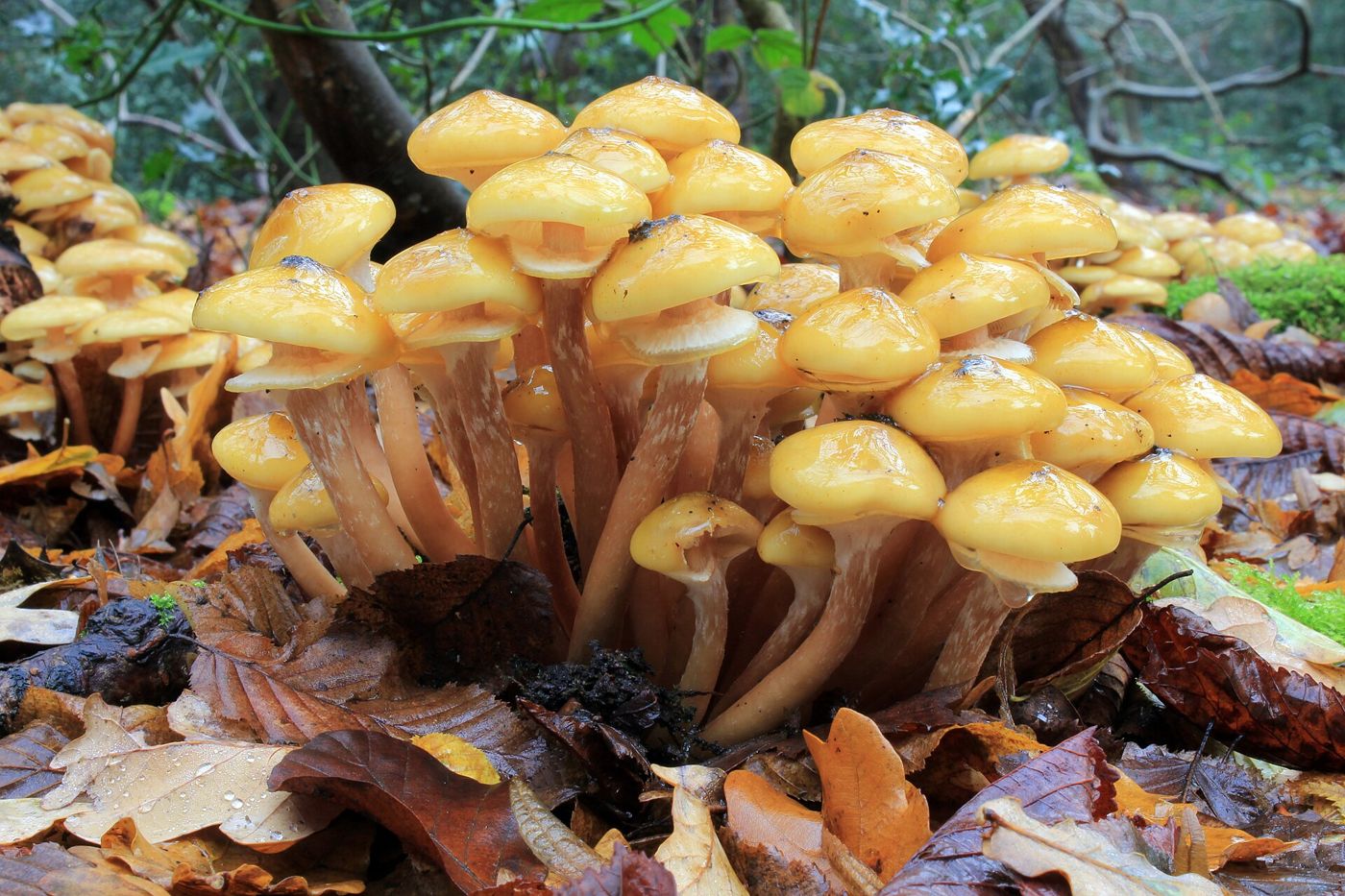
When people picture the largest living creature on Earth, they almost universally imagine a blue whale cutting through deep ocean waters or a giant sequoia like General Sherman towering over a California forest. Yet decades of biological research have established that the true heavyweight champion belongs to the fungal kingdom. Deep in the Blue Mountains of eastern Oregon, a single subterranean specimen of honey fungus, scientifically classified as Armillaria ostoyae, covers approximately 2,385 acres. That spans nearly three and a half square miles, an area equivalent to more than sixteen hundred football fields, all belonging to one contiguous living entity.
The discovery of this botanical colossus began in the late 1990s when forest pathologists set out to investigate widespread mortality among evergreen trees across the Malheur National Forest. Researchers gathered fungal tissue samples from dying Douglas firs and grand firs across square miles of mountainous terrain. Subsequent genetic testing revealed something astonishing: the samples were not separate individuals competing for resources, but genetically identical clones produced by the continuous growth of a single mated pair of spores. Based on its measured rate of expansion through the forest soil, biologists estimate this individual organism is at least 2,400 years old, with some scientific models suggesting it could be more than 8,000 years old, placing it among the oldest living things on our planet.
To understand how a mushroom can grow so massive, one must look below the forest floor. The mushrooms that people see above ground are merely the brief reproductive fruit bodies of a vast, permanent vegetative structure known as mycelium. To bridge the long distances between host trees, honey fungi produce specialized cord-like bundles of fungal filaments called rhizomorphs. Coated in dark, protective melanin and resembling bootlaces, these rhizomorphs act like biological pipelines, channeling moisture, enzymes, and nutrients across yards of dry woodland soil and beneath the bark of adjacent trees. This hydraulic network enables the humongous fungus to coordinate its growth, marshal defensive responses, and sustain its colossal footprint.
While forest managers and timber growers often regard Armillaria as a destructive pathogen responsible for white rot root disease, ecological science views the humongous fungus through a much broader lens. In healthy native woodland ecosystems, wood-decaying fungi are primary drivers of regeneration. By attacking weakened, aged, or drought-stressed trees, Armillaria creates natural canopy openings that allow sunlight to reach the forest understory, fostering plant diversity. Furthermore, its ability to enzymatically break down complex wood polymers like lignin and cellulose returns valuable nutrients to the soil, building fertile humus that supports future generations of woodland plants, insects, and wildlife.
For most of the year, this monumental organism remains completely hidden from view, thriving silently out of sight within tree roots and forest duff. It only betrays its presence in the autumn when cooling temperatures and seasonal rains stimulate the mycelium to reproduce. When triggered, the network pushes clusters of golden-brown mushrooms up through the soil and around tree trunks. These mushrooms typically display warm, honey-toned caps covered in fine dark scales, pale gills attached to fibrous stems, and a prominent ring on the upper stalk. To a casual hiker strolling down an Oregon trail, they look like ordinary forest mushrooms, giving no hint of the miles-wide titan flourishing beneath their boots.
Encountering wild clusters of honey-colored mushrooms often sparks questions about edibility, but foraging around tree bases requires exceptional care. Several wild mushrooms share this same wood-rotting habitat and can appear remarkably similar to the untrained eye, including the funeral bell (Galerina marginata), a small brown mushroom containing lethal amatoxins that cause catastrophic liver failure. Dangerous folk tests, such as assuming mushrooms eaten by forest animals are safe or believing that toxic species tarnish silver spoons, are perilous myths with no basis in science. Edibility can never be confirmed by rules of thumb, photographic comparison, or mobile apps; only an experienced mycologist who has physically examined the specimen can verify a species. If anyone ever swallows a wild mushroom of uncertain identity, call poison control or emergency services right away and preserve a specimen for laboratory analysis.
Whether you are investigating a cluster of mushrooms at the base of a garden tree or exploring native woodland, accurate identification begins with observing the entire specimen in its natural habitat. Take sharp, well-lit photographs showing the top of the cap, the arrangement of the gills beneath, and the very base of the stem where it meets the wood or soil. You can submit these photos to the Shroomly app to review probable species matches, study key anatomical traits, and learn about toxic look-alikes to avoid. For definitive answers, always share your finds with a local mycological society or professional expert who can examine your specimens in person.