


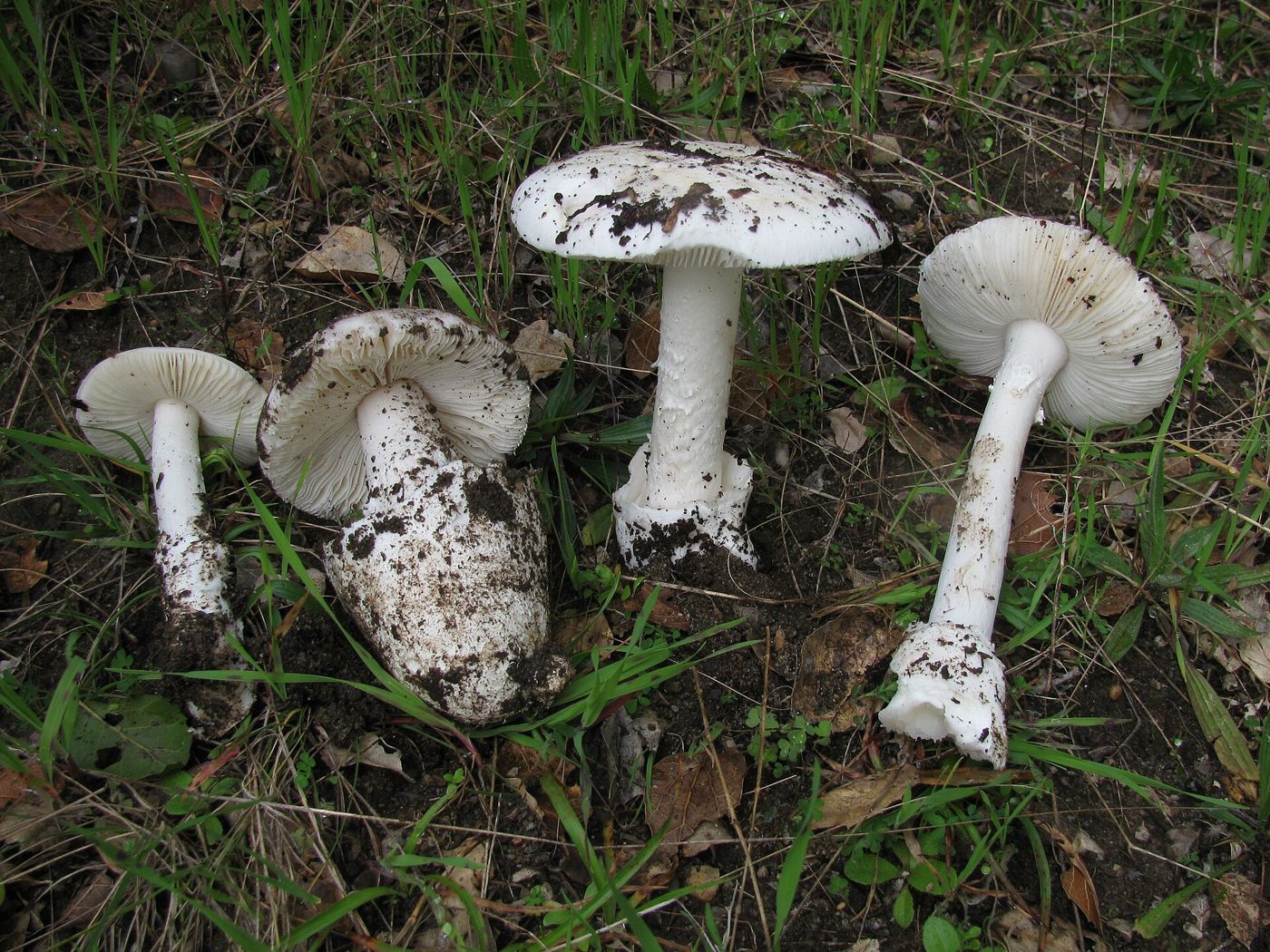
Along the Pacific coast of North America, from Washington and Oregon down through California and into Baja California, grows one of the continent's most dangerous fungal species: the Western destroying angel (Amanita ocreata). While many foragers associate fatal mushroom poisonings with the infamous death cap (Amanita phalloides), Amanita ocreata is equally deadly. What makes it uniquely hazardous is its seasonal timing. While most European and North American amanitas produce fruit bodies during late summer or autumn, the Western destroying angel primarily fruits from January through May, earning it the regional moniker of the spring destroying angel. It forms mycorrhizal partnerships predominantly with coast live oak, California black oak, and occasionally pines or Douglas firs, often appearing in suburban parks, greenbelts, and undisturbed woodlands.
Recognizing Amanita ocreata requires understanding the structural hallmarks shared by the lethal section Phalloideae of the genus Amanita. It emerges from an underground universal veil as an egg-shaped button before expanding into a medium to large mushroom with a cap that typically spans five to twelve centimeters across. The cap surface is smooth, dry to slightly tacky when wet, and pure white to chalky ivory, sometimes developing a pale ochre or yellowish blush across the center as it matures. Beneath the cap, the gills are clean white, crowded, and free from the stem, remaining pale throughout the life of the mushroom rather than darkening as spores mature. The tall, slender stem features a delicate, skirt-like ring or annulus near the top, which can easily tear away or collapse against the stem in windy or rainy weather.
The most critical anatomical feature of the Western destroying angel is located at the very base of the stem, often buried entirely beneath fallen leaves, pine needles, or compacted soil. When the mushroom expands, the protective universal veil ruptures, leaving behind a persistent, loose, membranous cup called a volva. This sac-like volva wraps around the bulbous stem base and provides definitive proof of an Amanita, yet casual observers frequently snap mushrooms off at the soil line and miss this vital clue entirely. Without excavating the base to examine whether a volva is present, identifying white wild mushrooms with any degree of certainty is impossible.
The lethality of Amanita ocreata is driven by potent cellular toxins known as amatoxins, which do not break down with cooking, freezing, boiling, or drying. Amatoxins rapidly target internal organs, specifically inhibiting the enzyme RNA polymerase II and halting protein synthesis in liver cells and kidneys. Poisonings are notoriously insidious because symptoms do not appear immediately. An initial latency period of six to twenty-four hours passes without any indication of harm, giving the ingested toxins ample time to enter the bloodstream. When violent vomiting, abdominal cramping, and severe diarrhea finally strike, they are frequently misdiagnosed as food poisoning or stomach flu. A deceptive period of apparent recovery often follows a day later, while hidden cellular necrosis silently escalates toward acute liver failure, kidney damage, and potentially death.
Because the Western destroying angel looks clean, attractive, and remarkably similar to store-bought button mushrooms, it is easily confused with harmless wild species. In its rounded immature button stage, it can easily be mistaken for an edible puffball, while fully opened specimens are regularly confused with meadow mushrooms and field mushrooms (Agaricus species), or the edible pine mushroom matsutake (Tricholoma murrillianum). Widespread folk tests—such as believing that poisonous mushrooms tarnish a silver spoon, that safe mushrooms have peelable skin, or that nibbled wild fungi must be safe because a squirrel or deer ate them—are complete fallacies. Wildlife possess completely different metabolic pathways than humans, and cooking or peeling toxic mushrooms does nothing to remove amatoxins.
If you suspect that anyone, including a child or pet, has swallowed even a scrap of a Western destroying angel, treat it as a critical medical emergency. Never wait for symptoms to develop, and do not attempt to induce vomiting or rely on home remedies. Call emergency services or your national poison control helpline immediately, and carefully gather any remaining pieces of the mushroom, including soil and root remnants, into a clean paper bag to bring to the hospital for urgent mycological analysis.
Distinguishing deadly white amanitas from other woodland fungi requires examining every single part of the specimen, from the texture of the cap to the attachment of the gills and the structure of the buried volva. When you find an unfamiliar wild mushroom, carefully photograph the top of the cap, the gills beneath, and the intact base of the stem, then let Shroomly suggest likely species and flag dangerous toxic look-alikes. Use these digital tools as an educational starting point, and always consult an experienced regional mycological society or verified professional identifier before ever handling or classifying wild mushrooms.