


If you have ever followed a sickening smell of rotting meat across a garden and found a strange, slimy mushroom swarming with flies, you have probably met a stinkhorn. Stinkhorns are fungi in the family Phallaceae and related groups, and they have taken an unusual route to spreading their spores. Most mushrooms release dry spores from gills or pores and let the wind do the work. Stinkhorns instead package their spores in a sticky, smelly, olive-brown slime called the gleba, and recruit insects to carry them away. The result is one of the most memorable, and most searched-for, encounters people have with fungi.
The best-known species is the common stinkhorn, Phallus impudicus, found widely in Europe and in parts of North America. Its scientific name leaves little to the imagination: a white, spongy stalk rises from the ground topped by a cap coated in dark green-brown slime. In eastern North America, Phallus ravenelii is a familiar relative, and the slimmer dog stinkhorns, Mutinus caninus and Mutinus elegans, have a tapering orange-pink tip. Other stinkhorns look nothing like a horn at all. The latticed stinkhorn, Clathrus ruber, forms a red, hollow cage, while the octopus stinkhorn or devil's fingers, Clathrus archeri, unfurls red arms from a central point. Clathrus archeri is native to Australia and New Zealand and has spread to Europe and North America, while Australia is also home to the anemone stinkhorn, Aseroe rubra, which looks like a red starfish.
The smell is the whole point. The gleba gives off a cocktail of volatile compounds, including sulfur-containing chemicals, that mimic the odour of dung or decaying flesh. Blowflies, flesh flies and other carrion-seeking insects are drawn in, land on the slime and feed on it. Spores stick to their bodies and pass through their digestive systems, and they are then deposited wherever the insects go next. Within a day or so of emerging, a stinkhorn's cap is often licked clean by flies, leaving a pale, pitted surface and a much fainter smell. It is an elegant example of how fungi can exploit animal behaviour, much as flowering plants use scent to attract pollinators.
Stinkhorns begin life underground or in leaf litter as a soft, rounded structure often called an egg or witch's egg. It is whitish to pinkish, may be partly buried, and is usually connected to the soil by white cords of mycelium. Inside, a layer of jelly surrounds the folded-up stalk and spore mass. When conditions are right, the stalk can expand remarkably quickly, pushing out of the egg in a matter of hours, which is why stinkhorns often seem to appear from nowhere overnight. The torn remains of the egg stay at the base as a cup-like volva. Like other fungi, stinkhorns are mainly decomposers, feeding on dead wood and plant matter, which is why they are so common in gardens with fresh wood-chip mulch, compost or rotting stumps.
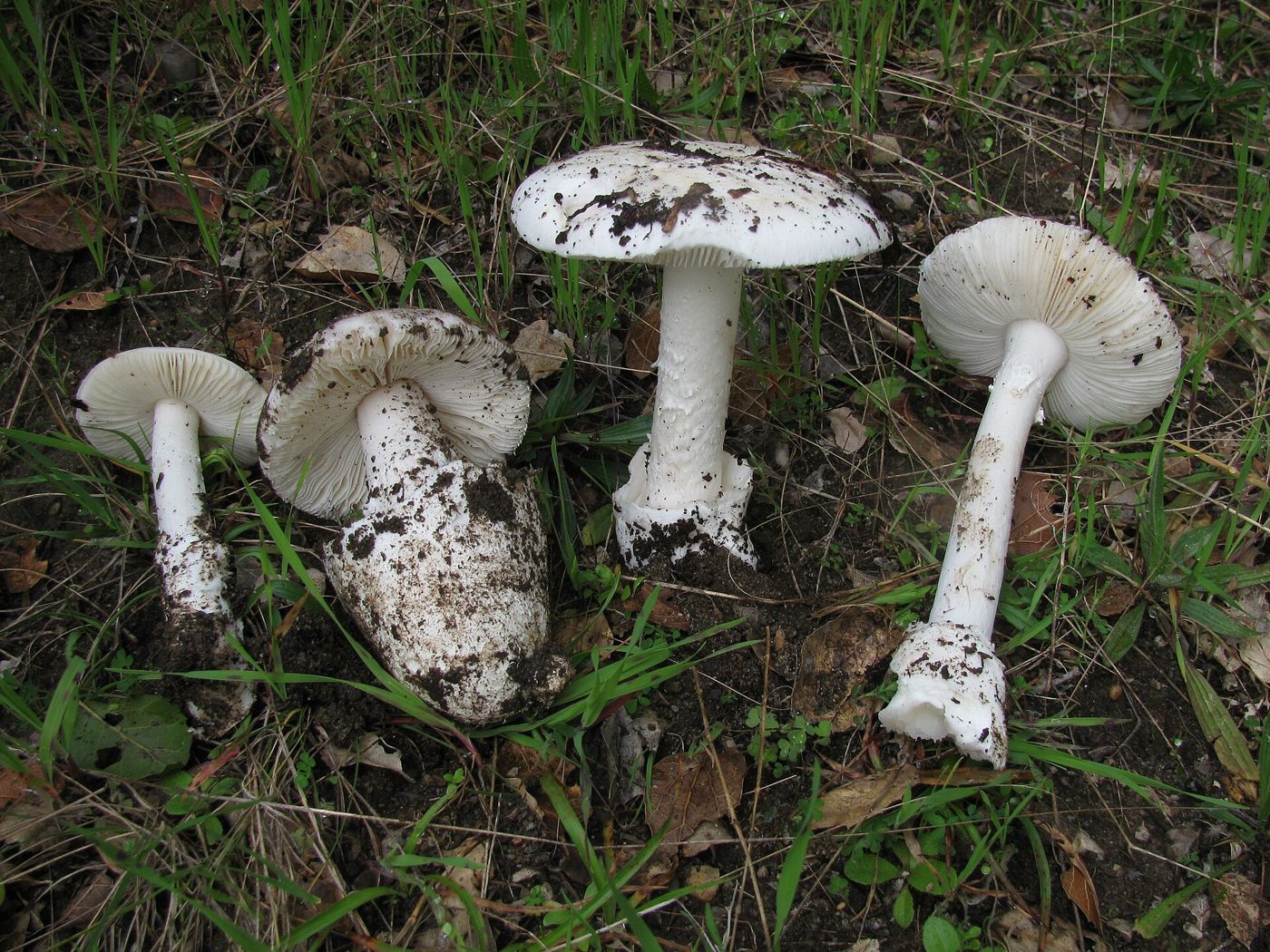
That egg stage is where real danger can come in. A young stinkhorn egg can look superficially similar to the button stage of deadly Amanita species, such as the death cap, Amanita phalloides, and the destroying angels, which also emerge from an egg-like universal veil and leave a volva at the stem base. Some people have mistaken one for a puffball, too. Cutting an egg open reveals internal structure, but reading that structure correctly takes experience, and a mistake with an Amanita can be fatal. Although stinkhorn eggs are eaten in some cultures, you should never eat any wild mushroom, egg or otherwise, unless an expert who has examined the actual specimen has confirmed its identity. Some deadly species look like popular edible ones, and no single trait, smell or rule of thumb can tell you a mushroom is safe.
For most people, stinkhorns are simply an unpleasant nuisance rather than a hazard. Touching one is not known to cause poisoning, though the slime is messy and the smell clings, so gloves are sensible if you want to remove them. Bagging them before they open reduces the odour, but the underground mycelium usually survives and fruits again while there is woody material to feed on, and they will tend to fade as mulch breaks down. Dogs, however, can be fascinated by the smell. If a pet, or a child, eats any wild mushroom, including a stinkhorn egg that might actually be something else, call poison control, your vet or emergency services immediately and keep a sample of the mushroom to help with identification. Do not wait to see whether symptoms develop.
If you find a strange egg-shaped or foul-smelling mushroom and want to know what it is, a few good photos go a long way. Photograph the cap or spore mass, the side profile, any gills or lattice structure, and especially the base of the stem, gently digging around it to show whether there is a cup-like volva. Shroomly can suggest likely species from your photos and flag toxic look-alikes such as Amanita buttons, which helps you understand what you are looking at. Treat that result as a starting point rather than a verdict, and confirm anything important with a local mycological society or an experienced expert who can examine the specimen in person.