

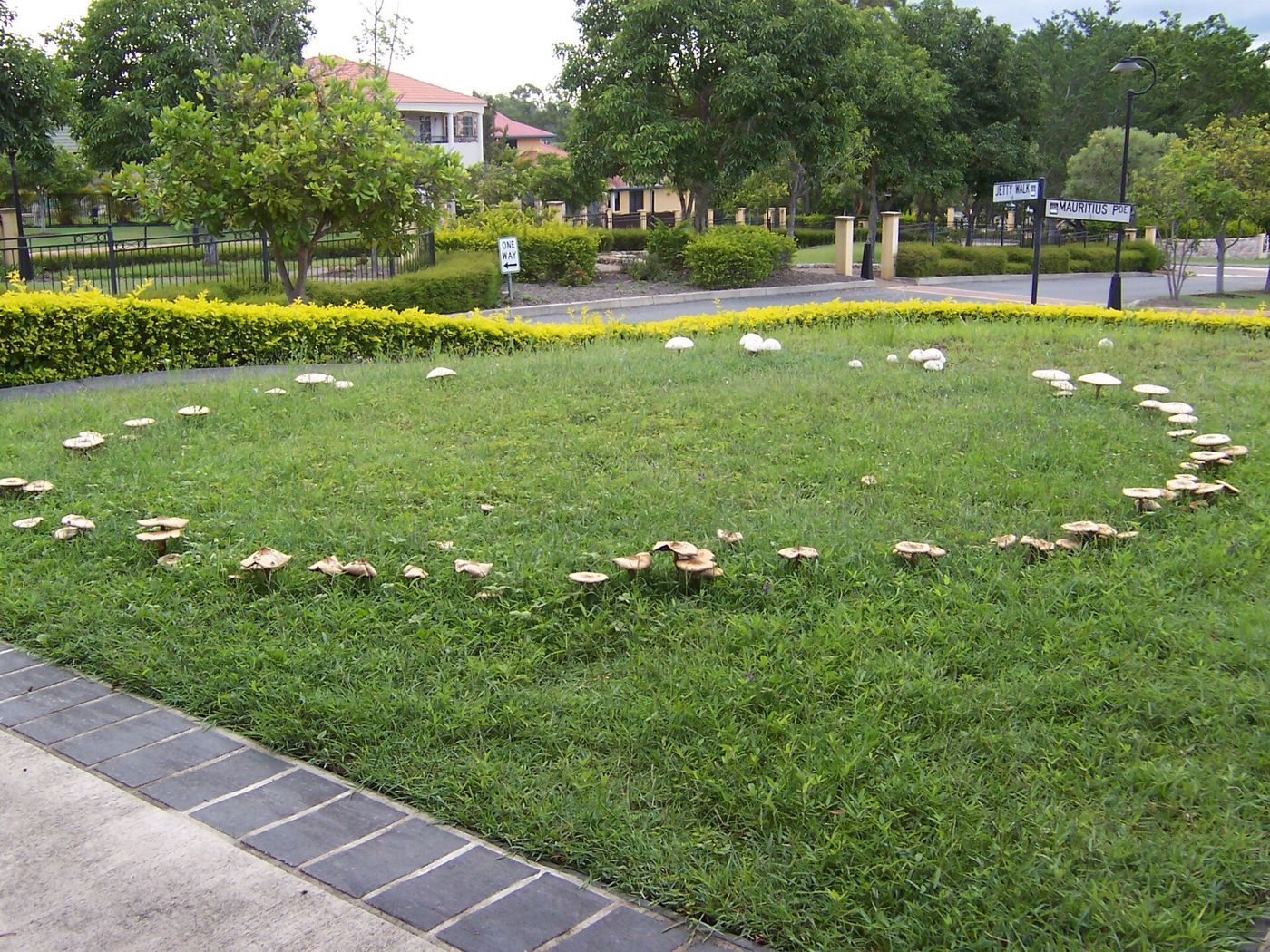
What is a fairy ring? It is a circle or arc of mushrooms produced by one fungus spreading out through the soil from a central starting point. Underground, the mycelium grows outward in every direction at roughly the same rate, using up food as it goes. The active, feeding edge is where it puts up mushrooms, so the fruiting bodies trace a ring that gets wider year after year.
Fairy rings often show up in the grass even when no mushrooms are visible. Many rings have a band of lush, dark green grass where the fungus breaks down organic matter and releases nitrogen. Some also have a band of dead or stressed grass, where the dense mycelium makes the soil repel water. Lawn professionals sort rings into types depending on which of these effects shows up.
Several species form rings. One of the best known is the fairy ring champignon, Marasmius oreades, a small tan mushroom of lawns and pastures. The poisonous green-spored parasol, Chlorophyllum molybdites, also forms large rings on lawns in warmer regions, and so do many woodland species around trees. A ring tells you how the fungus grows, not whether it is safe; the toxic ivory funnel, Clitocybe dealbata, can grow in the same lawns as the fairy ring champignon.
Rings can be remarkably old. Because the fungus moves outward slowly and steadily, large rings in old pastures are thought to have been growing for centuries. In woodland, rings are often broken into arcs by trees, paths, and obstacles, so they are easier to notice in open grassland.
European folklore filled these circles with meaning: they were said to mark where fairies or elves danced, or where witches gathered, and stepping inside was supposed to bring bad luck or trap you in the fairy world. In German they are called witches' rings. The scientific explanation is less magical but still impressive: a single organism, quietly drawing a circle across your lawn over many years.
If a ring has popped up in your grass, take photos of a few mushrooms showing the cap, gills, and stem, and let Shroomly tell you which species is likely behind it and whether it is toxic. That way you know whether to keep children and pets away from it while it fruits, and you can enjoy the ring for what it is.