


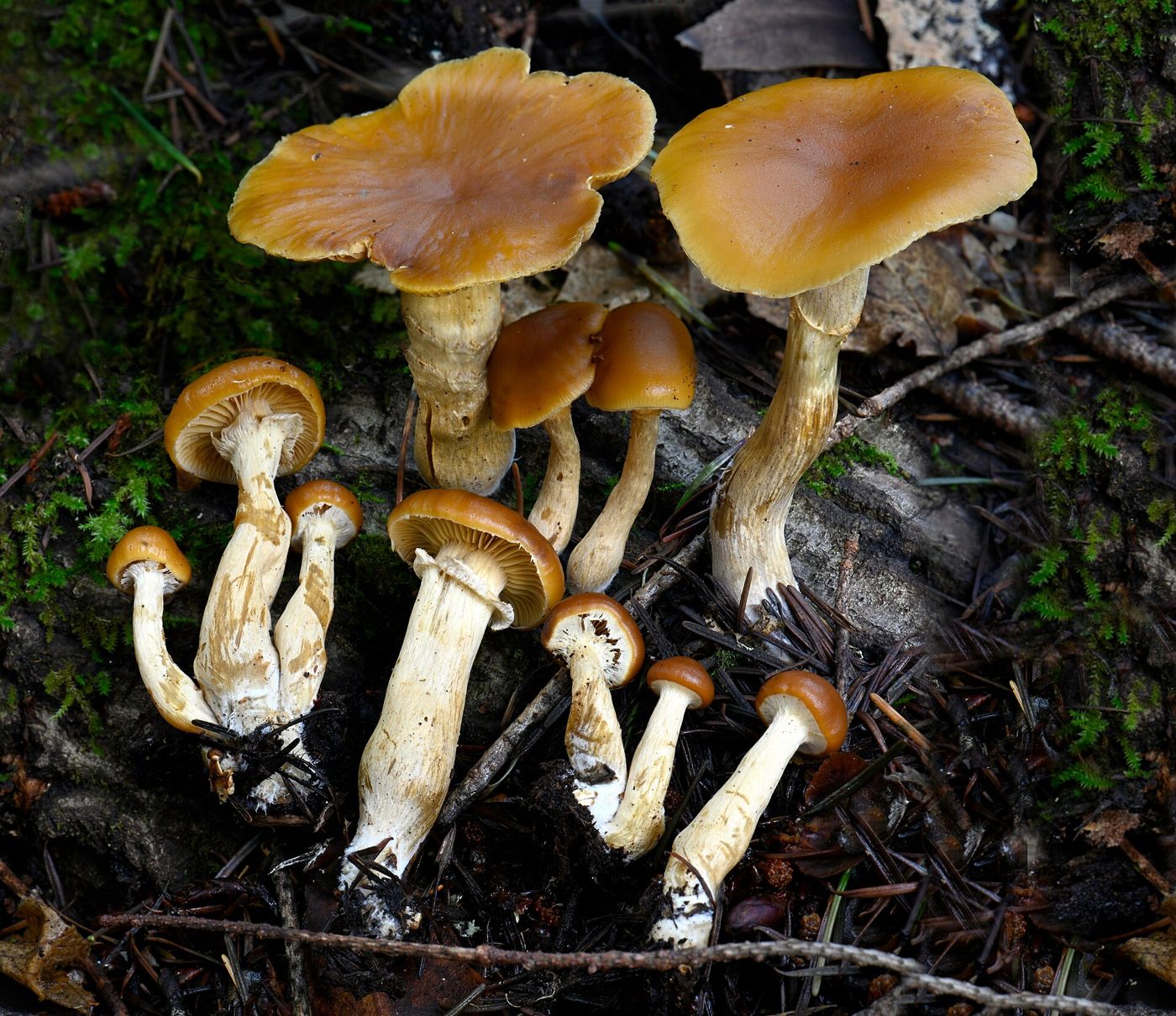
If you have ever picked a dark, glossy brown mushroom in the morning and found a pale tan one in your basket by the afternoon, you have met a hygrophanous fungus. The word comes from Greek roots meaning roughly 'appearing wet', and mycologists use it for caps whose color depends on how much water the tissue holds. When the cap is saturated it looks darker, often slightly translucent and waxy; as it dries the flesh fills with tiny air spaces, scatters more light and becomes paler and more opaque. The change is reversible to a degree, and it can happen within minutes on a warm, breezy day. Many species with this trait are also small brown mushrooms, which is exactly the group where identification is hardest and mistakes are most dangerous.
The most recognizable sign of hygrophanous drying is a two-toned cap. Drying usually starts either at the center or at the margin and moves across the cap as a fairly sharp zone, so for a while the mushroom shows a dark wet band next to a pale dry one. In some species the cap dries from the middle outward, leaving a dark rim; in others a pale ring appears partway across. Another related clue is translucent striation: when the cap is moist and thin, the lines of the gills beneath show through the margin as fine radial stripes, which then vanish as the cap dries and becomes opaque. Field guides often describe a species as 'striate when moist' for this reason, and noting whether you can see those lines is worth doing on the spot.
Hygrophanous color change is common across several unrelated groups. The deadly funeral bell (Galerina marginata), a small brown mushroom that grows on wood and contains the same amatoxins as the death cap, typically has a hygrophanous cap that fades from orange-brown to buff. The sheathed woodtuft (Kuehneromyces mutabilis), a clustered wood mushroom of Europe, is famous for its strikingly two-toned caps, and it is one of the classic species confused with the funeral bell because both grow on wood, both have brown caps that dry in bands and both can have a ring zone on the stem. Brittlestems (Psathyrella), mottlegills (Panaeolus), many Psilocybe species and a number of Clitocybe and Mycena species also show the trait to varying degrees, and the fairy ring champignon (Marasmius oreades) noticeably pales as it dries in a lawn.
It helps to separate true hygrophanous change from other reasons a cap might look different. Sun-bleaching and age can slowly fade pigments, but they do not produce the clean moving boundary between wet and dry zones. Viscid or slimy caps can look shiny and dark when wet and dull when dry, yet the color of the tissue itself usually stays much the same. Bruising and staining, where flesh turns yellow, red or blue after handling or cutting, are chemical reactions rather than water loss. To test what you are seeing, look closely at the cap edge with a hand lens and watch whether the pale area grows over time, or gently compare a moist specimen with a dry one from the same cluster, always washing your hands afterwards.
The practical lesson is that cap color is one of the least reliable features for these mushrooms. A single patch of mushrooms can contain dark, wet caps, pale dry caps and every stage in between, and photographs taken an hour apart can look like different species. That is why experienced identifiers rely on combinations of features instead: the color of the spore print (rusty brown for Galerina, dark purple-brown to black for Psathyrella and Panaeolus), gill attachment, the texture and markings on the stem, the presence of a ring or ring zone, and the exact substrate. Even then, the funeral bell and its edible-looking relatives can only be told apart reliably by someone with experience, sometimes using a microscope, and no rule of thumb, smell, taste or folk test such as a silver spoon or peeling the cap will tell you whether a mushroom is safe. Only an expert who has examined the actual specimen can confirm edibility, and some deadly species closely resemble popular edible ones.
When you photograph a mushroom for identification, record its hygrophanous state rather than trying to hide it. Take pictures as soon as you find it, before it dries in a pocket or warms in your hand, and include several caps of different ages from the same group so the range of colors is visible. Photograph the top of the cap, the margin from the side to show any translucent striations, the gills, and the whole stem including the very base and whatever it is growing from. With those images, Shroomly can suggest likely species and flag toxic look-alikes such as Galerina marginata, giving you a clear starting point. Treat that result as a guide, not a verdict, and confirm any identification with a local mycological society or an experienced expert who can examine the specimen in person. If anyone has eaten a wild mushroom that might be toxic, call poison control or emergency services immediately and keep a sample of the mushroom for identification.