


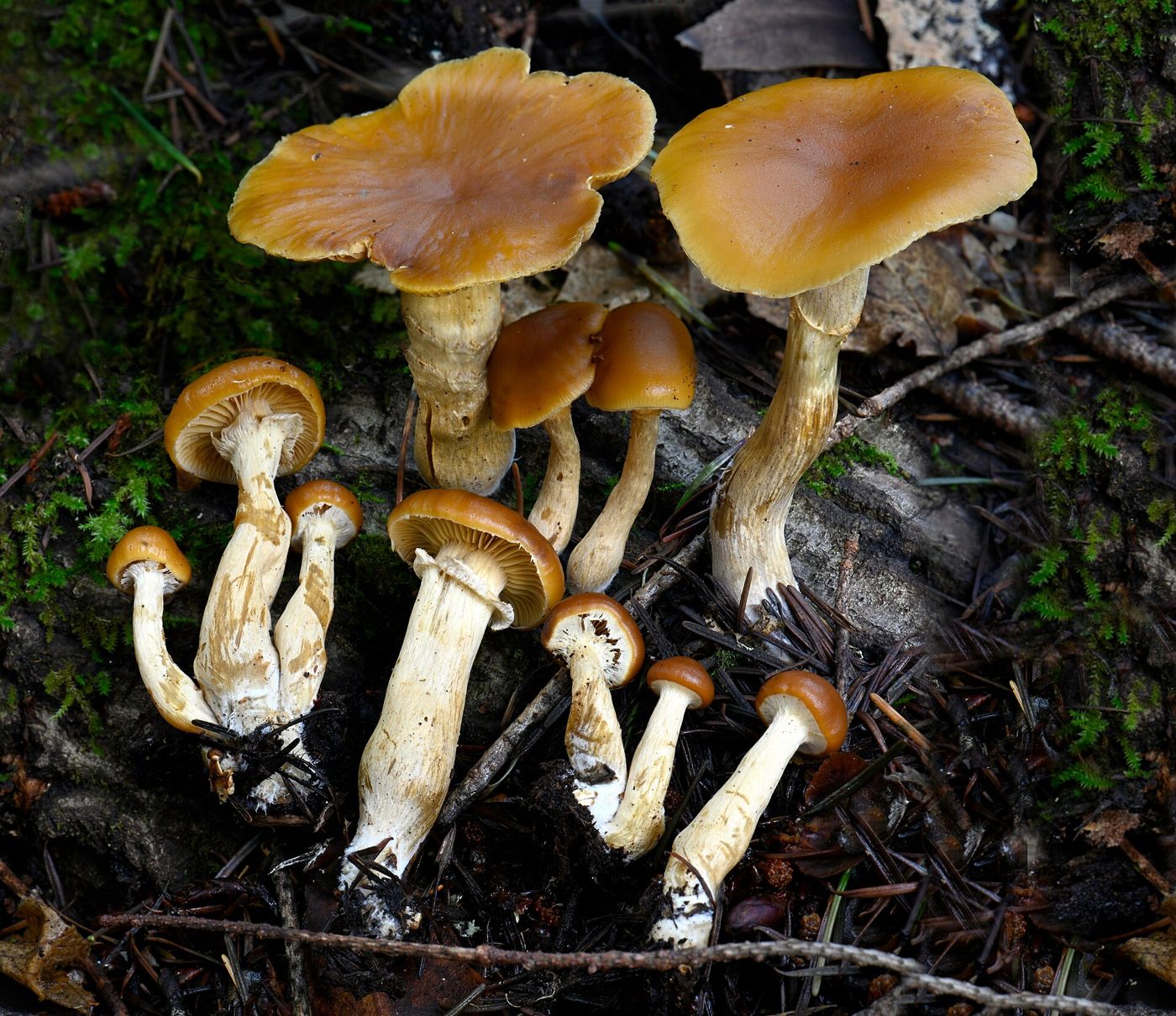
Velvet shank (Flammulina velutipes) is one of the few mushrooms many people notice in the depths of winter. On a grey December or January day, a cluster of glossy orange-brown caps on a dead elm, willow or ash stump stands out. Search interest is high partly because velvet shank is closely related to the long, pale enoki sold in supermarkets, and people are surprised to learn there is a wild version. The trouble is that a small brown wood-rotting mushroom on a log in winter could also be the funeral bell (Galerina marginata), a species containing amatoxins, the same liver-destroying toxins found in the death cap. Knowing how these two differ, and why that knowledge is never enough on its own, matters a great deal.
Velvet shank grows in tight clusters on dead or dying broadleaf trees, especially elm, ash, willow, beech and oak, and occasionally on buried roots so that it appears to come from the ground. Its main season runs from late autumn through winter and into early spring, and it is famously tolerant of cold: fruiting bodies can freeze solid and recover when they thaw. The cap is usually 2 to 10 centimetres across, convex to flattened, orange to tan with a darker centre and a paler margin, and noticeably sticky or slimy when wet. The gills are white to pale cream or yellowish and attached to the stem. The stem gives the species its name: it is pale near the top but becomes dark brown to almost black and finely velvety towards the base. There is no ring, and the spore print is white. Wild velvet shank looks very different from cultivated enoki, which is grown in darkness and high carbon dioxide to produce long, thin white stems; the familiar supermarket form is often treated as a separate Asian species, Flammulina filiformis.
The funeral bell is found across North America, Europe and other temperate regions, growing on well-rotted wood of both conifers and broadleaf trees, sometimes on buried wood or woody debris in moss. It is most common in autumn but can appear in almost any month during mild, damp spells, which is exactly why winter foragers may encounter it alongside velvet shank. The cap is typically 1 to 4 centimetres across, honey-brown to orange-brown, often smooth and slightly sticky, and it is hygrophanous, meaning it fades to a paler tan as it dries, often in bands. The gills are pale at first but turn rusty brown as the spores mature. The stem is brownish, covered in fine silvery fibres, and usually carries a thin membranous ring or at least a ring zone that may be dusted rusty brown with fallen spores. The spore print is rust-brown.
Set side by side, the most useful contrasts are the stem, the ring and the spore colour. Velvet shank has a smooth-topped stem that darkens and becomes velvety at the base and never has a ring, while the funeral bell has a fibrous, silvery-streaked stem and usually some trace of a ring. Velvet shank gills stay pale, and its spore print is white; funeral bell gills brown with age, and its spore print is rusty brown. A spore print taken from each individual cap is one of the most informative checks, because colour in the field can be misleading. Size and growth habit help less than people expect: both can grow in clusters on wood, both can be sticky and orange-brown, and young or weathered specimens of either can lose their textbook features. The ring on Galerina is fragile and can disappear entirely, and a velvet shank stem can look paler than usual in young or shaded fruit bodies.
The single biggest danger is a mixed collection. Velvet shank and funeral bell can fruit on the same stump or a neighbouring log, and a handful of small brown caps cut at the stem without checking each one individually could include both. Other wood-growing look-alikes add to the confusion, including sheathed woodtuft (Kuehneromyces mutabilis), which itself closely resembles Galerina, and honey fungus (Armillaria species), which has a ring and a white spore print. Amatoxin poisoning is especially treacherous because symptoms are typically delayed by several hours or more, by which time serious liver damage may already be under way, and people can appear to recover temporarily before becoming severely ill. If anyone may have eaten a funeral bell or any unidentified wild mushroom, call poison control or emergency services immediately, even if they feel fine, and keep a sample of the mushroom for identification.
It is worth repeating what this comparison cannot do. None of the features above, and no folk test such as peeling the cap, tarnishing a silver spoon, smell, or seeing animals nibble the mushroom, can show that a wild mushroom is safe to eat. Only an experienced expert who has examined the actual specimens, ideally including spore prints and the full stem base, can confirm an identification, and some deadly species look remarkably like popular edible ones. Velvet shank is a good example of an edible mushroom whose reputation rests on reliable identification rather than any rule of thumb, and many experienced foragers simply leave small brown wood-growing mushrooms alone.
If you spot orange-brown mushrooms on a winter log and want to know what they are, a careful photo set is the best place to start. Photograph the top of the cap, the gills from below, the full length of the stem including any ring or ring zone, and the very base where it meets the wood, and note the tree or substrate it is growing on. Shroomly can then suggest likely species and flag toxic look-alikes such as Galerina marginata, helping you understand which features to look at next. Treat that result as a starting point for learning, not a verdict on edibility, and confirm any identification with a local mycological society or an experienced expert who can examine the mushrooms in person.