


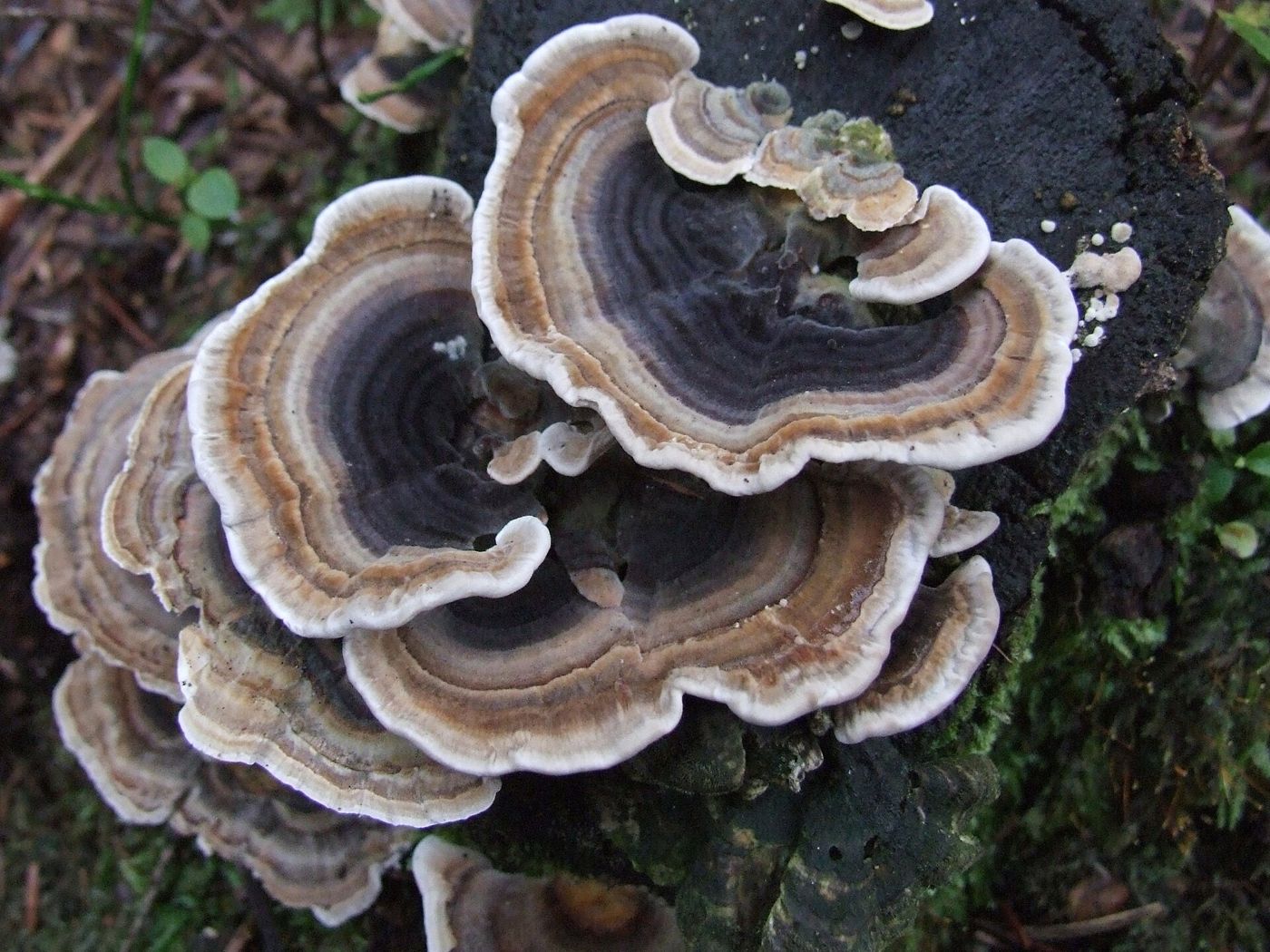
Woodland walkers and foragers across North America, Europe, and Australia frequently encounter dense, fan-shaped brackets decorating fallen logs and dead hardwood stumps. Among the most sought-after of these forest dwellers is the turkey tail mushroom (Trametes versicolor), famous for its sweeping concentric rings of contrasting colors that resemble the fanned tail feathers of a wild turkey. However, because dead deciduous wood provides habitat for dozens of bracket and crust fungi that share similar fan-like growth habits, nature enthusiasts routinely stumble upon convincing mimics. The most widespread of these look-alikes is the false turkey tail (Stereum ostrea), alongside other common polypores that display zoned coloration. Learning to reliably tell them apart requires looking past the surface colors and checking the structural features beneath the cap.
The single most reliable way to distinguish true turkey tail from false turkey tail is to look directly at the underside of the bracket. True turkey tail belongs to the polypore family, meaning it releases its microscopic spores from tiny tubes that open into surface pores. When you flip a fresh specimen over, the fertile underlayer is white, cream, or pale beige and densely covered in minute, round pores numbering between three and eight per millimeter. These pores are easily visible to the naked eye upon close inspection or under a simple magnifying lens. By contrast, false turkey tail is not a polypore at all; it is a corticioid or crust fungus in the family Stereaceae. Its underside is entirely smooth, completely lacking pores, tubes, or teeth. This fertile surface often appears parchment-colored, dull beige, tan, or greyish-brown, presenting an unperforated plane that immediately separates it from Trametes versicolor.
Examining the upper surface provides valuable secondary clues, although cap coloration alone can be deceptive. The scientific name Trametes versicolor translates literally to 'of many colors,' and individual specimens can exhibit rich bands of chestnut brown, amber, grey, blue, black, buff, and reddish-copper. What truly distinguishes the cap of true turkey tail, however, is its texture. The upper surface is covered in microscopic hairs, giving it a soft, distinctly velvety or felt-like feel when stroked with a thumb. While false turkey tail also displays concentric zones of reddish-brown, cinnamon, and tan, its upper surface is generally much smoother, leathery, and parchment-thin. As Stereum ostrea matures, it also frequently hosts microscopic green algae that give the inner rings an intense greenish cast, a trait seen less commonly and far less uniformly on fresh turkey tails.
Handling the mushroom also reveals distinct differences in flexibility and overall thickness. Fresh specimens of true turkey tail are pliable, tough, and fibrous. If you bend the bracket between your fingers, it flexes easily without snapping, and cutting through it reveals a thin, white interior layer of fungal tissue known as the context. False turkey tail, on the other hand, is paper-thin and noticeably more rigid. While slightly pliable when soaked with rain, it quickly dries out to become brittle and stiff, often curling inward at the edges like dried parchment paper. Foragers should also beware of other woodland look-alikes such as the violet-toothed polypore (Trichaptum biforme), which shares zoned caps but has a porous underside that quickly fractures into ragged teeth with lilac or purplish margins, as well as the hairy bracket (Trametes hirsuta), which is much thicker, tougher, and covered in coarse, bristly hairs.
Popular foraging culture is filled with misleading shortcuts, such as the belief that any banded shelf fungus growing on dead wood is safe to brew or that boiling wild brackets neutralizes potential toxins. In reality, no single rule of thumb or folk test can confirm the identity or safety of any wild fungus. Consuming an improperly identified bracket fungus or a spoiled wild specimen can trigger severe stomach cramps, nausea, vomiting, or allergic reactions. If anyone accidentally ingests an unknown wild mushroom or experiences adverse symptoms, contact local poison control or emergency medical services immediately, and be sure to retain the physical specimen so toxicologists can verify the species.
Before you harvest or study bracket fungi in the forest, take a few moments to thoroughly document your find. Photograph the banded upper cap in clear natural light, take a sharp close-up of the underside to confirm whether it is porous or smooth, and capture how the bracket attaches to the wood. You can upload these detailed images to Shroomly to quickly narrow down likely candidate species and identify deceptive look-alikes. Once you have a preliminary identification, always share your specimen with an experienced mycologist or a regional mycological society for hands-on verification before attempting to use any wild mushroom.