


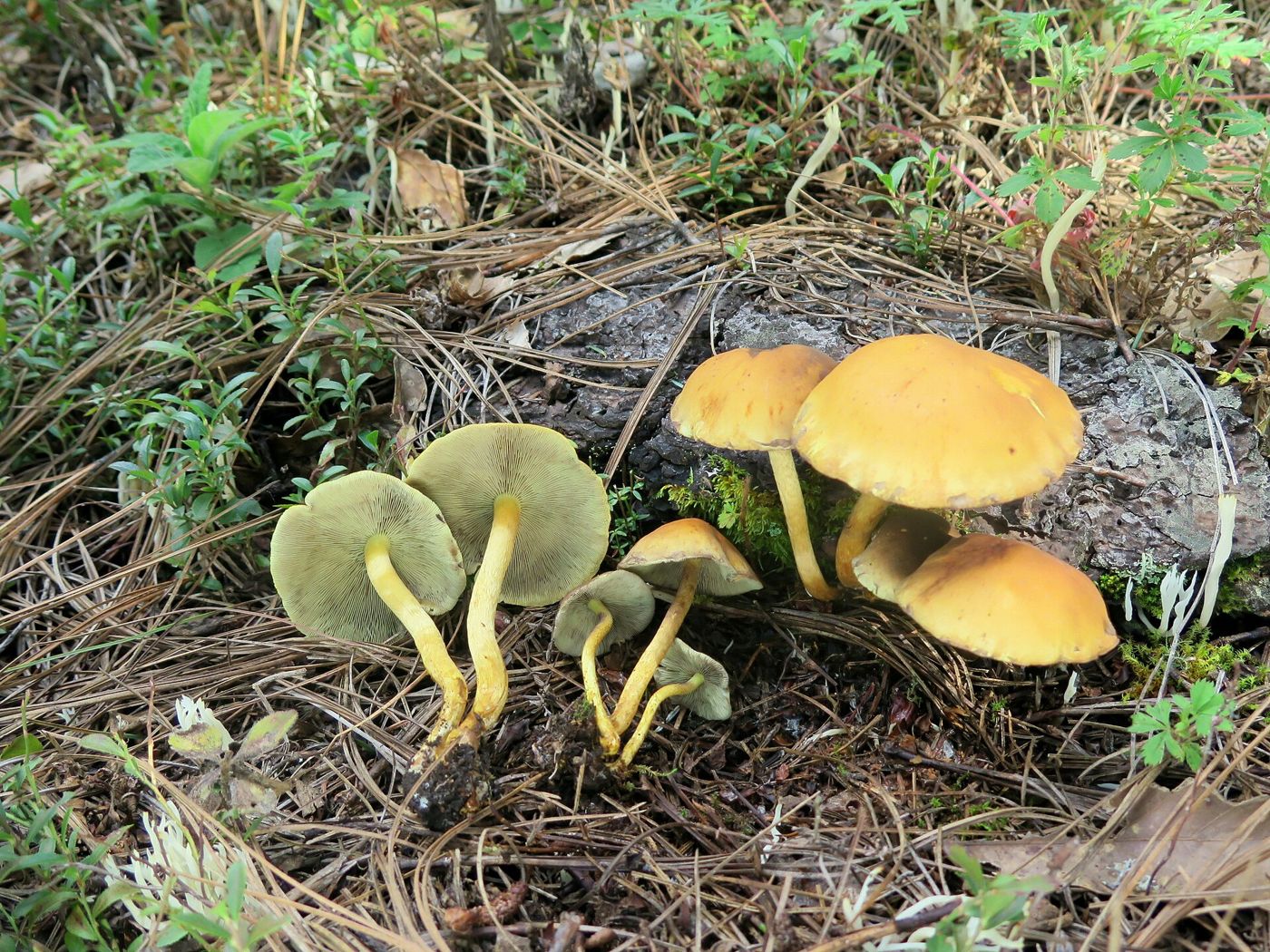
If you have found a crowded bunch of yellowish mushrooms sprouting from a stump, a buried root or the base of a tree in autumn, the two names most likely to come up are sulphur tuft (Hypholoma fasciculare) and honey fungus (Armillaria mellea and its close relatives). Both are common across the United Kingdom, much of Europe and North America, and both appear in similar habitats at similar times of year. From a distance they can look remarkably alike: tufts of medium-sized caps in shades of yellow, tan and honey-brown, packed tightly together on wood. Up close, however, they differ in their gills, their stems, their cap surface and, most decisively, the color of their spores. Learning these differences is a good exercise in careful identification, but it is not a route to a meal. Sulphur tuft is poisonous, honey fungus is known to cause digestive upsets in many people, and a genuinely deadly species shares the same stumps.
Start with the gills, because they are often the quickest giveaway. Sulphur tuft gets its name from the vivid sulphur-yellow color of young gills, which gradually turn greenish-yellow and then dark purple-brown to almost black as the spores mature. A cluster at different ages may show this whole range of colors at once, and that greenish tinge is very characteristic. Honey fungus gills, by contrast, are whitish to pale cream when young, sometimes developing pinkish or brownish spots with age, and they never take on that sulphur-green hue. The gills of honey fungus are typically attached broadly to the stem or run slightly down it, while sulphur tuft gills are attached and crowded. Gill color is affected by age, weather and lighting, so look at several caps rather than just one.
The stem is the next place to check. Most honey fungus in the Armillaria mellea group carries a distinct ring on the upper stem, often whitish and cottony, and in A. mellea it frequently has a yellowish edge. Be aware that some related species, such as the ringless honey mushroom (Desarmillaria tabescens, formerly Armillaria tabescens) in North America and Europe, lack a ring entirely, so absence of a ring does not rule honey fungus out. Sulphur tuft has no true membranous ring. Young caps are linked to the stem by a fine cobweb-like veil, and as it breaks it may leave a faint fibrous zone on the stem that becomes darkened by falling purple-brown spores. This can look like a ring at a glance, so examine it closely: a thin dark stain is very different from a soft, skirt-like collar.
The cap surface adds further evidence. Sulphur tuft caps are generally smooth, bright sulphur-yellow towards the margin and darker orange or tawny at the center, with no real scales. Honey fungus caps are more variable, ranging from honey-yellow through tan to darker brown, and they usually carry small dark hair-like scales, concentrated towards the middle. These scales can wash off in heavy rain, so they are helpful when present but not conclusive when missing. Honey fungus also leaves a distinctive signature on its host: black, shoelace-like cords called rhizomorphs, which can often be found under loose bark or in the surrounding soil. Honey fungus is a well-known parasite of living trees and shrubs as well as a decomposer of dead wood, whereas sulphur tuft is primarily a decomposer of stumps and dead wood of both broadleaf and conifer trees.
The single most useful test for separating these two is a spore print. Place a mature cap gills-down on a sheet of paper, ideally half on white and half on dark paper, cover it and leave it for several hours. Sulphur tuft produces a dark purple-brown print, while honey fungus produces a white to cream print. Often you will not even need to make one, because spores from upper caps naturally dust the caps below them in a cluster. A white powdery dusting points towards honey fungus, while a dark purplish-brown deposit points towards sulphur tuft. Spore color is not a complete answer, though, because other wood-loving species overlap with each of these. Brick cap (Hypholoma lateritium), a close relative of sulphur tuft, also has a purple-brown print but brick-red cap centers and lacks the strong greenish gill stage. In North America, the orange jack-o'-lantern mushrooms (Omphalotus species) also grow in clusters on wood or buried roots and give a whitish to cream print, so they can be confused with honey fungus by spore color alone.
The most serious look-alike is the funeral bell (Galerina marginata), a small brown mushroom that grows on rotting wood, sometimes in groups or tight clusters, and can appear alongside both sulphur tuft and honey fungus. It contains amatoxins, the same deadly toxins found in the death cap, and poisonings have occurred when people collected it believing it to be honey fungus or other clustered wood mushrooms. The funeral bell has a rusty-brown spore print and a small, often fragile ring, but young or weathered specimens can be very difficult to separate by eye, and a single stray cap mixed into a basket can be enough to cause serious harm. This is why no rule of thumb, whether it is growing on wood, growing in a cluster, having a ring, or being nibbled by slugs or squirrels, can tell you a mushroom is safe. Only an expert who has examined the actual specimen can confirm edibility, and some deadly species look very like popular edible ones. If anyone may have eaten a wild mushroom, call poison control or emergency services immediately and keep a sample of the mushroom for identification.
If you want to know what is growing on your stump, the best approach is to document it carefully. Photograph a whole cluster in place, then take close-up shots of the top of a cap, the gills underneath, and the full stem down to its base, including any ring, veil remnants, dark scales or black bootlace cords nearby. A spore print photographed on white and dark paper adds valuable evidence. Shroomly can analyse those photos and suggest likely species, such as sulphur tuft, honey fungus or brick cap, along with toxic look-alikes like the funeral bell that you should rule out. Treat that result as a starting point for learning rather than a verdict on edibility, and confirm any identification with a local mycological society or an experienced expert who can examine the specimen in person.