


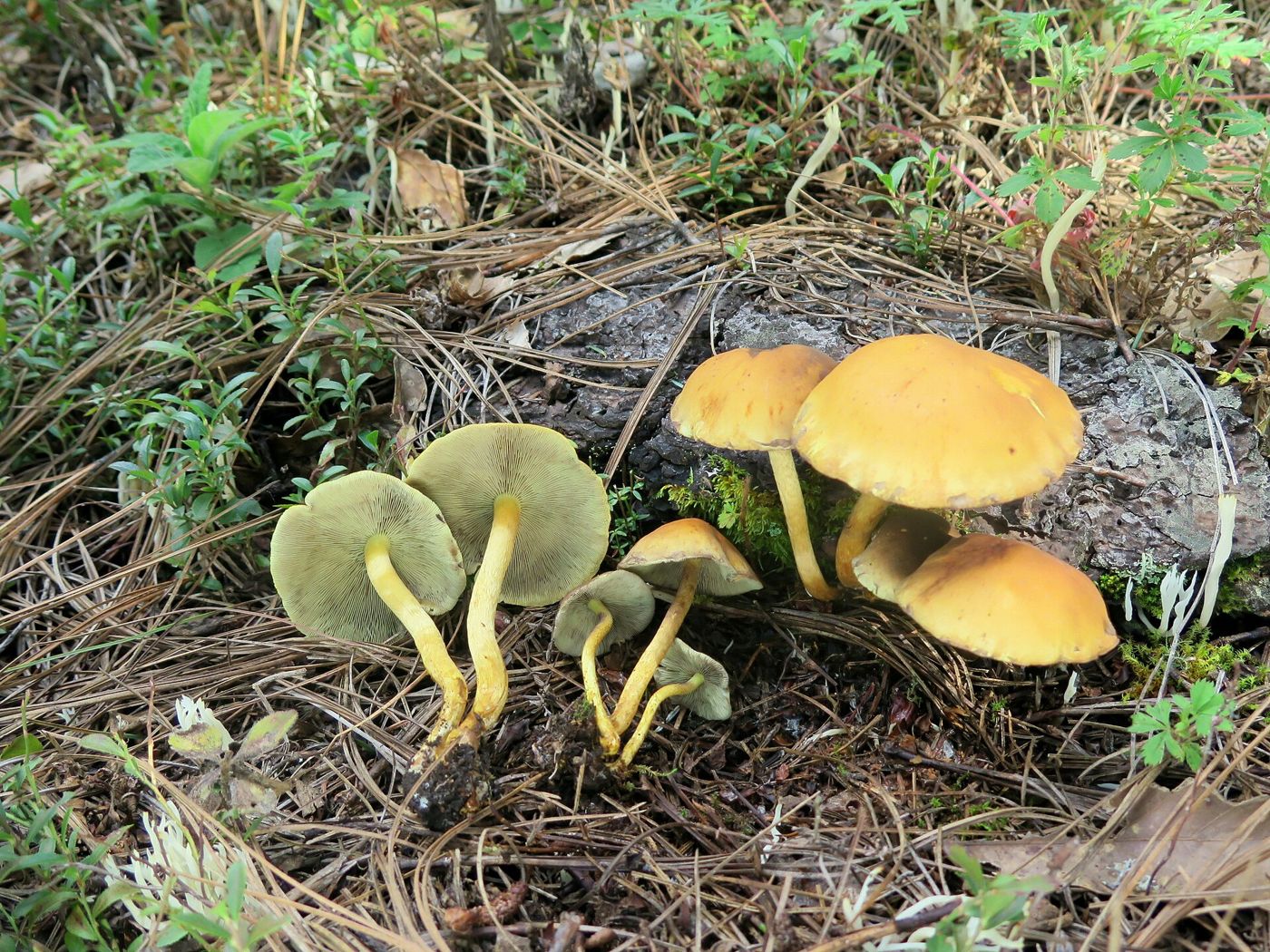
If you walk through almost any woodland, park or garden with old stumps in autumn, there is a good chance you will find tight clusters of yellowish to orange mushrooms sprouting from rotting wood. Many of these belong to the genus Hypholoma, and the two most frequently confused members are sulphur tuft (Hypholoma fasciculare) and brick cap (Hypholoma lateritium, often listed in North American guides as Hypholoma sublateritium). They are close relatives, they share the same growth habit and the same dark spore print, and from a distance a cluster of one can look very much like a cluster of the other. The distinction matters because sulphur tuft is a well-known poisonous species, and because the stumps where both grow also host far more dangerous mushrooms.
Sulphur tuft is one of the most common wood-rotting mushrooms in Britain, Europe and much of North America, and it also occurs in Australia. It fruits in crowded tufts on dead hardwood and conifer wood alike, including buried roots, which can make it appear to grow from soil. The caps are usually small to medium, convex then flattening, and a bright sulphur yellow, often with a more orange or tawny centre. The most useful feature is underneath: the gills start sulphur yellow, then develop a distinctly greenish or olive tint before darkening to purplish black as the spores mature. The flesh is yellow, the stem is yellowish and often darker towards the base, and young specimens have a faint cobwebby veil that leaves a dark, spore-dusted ring zone rather than a proper ring. It can be found in almost any month, but it is most abundant in autumn.
Brick cap is generally a little larger and sturdier. Its cap is a warm brick red to reddish brown in the centre, fading to a paler buff or yellowish margin that often carries whitish veil fragments when young. The gills are pale cream to greyish yellow at first, then turn grey to purplish grey as spores ripen, and crucially they lack the green tones of sulphur tuft. Brick cap is strongly associated with dead hardwood, especially oak, and in many regions it fruits later in the season, from mid-autumn into early winter, sometimes after sulphur tuft has peaked. Some guides mention that brick cap tastes mild and sulphur tuft tastes very bitter, but tasting wild mushrooms is not a safe identification method and is never something we recommend.
A third relative complicates the picture. Conifer tuft (Hypholoma capnoides) grows in similar clusters but on conifer wood, with an ochre to orange-tan cap and gills that are pale greyish when young, again without green tints. Where conifer and hardwood debris mix, or where a stump has been buried and its wood type is unclear, substrate alone will not separate these species. Cap colour also varies with age, weather and light: older sulphur tuft can look orange, and faded brick cap can look yellowish. That is why experienced identifiers look at a combination of features, including young and mature gills, stem colour, substrate and a spore print, rather than relying on any single trait.
The more serious risk is not confusing one Hypholoma with another, but confusing any clustered wood mushroom with something deadly. The funeral bell (Galerina marginata) grows on the same kinds of rotting wood, often in small groups, and contains amatoxins, the same liver-destroying toxins found in the death cap. It has a rusty brown spore print and usually a small membranous ring on the stem. Honey fungus (Armillaria species) also fruits in dense clusters on stumps but has a white spore print and a more obvious ring. Sulphur tuft itself causes gastrointestinal poisoning, and severe cases have been reported in the medical literature. Whether any mushroom from these clusters is edible can only be confirmed by an expert who has examined the actual specimen, and folk tests such as peeling the cap, seeing whether animals have nibbled it or checking the smell tell you nothing about safety.
If you have found a clustered mushroom on a stump and want to know what it is, take clear photos of the top of the cap, the gills from underneath, the full stem and the base where it meets the wood, and note whether the wood is hardwood or conifer. Shroomly can analyse those photos and suggest likely species, including sulphur tuft, brick cap and dangerous look-alikes such as the funeral bell, so you know what to look for next. A spore print adds valuable confirmation. Treat any app result as a starting point rather than a verdict, and confirm the identification with a local mycological society or experienced expert. If anyone has eaten a wild mushroom and you are concerned, call poison control or emergency services immediately and keep a sample of the mushroom for identification.