


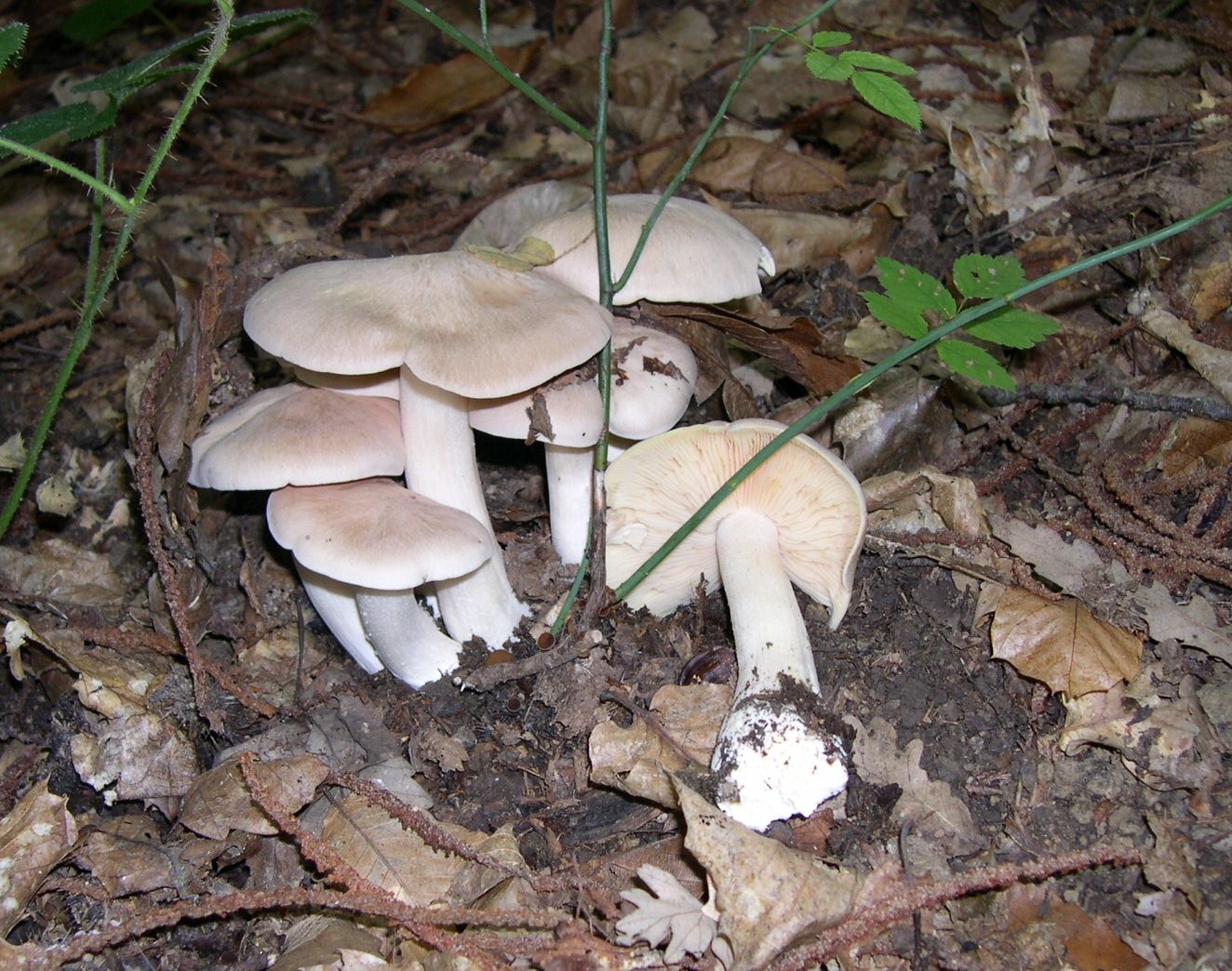
Every spring, people in the United Kingdom and much of Europe go looking for St George's mushroom, Calocybe gambosa, a stocky white-to-cream mushroom named for its habit of appearing around St George's Day on 23 April. It is one of the few substantial gilled mushrooms that fruits so early in the year, which is exactly why it gets so much attention. The problem is that several pale, fleshy mushrooms share its general look, and one of the most notorious is the livid entoloma, Entoloma sinuatum, sometimes called the livid pinkgill or lead poisoner. Both can be pale, chunky and smell strongly of fresh meal or flour, and that overlap has led to real poisonings. Understanding where and when each species grows, and what to check underneath the cap, will help you see why these two should never be casually confused.
St George's mushroom is a spring and early summer species in most of its range, typically fruiting from about April into early June depending on the weather and latitude. It grows in grassland rather than deep forest: pastures, road verges, hedgerow margins, field edges, parks, churchyards and woodland clearings, often on chalk or limestone soils. It frequently forms arcs or rings in grass that reappear in the same place year after year. The cap is usually white, cream or pale buff, thick-fleshed and dome-shaped at first, often with an inrolled margin and becoming irregular and wavy with age. The gills are white to pale cream, very crowded and narrow, and the stem is stout and white with no ring and no volva. Crucially, it produces a white spore print. It is widespread in Europe, including Britain and Ireland, but it is not a common species in North America or Australia, where readers should be especially wary of anything that seems to match it.
The livid entoloma keeps a different calendar and a different address. It is mainly a late summer and autumn mushroom, most often found in broadleaf woodland and parkland where it forms partnerships with trees such as oak, beech and hornbeam, often on heavier or chalky soils. It occurs in Europe and is also recorded in parts of North America. The cap is large and fleshy, typically pale grey, ivory or greyish-buff, sometimes with a faint silky sheen, and the margin is often wavy. The tell-tale feature is in the gills: they are often pale yellowish when young, then gradually turn salmon-pink as the spores mature. A spore print is dull pink to salmon, never white. Its smell is usually described as mealy or farinaceous, sometimes with a rancid edge, which means the smell that some foragers rely on for St George's mushroom offers no protection here.
Eating the livid entoloma causes severe gastrointestinal poisoning, with intense vomiting, diarrhoea and abdominal pain that can lead to dangerous dehydration, and liver involvement has been reported in some cases. It has been described as responsible for a notable share of mushroom poisonings in parts of Europe. That is why season and habitat alone are never enough: although St George's mushroom is a spring grassland species and the livid entoloma is typically an autumn woodland species, fruiting times shift with weather, woodland edges blur the line between grass and trees, and a single misplaced specimen can turn up where you do not expect it. The spore print and the colour of mature gills are far more telling, but even these should be part of a full examination rather than a quick test.
There is a second look-alike that matters even more in spring, because it fruits at the same time as St George's mushroom. The deadly fibrecap, Inocybe erubescens (also listed as Inocybe patouillardii), is a pale mushroom that can appear from late spring into summer, often under beech and lime on chalky soils. It contains high levels of muscarine, which can cause heavy sweating, salivation, tears, blurred vision, slowed heart rate and breathing difficulties, and it has caused deaths. It tends to have a conical to umbonate cap with radiating fibres, flesh and gills that bruise or age reddish, and a brown spore print. Pale lawn and woodland mushrooms such as the ivory funnel, Clitocybe dealbata, which also contains muscarine, add further risk for anyone who identifies by colour and shape alone.
It is worth being blunt about folk tests, because they are often repeated in discussions of pale spring mushrooms. A pleasant mealy smell does not mean a mushroom is safe, since the livid entoloma can smell similar. A cap that peels easily, a silver spoon that does not tarnish, slugs or rabbits nibbling the cap, or a mushroom growing in a familiar spot every year tell you nothing reliable about toxicity. Cooking does not make the livid entoloma or the deadly fibrecap safe. Edibility can only be confirmed by an experienced expert who has examined the actual specimen, ideally including its spore print and stem base, and even then many cautious foragers simply avoid pale fleshy mushrooms they are not completely certain of. If anyone has eaten a mushroom suspected to be one of these species, call poison control or emergency services immediately and keep a sample of the mushroom, or a photo and any leftovers, to help medical staff.
If you come across a pale, fleshy mushroom in spring grass or autumn woodland and want to know what it might be, Shroomly can help you narrow things down. Photograph the top of the cap, the gills from underneath, the full stem and the stem base, and note the date, the nearest trees and whether it was growing in grass or leaf litter. Shroomly will suggest likely species and flag toxic look-alikes such as Entoloma sinuatum and Inocybe erubescens, and taking a spore print on white and dark paper adds an important extra clue. Treat any app result as a starting point for learning, not a verdict on edibility, and confirm your find with a local mycological society or an experienced expert who can examine the specimen in person.