


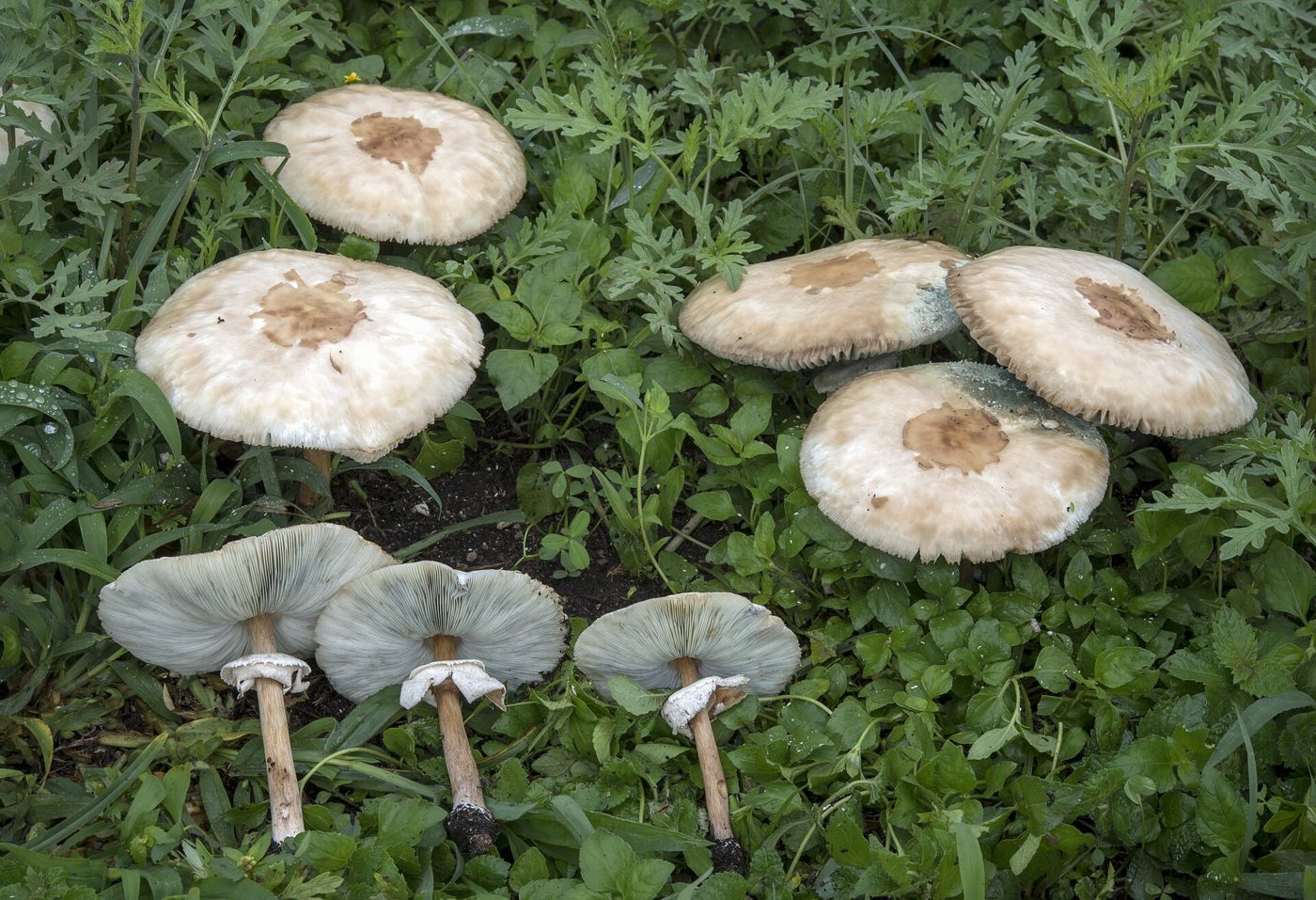
The shaggy parasol (Chlorophyllum rhacodes) and the green-spored parasol (Chlorophyllum molybdites) are close relatives, and to a casual eye they can look almost identical. Both are large, pale mushrooms with brownish scales on the cap, free gills, a tall stem and a thick ring that can often be slid up and down. Both can appear suddenly in gardens and parks after warm, wet weather. The difference matters a great deal, though. The green-spored parasol is notorious for causing severe vomiting, diarrhoea and cramping, and it is one of the most frequently reported causes of mushroom poisoning in North America. Many of those cases involve people who believed they had picked a parasol or shaggy parasol. This guide explains which features to check and why only one of them is truly decisive.
The single most important test is the spore print. Chlorophyllum rhacodes produces a white to cream spore print, while Chlorophyllum molybdites produces a dull green to greyish-green one. To check, cut the stem off a mature cap and place it gills down on a sheet of paper or glass, half on white and half on dark if you can, then cover it with a bowl and leave it for several hours or overnight. A faint green tinge can be easy to miss on bright white paper, so look at the deposit in good daylight and compare it against something truly white. Young green-spored parasols can have gills that still look white, which is exactly why gill colour alone is unreliable on fresh, unopened specimens. As the mushroom matures, its gills usually darken to a greyish or olive-green shade that a shaggy parasol never shows, since its gills stay white to cream and may bruise reddish.
Cap texture offers supporting clues but should never be relied on alone. The shaggy parasol earns its name from coarse, ragged, often upturned brown scales that break up over a whitish, fibrous background, with a smoother brown patch remaining at the centre. The green-spored parasol also has brownish scales on a white cap, sometimes arranged in rough concentric patches, and in large specimens the cap can look strikingly similar. Neither species has the snakeskin-patterned stem of the true parasol (Macrolepiota procera); both have relatively smooth whitish stems. The shaggy parasol typically has an abrupt, swollen bulb at the base of the stem. The green-spored parasol's base may be slightly enlarged but is usually less sharply bulbous, though this varies and is not a dependable separator.
Flesh staining is often mentioned in field guides. When cut or scratched, the flesh of the shaggy parasol, especially in the stem, quickly turns saffron-orange to reddish and later brownish. This is a useful character, but it is not a safe shortcut. Some related Chlorophyllum species, including Chlorophyllum brunneum and Chlorophyllum olivieri, also stain reddish, and the green-spored parasol can discolour to some extent as well. Staining narrows the possibilities, but it cannot rule out the toxic species on its own, which is why the spore print remains the key test.
Geography and habitat help explain where confusion is most likely. The green-spored parasol thrives in warm climates and is common in lawns, parks, sports fields and golf courses across much of the United States, particularly the south and east, as well as in parts of Australia and other warm regions. It often grows in rings or arcs in short grass during summer and early autumn after heavy rain. In the United Kingdom it is rare, but records exist, and it can turn up in heated or imported soil. The shaggy parasol is widespread in Britain, Europe and North America and favours richer, disturbed ground such as woodland edges, conifer needle litter, shrubberies, garden borders and compost heaps. A large scaly mushroom fruiting in an open, mown lawn in a warm region should raise immediate suspicion of Chlorophyllum molybdites.
It is worth being clear about edibility. Although the shaggy parasol is eaten by some people, it is also known to cause gastrointestinal upsets and allergic-type reactions in a proportion of those who try it, and it shares its family with genuinely dangerous mushrooms, including small deadly Lepiota species. No rule of thumb makes any of these mushrooms safe. Peeling the cap, watching whether slugs or squirrels eat it, smelling it or testing it with silver all tell you nothing about toxicity. Only an experienced expert who has examined the actual specimen, including its spore print, can confirm an identification, and some deadly species resemble popular edible ones. If anyone has eaten a mushroom like this and you are unsure what it was, call poison control or emergency services immediately and keep a sample of the mushroom for identification rather than waiting to see whether symptoms develop.
If you find a large scaly parasol-type mushroom and want to know what it is, start with good photographs. Capture the top of the cap to show the scale pattern, the underside to show gill colour and attachment, the ring, and the full stem including the base, dug out carefully rather than snapped off. A photo of a cut stem showing any colour change and a picture of your spore print add valuable detail. Shroomly can suggest likely species from those photos and flag toxic look-alikes such as the green-spored parasol, helping you understand which features to check next. Treat any app result as a starting point, not a verdict, and confirm your find with a local mycological society or an experienced expert who can examine the specimen in person.