


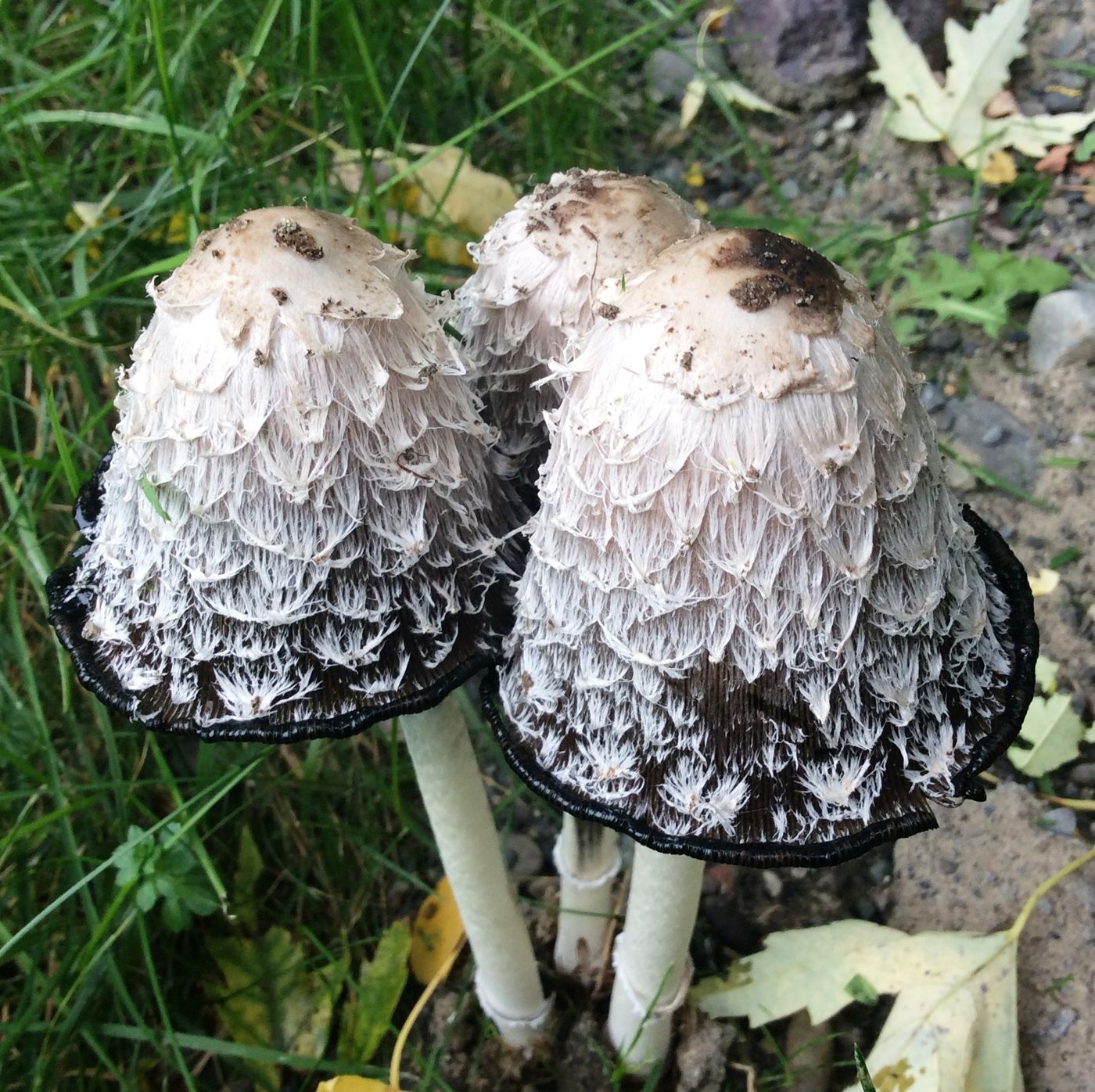
Ink caps are some of the most recognizable mushrooms in parks, lawns, roadside verges and gardens across the United States, the United Kingdom, Canada and Australia, largely because of their strange habit of dissolving into a black, inky liquid as they mature. That process, called deliquescence, is shared by several unrelated species, which is exactly why people so often confuse the two best-known ones: the shaggy ink cap, Coprinus comatus, sometimes called the lawyer's wig, and the common ink cap, Coprinopsis atramentaria, widely nicknamed tippler's bane. They can appear in similar places and at similar times of year, and both blacken from the gill edges upward, but they differ in several consistent ways and they carry different risks. This article walks through the features that separate them, where and when each tends to appear, and why the common ink cap has such a notorious reputation with alcohol.
The shaggy ink cap is the taller and more dramatic of the two. Young specimens push up as elongated, almost egg-shaped or cylindrical white caps that can stand well above the grass, and the cap surface breaks up into coarse, upturned, cream to pale brown scales that give it a shaggy, wig-like look. The very top of the cap is often smoother and tinged light brown. Underneath, the gills are crowded and start white, then turn pinkish and finally black as the cap edge curls and liquefies. The stem is white, smooth, hollow and fairly slender for the cap's height, and there is usually a thin, loose ring low on the stem that can slide up and down or drop off entirely. The spore print is black. Shaggy ink caps typically appear from summer into late autumn, often in groups or lines on disturbed ground, lawns, new road verges, wood chip and recently landscaped soil, and they can pop up in places where no mushrooms were noticed before.
The common ink cap looks noticeably different once you know what to check. Its cap is smaller, more bell-shaped or egg-shaped, and grey to grey-brown rather than white. Instead of coarse shaggy scales, the surface is fairly smooth, with fine radial grooves or pleats running from the edge toward the center, and sometimes a few small brownish scales concentrated near the top. It generally grows in tight clusters, often at the base of trees, around stumps, or in grass where it is fruiting from buried roots or decaying wood that you cannot see. The stem is white and hollow, and any ring-like zone is usually a faint ridge near the base rather than the loose movable ring of the shaggy ink cap. Like its shaggy relative, it blackens and dissolves from the edge as it ages and leaves a black spore print. It can appear from spring right through to autumn, frequently after rain, and is common in urban settings.
The reason this comparison gets searched so often is coprine, a compound found in the common ink cap. Coprine interferes with the way the body breaks down alcohol, allowing a by-product called acetaldehyde to build up. When someone who has eaten the mushroom drinks alcohol, they may experience facial flushing, a racing or pounding heartbeat, headache, nausea, vomiting, sweating, tingling and a feeling of anxiety. The effect resembles the reaction caused by a medication once used to discourage drinking, which is where the nickname tippler's bane comes from. Importantly, the sensitivity can persist for a period after the mushroom is eaten, commonly cited as up to a few days, so avoiding alcohol at the same meal is not a reliable safeguard. The shaggy ink cap is not generally associated with coprine in the same way, but that is not a reason to treat any ink cap casually: confusing the two species is precisely how people end up exposed.
Several other look-alikes complicate the picture. The magpie ink cap, Coprinopsis picacea, has a dark cap broken into white patches and is regarded as poisonous. The glistening ink cap, Coprinellus micaceus, is smaller, tan to honey-brown and covered when young in tiny shiny granules, and it clusters on wood. Very young, unopened shaggy ink caps can occasionally be confused with the immature stages of other white mushrooms, and some deadly Amanita species, including destroying angels, are white with a ring on the stem, so a white mushroom with a ring should never be assumed to be a harmless ink cap. Ink caps that grow along busy roads or on contaminated ground can also absorb pollutants from the soil. Folk tests do not help here either: a cap that peels, a mushroom that animals have nibbled, a pleasant smell or a silver spoon that does not darken tells you nothing about whether a mushroom is safe. Although field guides often describe the shaggy ink cap as edible, only an expert who has examined the actual specimen can confirm what it is, and some deadly species look like popular edible ones.
If anyone has eaten an ink cap or any wild mushroom and feels unwell, particularly with flushing, palpitations or vomiting after alcohol, or if you are unsure what was eaten, call poison control or emergency services immediately. Keep a sample of the mushroom, or the remains of it, wrapped in paper so that it can be identified by professionals. Do not try to treat symptoms at home or wait to see whether they pass, because the identity of the mushroom matters and ink cap clusters can grow alongside other species.
Telling these two apart starts with good observation, and a clear photograph makes that much easier. Capture the whole mushroom from the side to show cap shape and surface texture, then photograph the gills, the stem and any ring, and dig gently to show the stem base and whatever it is growing from, whether grass, buried wood or a stump. Noting the color of the gills and any inky edges helps too. Shroomly can use those photos to suggest likely species, including the shaggy ink cap, the common ink cap and their toxic look-alikes, so you know which features to look at more closely. Treat that result as a starting point rather than a verdict, and confirm any identification with a local mycological society or an experienced expert who can examine the specimen in person, especially before anyone considers eating it.