


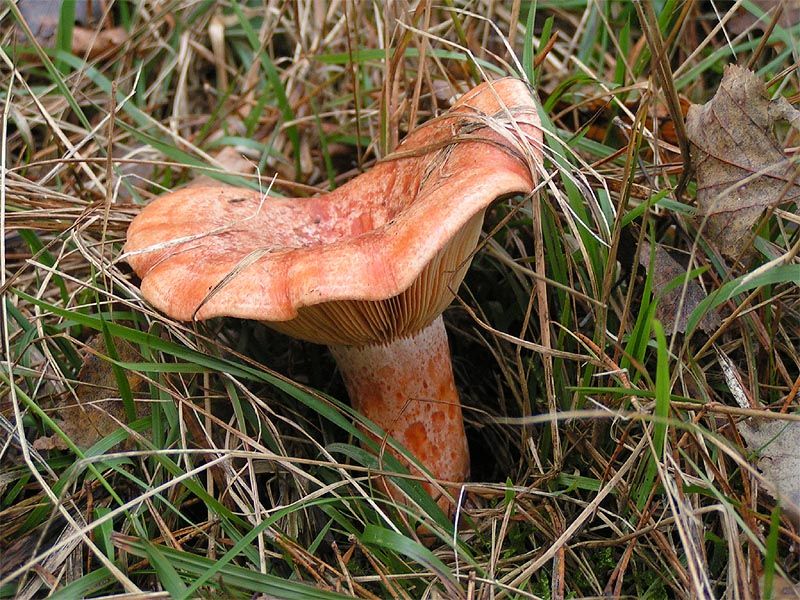
Milk caps are some of the most distinctive mushrooms on the forest floor. Break the gills of any Lactarius and droplets of latex, or milk, bead up from the wound. Two species turn up again and again in searches and foraging forums because they look alike at a glance. The saffron milk cap, Lactarius deliciosus, is a sought-after species in parts of Europe. The woolly milkcap, Lactarius torminosus, is a well-known cause of gastrointestinal poisoning. Both have orange to salmon caps marked with darker concentric rings, both grow in late summer and autumn, and both can appear in the same mixed woodland. Knowing the features that separate them is a good lesson in how mushroom identification really works: by looking at several characters together, never at one in isolation.
The saffron milk cap is a medium-sized mushroom with a cap that is usually about 4 to 12 centimetres across. It starts convex and becomes shallowly funnel-shaped with age. The cap is carrot to apricot orange with darker orange zones, and it often develops greenish stains, especially on older specimens. The gills are crowded, run slightly down the stem and share the cap's orange color. The stem is short, often hollow, and frequently marked with small orange pits. The most important feature is the latex. When the gills or flesh are cut, Lactarius deliciosus releases bright carrot-orange milk, and the damaged areas slowly turn green over minutes to hours. It is mycorrhizal with pines, so it is usually found in pine plantations, heaths with scattered pines and sandy pine woods. It is widespread in Europe and has been introduced with pines in places such as Australia.
The woolly milkcap is similar in size but differs in several ways. Its cap is pale salmon to pinkish orange with darker rose-colored zones. The giveaway is the margin: it is strongly inrolled and covered in long, shaggy, woolly hairs, as if fringed with damp wool. This feature is easiest to see on young and mid-aged caps and may wear away on old ones. The gills are pale cream to faintly pinkish, not orange. When cut, Lactarius torminosus produces white latex that stays white or changes very little, and it tastes intensely hot and acrid. Do not taste it to check, as this is not a safe identification method for a beginner. It is mycorrhizal with birch and is common across the cooler parts of Europe and North America wherever birches grow, including parks, gardens and roadside plantings.
In practice, four features together separate them most reliably. First, check the milk color: carrot-orange in the saffron milk cap, white in the woolly milkcap. Second, look at the cap edge: smooth or only slightly downy in the saffron milk cap, distinctly shaggy and hairy in the woolly milkcap. Third, check the gill color: orange versus pale cream or pinkish. Fourth, note the nearest trees: pine for Lactarius deliciosus, birch for Lactarius torminosus. Green bruising points toward the saffron milk cap group, but it is not proof on its own. Tree associations can also mislead in mixed woods, where roots from different trees overlap. If any of these features disagree with each other, treat the mushroom as unidentified.
The picture is further complicated by other milk caps. Several close relatives of the saffron milk cap also have orange milk. These include the false saffron milkcap, Lactarius deterrimus, under spruce, whose milk turns wine-red after a while. Others are Lactarius salmonicolor under fir and Lactarius sanguifluus, which has blood-red milk. In North America, mushrooms long called Lactarius deliciosus are now thought to belong to a group of related species that experts still sort through with care. On the toxic side, the yellowdrop milkcap, Lactarius chrysorrheus, has white milk that quickly turns sulphur yellow. Lactarius pubescens, a paler, birch-associated cousin of the woolly milkcap, also has a hairy margin. Some unrelated orange mushrooms in pine woods, including certain Cortinarius species, can catch a beginner's eye. Cortinarius has no milk at all, which is one reason the latex test matters.
The woolly milkcap is not usually deadly, but it is not harmless. Eating it typically causes nausea, vomiting, abdominal cramps and diarrhoea, sometimes severe. The risk is higher for children, older people and anyone who becomes dehydrated. Folk tests will not protect you. Silver spoons, peeling the cap, seeing a slug or squirrel nibbling it, or a pleasant smell tell you nothing about whether a milk cap is safe. Orange milk is also not a general rule for edibility across all fungi. Some deadly mushrooms look like popular edible ones, and only an expert who has examined the actual specimen can confirm what it is. If anyone may have eaten a wild mushroom and you are unsure what it was, call poison control or emergency services immediately and keep a sample of the mushroom for identification. Do not wait for symptoms to appear.
If you find a zoned orange or pink mushroom under pines or birches, a careful photo set will tell you far more than a single snapshot. Photograph the top of the cap, with a close-up of the edge to show whether it is smooth or woolly. Take one of the gills, and another of the milk welling from a small nick in the gills, both right away and again after some minutes to record any color change. Then dig gently to show the whole stem and its base, and include the surrounding trees in a wider shot. Shroomly can use these photos to suggest likely species, including toxic look-alikes such as the woolly milkcap, and point out which features to check next. An app result is only a starting point, never permission to eat anything. Confirm any identification with your local mycological society or an experienced expert who can examine the specimen in person.