


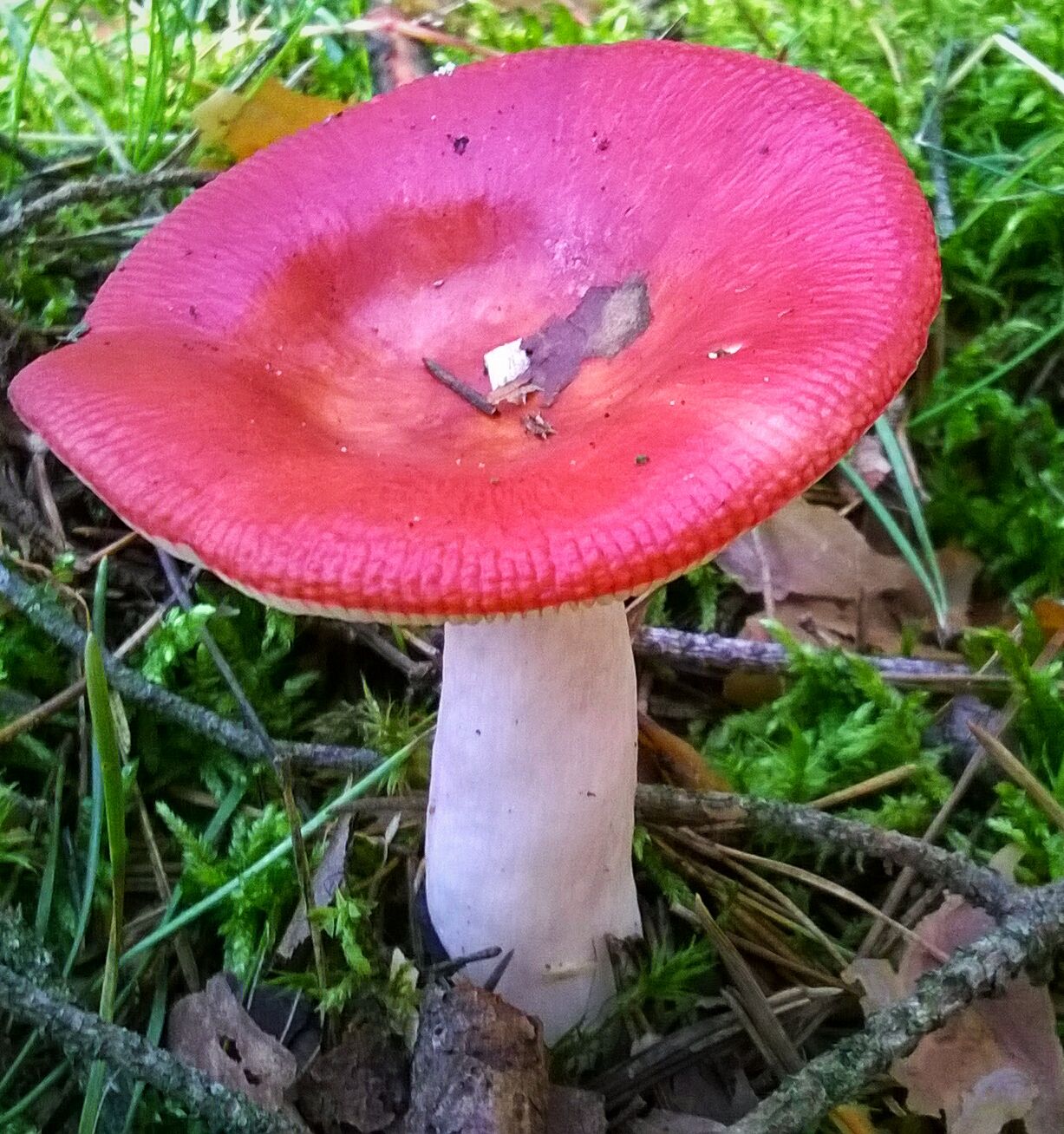
Brittlegills (Russula) and milk caps (Lactarius, plus the closely related Lactifluus) are some of the most common mushrooms in woodlands across North America, Britain, Europe and Australia. They belong to the same family, Russulaceae, and they share a feature that sets them apart from most other gilled mushrooms: their flesh is crumbly rather than fibrous. Snap the stem of a typical mushroom and it tears into strings; snap the stem of a Russula or Lactarius and it breaks cleanly, a bit like a stick of chalk or an apple. This happens because their tissue is packed with rounded cells called sphaerocysts. Once you recognise that chalky snap, you know you are probably in this family, and the next question is which of the two main groups you are holding.
The most reliable field test is latex. On a fresh, undamaged milk cap, cutting or nicking a gill or the cap flesh with a knife will usually release droplets of fluid, which is where the common name comes from. Brittlegills do not produce latex at all. The amount and colour of the milk is itself a major identification clue in Lactarius: many species bleed white latex, some bleed white that turns yellow on exposure to air, and species such as the saffron milk cap (Lactarius deliciosus) bleed carrot-orange milk, with the flesh often staining green over time. Watch the latex for a minute or two after cutting, and note whether it changes colour on its own or only where it touches the flesh. One caution: old, dried-out or frost-damaged milk caps may produce very little latex, so a dry cut on a tired specimen does not prove it is a Russula.
Cap and gill features help too, though none is decisive on its own. Many milk caps have caps that become depressed or funnel-shaped with age, often with an inrolled margin when young, and quite a few show concentric zones or bands of colour on the cap, as in Lactarius deliciosus and the woolly milkcap (Lactarius torminosus), whose margin is also shaggy with hairs. Their gills often run slightly down the stem. Brittlegills are famous for their range of cap colours, from red and purple to green, yellow and white, and their caps are often smooth and slightly sticky when wet. Russula gills tend to be brittle enough to crumble when you run a finger across them, and the stem is often white, smooth and evenly thick. Spore prints in both groups range from white through cream to ochre or yellowish, so spore colour helps separate species within each genus more than it separates the two genera.
It is worth knowing about the most common pitfalls. A red Russula such as the sickener (Russula emetica) can be confused with a fly agaric (Amanita muscaria) whose white warts have washed off in rain. The difference lies at the base: Amanita species grow from a bulb or sac-like volva and often have a ring on the stem, while Russula stems have no ring and no volva, and Amanita flesh is fibrous rather than chalky. Always dig out the whole stem base rather than cutting it at ground level, because that is where the critical evidence is. Some pale Lactifluus and Russula species can also look superficially like other white mushrooms, which is another reason to check for the chalky snap and latex rather than relying on colour.
There is a persistent folk rule that mild-tasting brittlegills are safe and peppery ones are not, and you will see the cap-peeling test mentioned too. Neither is a safe way to judge any wild mushroom. Experienced mycologists do use taste and cap-peel characteristics as identification features within Russula, under controlled conditions and with full knowledge of what they are handling, but these are tools for distinguishing species, not tests of safety. Both families contain species that cause severe gastrointestinal poisoning, including Russula emetica and Lactarius torminosus, some species such as the ugly milkcap (Lactarius turpis) have raised concerns about potentially harmful compounds, and in parts of East Asia Russula subnigricans has caused fatal poisonings. Silver spoons, animal nibble marks, smell and peeling caps tell you nothing reliable about toxicity. Only an expert who has examined the actual specimen can confirm whether a mushroom is edible, and some deadly species look very like popular edible ones.
Working out whether you have a brittlegill or a milk cap is satisfying, and it narrows down an enormous list of possibilities, but it is only the start. There are hundreds of Russula and Lactarius species, and many can only be separated with spore prints, chemical tests or microscopy. If you or someone else has eaten a mushroom from either group and feel unwell, or even if you are simply unsure, call poison control or emergency services immediately and keep a sample of the mushroom for identification.
To get a useful identification, photograph the mushroom from several angles: the top of the cap, the gills underneath, the full stem and the base after gently digging it out, and if you can, a close-up of any latex beading from a nicked gill. Upload those photos to Shroomly and it will suggest likely species and flag toxic look-alikes you should rule out, such as Amanita species that can resemble red brittlegills. Treat the result as a starting point for learning, not a decision about eating, and confirm any identification with a local mycological society or an experienced expert who can examine the specimen in person.