


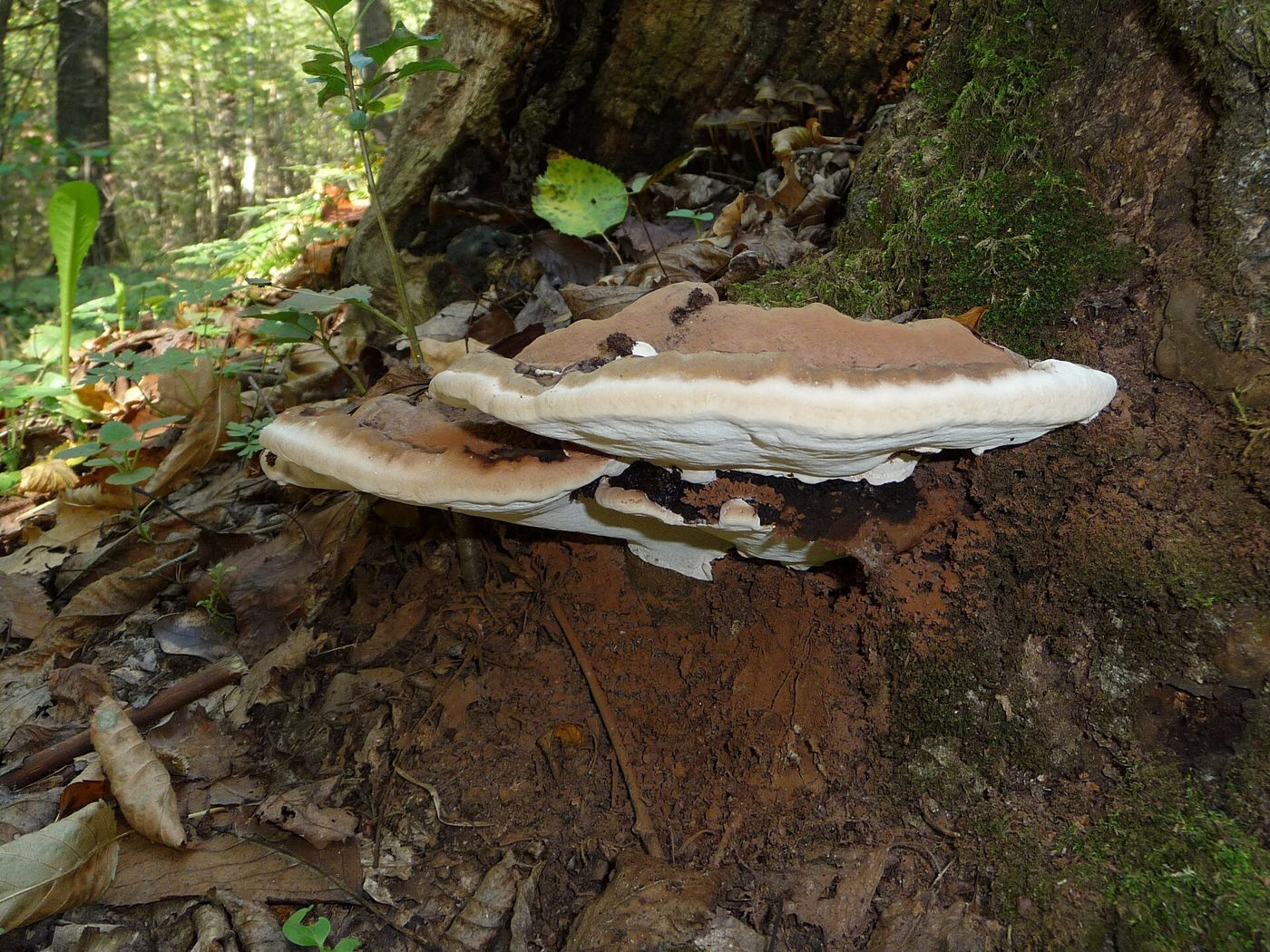
Few bracket fungi attract as many searches as reishi, the glossy shelf mushroom sold widely as a supplement, and artist's conk, the large woody shelf people scratch drawings into. Both belong to the genus Ganoderma, both grow on living or dead trees, and both have a pale pore surface underneath instead of gills, so it is easy to see why they get mixed up. The good news is that they differ in several consistent ways: surface shine, the presence or absence of a stem, how long the fruiting body lasts, and the trees they favour. Learning those differences is useful whether you are curious about what is on a stump in your yard or simply want to put the right name to a shelf you saw on a walk.
Reishi is not really a single species. The name Ganoderma lucidum is traditionally applied to the European fungus, while in North America the reishi-type brackets are usually split into species such as Ganoderma tsugae, which grows mainly on hemlock and other conifers, and Ganoderma sessile and Ganoderma curtisii, which grow on hardwoods. What unites them is the striking upper surface: it looks varnished or lacquered, typically deep red to mahogany, often with a paler yellow or white growing margin when young. Many specimens have a short stem attached at the side, though some are nearly stemless. Reishi brackets are annual, meaning they develop over spring and summer and then dry, fade and decay rather than adding new layers year after year.
Artist's conk, Ganoderma applanatum, is a sturdier, more matte fungus. Its upper surface is dull grey to brown, often uneven or ridged with concentric bands, and frequently dusted with a cocoa-brown layer of its own spores. It has no stem and attaches directly to the wood as a flat, hard shelf that can grow very large. It is perennial, adding a fresh layer of tubes each year, so a single bracket may persist for many seasons. Its most famous feature is the pore surface: white or cream when fresh, it bruises dark brown wherever it is touched, which is why people etch pictures into it. It grows mostly on hardwoods across North America, Europe and beyond, and occasionally on conifers. In Europe, close relatives such as Ganoderma australe can look very similar and usually need careful examination to separate.
When you are comparing the two in the field, start with shine. A glossy, lacquered, reddish surface points toward the reishi group, while a dull, dusty or crusty brown surface points toward artist's conk. Next, look at the attachment: a stem, even a stubby one, favours reishi, whereas a flat shelf fused directly to the trunk favours artist's conk. Consider texture and age as well, since reishi tends to be leathery to corky and seasonal, while artist's conk is rock-hard and may show many years of growth. The pore surface is less helpful on its own, because both can be pale and both can bruise brown. Other brackets add to the confusion, including the lacquered bracket Ganoderma resinaceum in Britain and Europe and the red-belted conk Fomitopsis pinicola, whose resinous red band near the margin can resemble the shine of reishi. Checking the host tree, location and season alongside these features gives a much more reliable picture than any single trait.
Both fungi matter for tree health. Ganoderma species are white rot fungi that break down lignin and cellulose in wood, and when a bracket appears on a living tree it usually means decay is already established in the lower trunk or roots. That can weaken the tree and, over time, make it a safety concern, so a Ganoderma bracket on a tree near a house, path or play area is worth showing to a qualified arborist. On stumps and fallen logs, however, these fungi are simply doing their natural job of recycling wood back into the soil.
Because reishi is marketed as a health product, people sometimes want to use wild-collected brackets, and this is where caution is essential. Woody brackets are not the classic deadly look-alikes that soft gilled mushrooms can be, but misidentification still happens, wild specimens can harbour mould or absorb contaminants, and supplements made from reishi have been linked to occasional reports of adverse effects, including liver problems. Health claims made for reishi are also not well established by rigorous clinical evidence. No photo, app result or single feature can confirm that a wild fungus is safe to consume; only an expert who has examined the actual specimen can do that, and it is wise to speak to a doctor before taking any fungal product. If anyone becomes unwell after eating or taking a wild mushroom, call poison control or emergency services immediately and keep a sample of the mushroom.
If you find a bracket and want to know which Ganoderma you are looking at, photograph it carefully: take a shot of the upper surface in natural light so any shine shows, one of the pore surface underneath, one of the attachment point showing whether there is a stem, and one of the tree or stump it is growing on. Shroomly can use those photos to suggest likely species and flag similar-looking brackets, which is a quick way to narrow things down. Treat that result as a starting point rather than a final answer, and confirm your identification with a local mycological society or an experienced expert, especially before making any decision about using a wild fungus or managing a tree.