

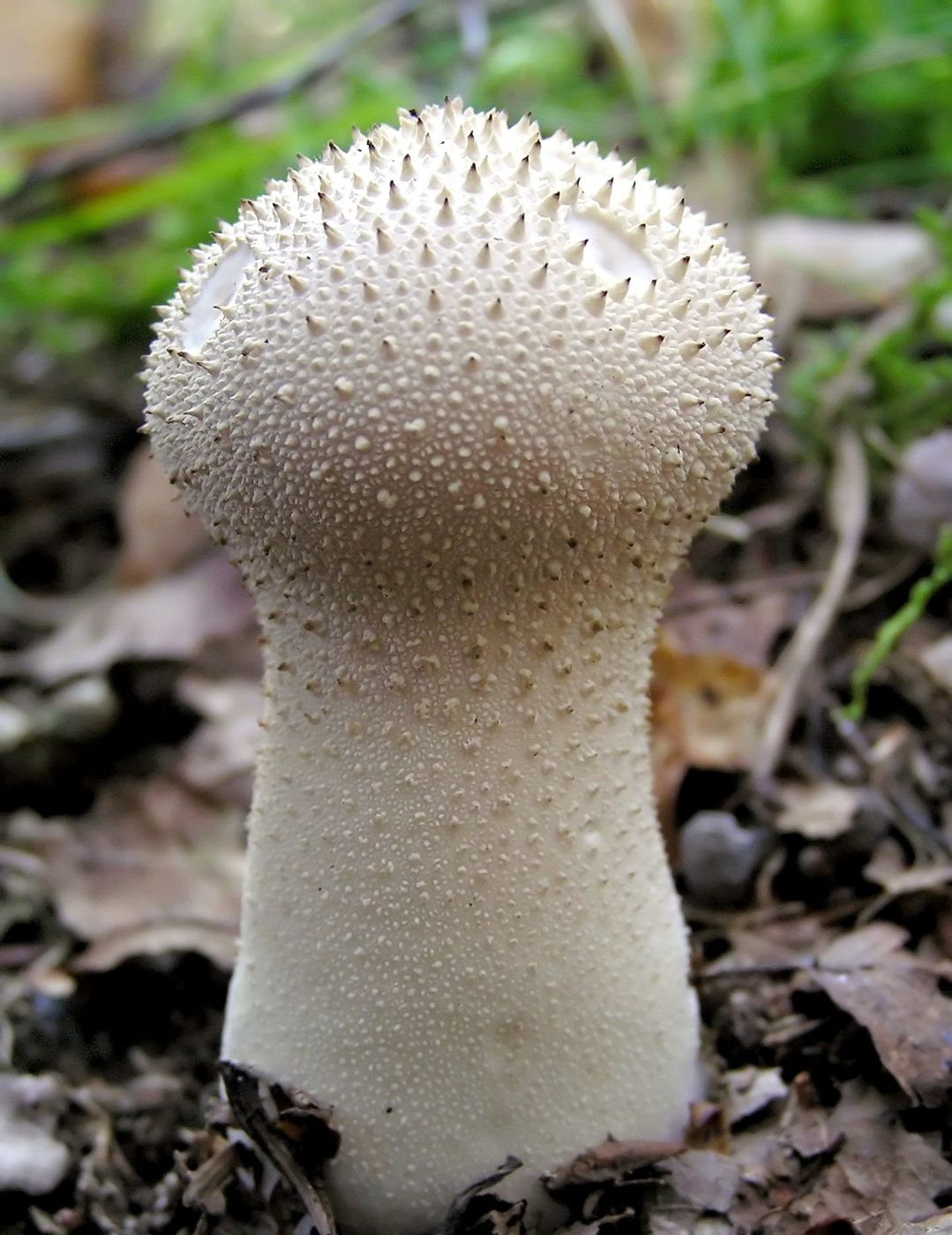
Puffball or death cap egg is a question that sounds unlikely until you see both side by side. Puffballs are round, white, stemless-looking fungi that grow on lawns and in woods. A young Amanita, including the death cap and the destroying angel, starts life wrapped in a white membrane called the universal veil, and in this egg stage it can be the same size, shape, and colour as a small puffball.
The outside is not enough to tell them apart. Both can be smooth and white, both can sit partly buried in the soil, and both appear in late summer and autumn. Small puffballs, such as the common puffball Lycoperdon perlatum, are the most easily confused, because they are about the size of an Amanita egg. Even the size of a giant puffball does not make the check unnecessary.
The slice test is the essential step. Cut the specimen vertically, from the top through the base. A true puffball at a young stage is solid and uniformly white inside, with a texture like marshmallow or tofu and no internal structure. An Amanita egg shows a ghostly silhouette of a mushroom: the outline of a cap, gills, and stem pressed inside the veil. If you see any outline at all, it is not a puffball.
Earthballs (Scleroderma species) are the other common mix-up. They have a thick, tough skin, often scaly or cracked, and their interior is firm and turns purplish black to black even when young. Earthballs are poisonous and cause gastrointestinal illness. Puffballs whose interior has turned yellow, olive, or brown are mature and releasing spores, and they are no longer the uniform white described above.
This is one of the clearest examples of why a single photo of the outside of a mushroom is not enough. A death cap egg and a puffball can look identical from above, and the feature that separates them is only visible after cutting. That is also why folk shortcuts fail: none of them include the one step, cutting the specimen open, that reveals an Amanita egg.
When you find something round and white, take a photo of it in place, then a photo of the cut surface, and let Shroomly compare it with puffballs, earthballs, and Amanita eggs. Treat the result as a way to learn what you are looking at. Any decision about eating a wild fungus needs an experienced person to examine the actual specimen.