


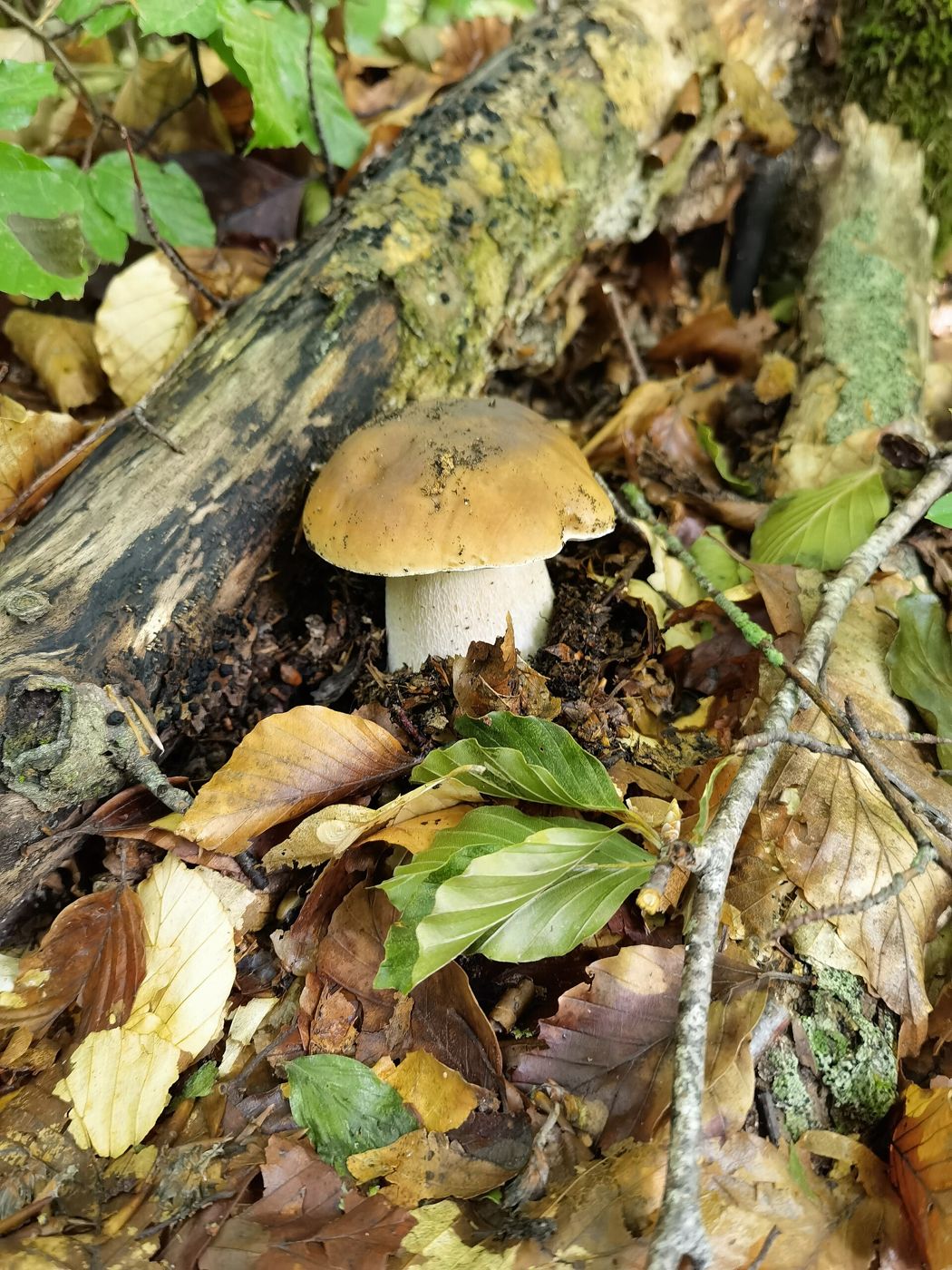
Porcini, also called the cep, king bolete or penny bun, is one of the best-known wild mushrooms in Europe and North America. People who find a chunky bolete with a fat, swollen stem often type 'porcini look-alikes' into a search bar. One look-alike they keep meeting is the devil's bolete, Rubroboletus satanas, formerly Boletus satanas. The two share a stout shape and grow in similar woodland, but several features separate them, and knowing those features is a good way to learn how boletes are identified.
Start with the cap. Boletus edulis usually has a cap in shades of tan, chestnut or reddish-brown, sometimes compared to a bread bun. The surface is smooth and can feel slightly greasy when wet. The cap edge often has a thin pale margin. The devil's bolete is strikingly different from above. Its cap is typically a pale chalky white, grey-white or light buff, sometimes with olive tones, and it can look dull or suede-like. A whitish, heavy bolete in leaf litter should already make you pay close attention, because porcini are rarely that pale.
The most important check is under the cap. Boletes have a sponge-like layer of pores instead of gills. In a young porcini the pores are white and stuffed with fine tissue. As the mushroom matures they turn yellowish and then olive-green. They never become red. The devil's bolete has pores that are red, orange-red or blood-red, often with a yellow layer behind them that shows in very young specimens. Red or orange pores are one of the most useful warning signs in bolete identification. Many experienced foragers advise beginners to leave every red-pored bolete alone. That rule only helps you avoid some dangerous species. It does not make any other bolete safe, because there are also toxic and very bitter boletes with white or yellow pores.
Next, look at the stem, also called the stipe. Both mushrooms can have a swollen, club-shaped or bulbous stem, which is why they get confused. A porcini stem is usually white to pale brown, with a fine raised net called reticulation. The net is white or pale and most obvious near the top of the stem. On the devil's bolete the swollen stem is typically yellow near the top and flushed red or pinkish-red further down. It is covered in a red net. A red net over a fat stem, under a pale cap, is a classic combination for Rubroboletus satanas.
Cutting the mushroom in half from top to bottom gives another clue. Porcini flesh is firm and white and generally stays white or changes very little when exposed to air. The flesh of the devil's bolete is pale yellowish-white and slowly turns blue, especially in the cap and above the pores. Be careful with this test. Bluing is common across many boletes, edible and toxic alike, and some porcini relatives stain slightly. So bluing narrows down the possibilities but never confirms that a mushroom is safe. Mature devil's boletes are often said to develop an unpleasant, rotting smell. Smell is unreliable and personal, though, so it should never be used to judge edibility.
Habitat and range help too. In Europe, Rubroboletus satanas is mostly associated with oaks and beech in warm, open woodland on chalky or limestone soils, and it is rather local and uncommon in many areas. Boletus edulis forms partnerships with a wide range of trees, including spruce, pine, oak, beech and birch, and grows across a much broader range of soils. In North America the true European devil's bolete is not the usual concern. Instead there are several red-pored, blue-staining relatives, such as Rubroboletus eastwoodiae in western oak woodland, which were long treated under the same name and are also known to cause poisoning. Eating the devil's bolete causes severe vomiting, diarrhea and abdominal cramps. Folk tests are worthless here, as they are for every mushroom. Silver spoons, peeling the cap, seeing slugs or squirrels nibbling it, and a pleasant smell tell you nothing about toxicity. If anyone has eaten a bolete they cannot positively identify, call poison control or emergency services immediately and keep a sample of the mushroom for the experts.
If you find a large bolete and want to know what it is, record the features that matter most. Photograph the top of the cap, the pore surface underneath, the full length of the stem including any net pattern, and the stem base. Also photograph a vertical cut through the middle a few minutes after slicing, so any color change is visible. Shroomly can use those photos to suggest likely species and point out toxic look-alikes such as red-pored boletes. Treat that result as a starting point, not a verdict. Some deadly and dangerous mushrooms look like popular edible ones, so only a local mycological society or an experienced expert who has examined the actual specimen can confirm what it is and whether it is edible.