


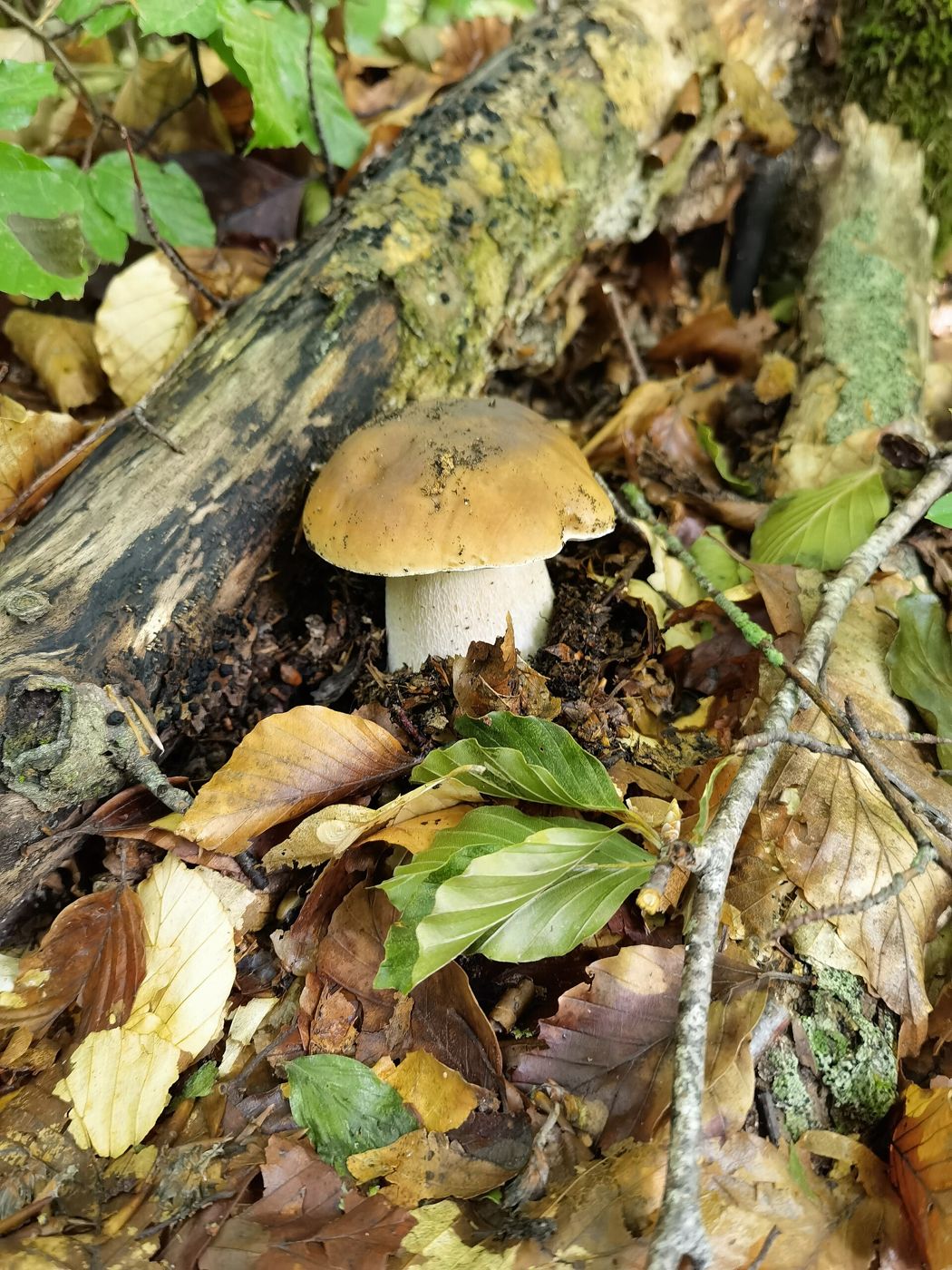
Few mix-ups frustrate mushroom hunters more often than porcini and the bitter bolete. Porcini, also called the king bolete, cep or penny bun (Boletus edulis), and the bitter bolete (Tylopilus felleus) both produce chunky fruiting bodies with brown, bun-shaped caps, a spongy layer of pores instead of gills, and thick stems that can swell toward the base. They fruit in the same woodlands during late summer and autumn across Europe, the United Kingdom and parts of North America, sometimes within a few metres of each other. From a standing height, especially in dim forest light, they can be almost impossible to separate, which is exactly why it pays to know which features actually matter.
The single most useful feature is the color of the pore surface under the cap. In young porcini the pores are white or off-white, often looking stuffed with a cottony layer, and as the mushroom matures they turn yellowish and eventually olive-green or olive-brown. The bitter bolete starts with whitish to pale pores as well, which is what makes young specimens so confusing, but as it ages the pores develop a distinctly pinkish, salmon or dull rose tint. That pink hue comes from the spores, and a spore print reinforces the difference: Tylopilus felleus leaves a pinkish to reddish-brown deposit, while Boletus edulis leaves an olive-brown one. Very young specimens of either species may not show these colors clearly, so a single immature mushroom is a poor candidate for a confident identification.
The second key feature is on the stem. Both species can have a raised net-like pattern called reticulation, but it looks very different on each. Porcini typically show a fine, delicate white or pale net, most obvious near the top of the stem just below the cap, fading lower down. The bitter bolete usually has a coarse, prominent net that is brown to dark brown, standing out clearly against a paler background and often extending well down the stem. If you see a bold, dark mesh pattern on a bolete stem, that is a strong warning sign you may be looking at Tylopilus felleus. Cap and stem shape, by contrast, are unreliable: both can be fat, both can be bulbous, and cap shades of tan, chestnut and hazel overlap heavily.
Habitat offers supporting clues but never proof. Both are mycorrhizal, meaning they form partnerships with tree roots. Porcini associate with a range of trees including spruce, pine, oak, beech and birch, while the bitter bolete is commonly found with conifers and some hardwoods and is sometimes seen near rotting stumps or on very acidic soils. In North America, what people call porcini is actually a group of closely related species, so regional field guides and local knowledge matter a great deal. The bitter bolete earns its name from an intensely bitter flavor, and some older guides describe tasting a tiny piece as a test. Shroomly does not recommend putting any unidentified wild mushroom in your mouth: taste tests are not a safe identification method, and the habit becomes dangerous when it is applied to groups that contain truly toxic species.
It is also important to remember that the bitter bolete is not the only bolete that can be confused with porcini. Some boletes have red or orange pores, stain blue when cut or bruised, or have red coloring on the stem, and several of these, such as the devil's bolete (Rubroboletus satanas), can cause serious gastrointestinal illness. Folk rules circulating online, like the idea that every bolete without red pores and blue staining is harmless, are oversimplifications that do not hold up everywhere. Smell, peeling the cap, seeing slugs or squirrels nibbling a mushroom, or a silver spoon changing color tell you nothing reliable about safety. Whether any wild mushroom is edible can only be confirmed by an expert who has examined the actual specimen, and in many groups of fungi deadly species closely resemble popular edible ones.
If you want to work out whether you have found porcini or a bitter bolete, the best approach is to collect clear evidence rather than rely on a single trait. Photograph the cap from above, the pore surface from below, the full length of the stem with its net pattern in good light, and the base of the stem, and note the trees growing nearby. Shroomly can analyze those photos and suggest likely species along with known look-alikes, which helps you see which features to examine more closely. Treat that result as a starting point, not a verdict, and take the specimen itself to a local mycological society, foray leader or experienced expert to confirm the identification. If anyone has eaten a wild mushroom and you are worried, call poison control or emergency services immediately and keep a sample of the mushroom to show them.