


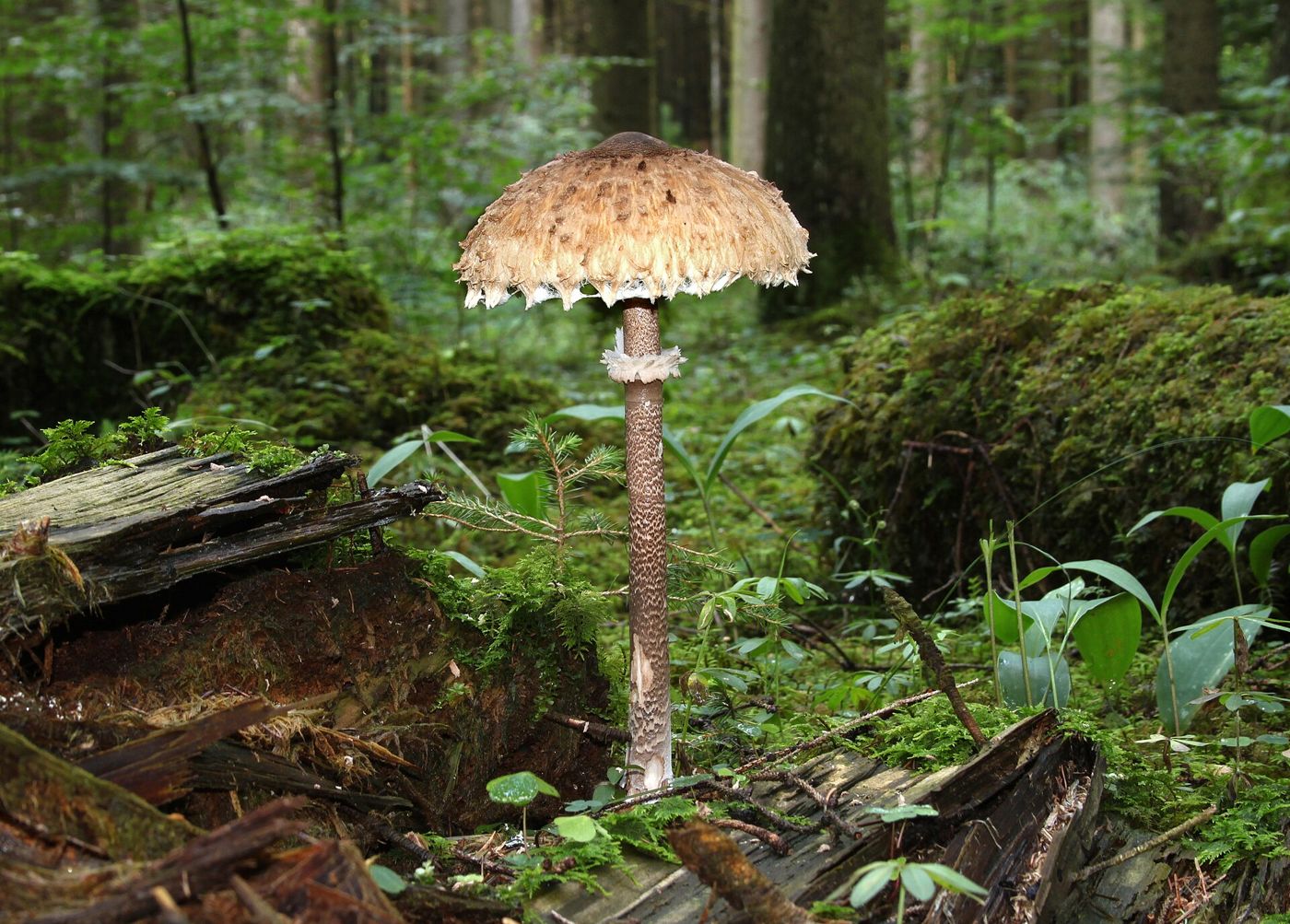
Few mushrooms are as eye-catching as the parasols. They have broad, scaly caps that can open wider than a dinner plate, and white gills sit underneath. For that reason, people often search for how to tell the classic parasol, Macrolepiota procera, from the shaggy parasol, Chlorophyllum rhacodes (some field guides group close relatives such as Chlorophyllum olivieri and Chlorophyllum brunneum under the same common name). The two share a lot. Both have a cap covered in brownish scales on a paler background, free white gills, a white spore print, a thick double ring that can often be slid up and down the stem, and a swollen stem base. Because of those shared features, separating them depends on a handful of details that are easy to overlook.
The single most useful feature is the stem. In Macrolepiota procera the stem is tall and fairly slender for the size of the cap. It is often well over twice as long as the cap is wide, and it is covered in fine brown bands or zigzags that look like snakeskin. The shaggy parasol has a shorter, stouter stem that is smooth and whitish to pale buff, with no snakeskin pattern at all. In Chlorophyllum brunneum and some related forms, the base ends in an abrupt, almost rimmed bulb that looks as if the stem has been pushed into a ball. If you photograph only the cap from above, you lose this key evidence. Always capture the full length of the stem and the base.
The second test is what happens to the flesh. Cut or scratch a shaggy parasol, especially in the stem or near the top of the stem, and the white flesh usually turns saffron-orange to reddish within a minute or so. Older specimens may later become brownish. The parasol's flesh stays white or changes only very slightly. This colour change is a strong clue, but it is not infallible. Staining can be faint in old, dry or waterlogged specimens, so treat it as one piece of evidence rather than a verdict.
The cap gives supporting clues. The parasol's cap usually keeps a neat, dark brown central bump, or umbo. The rest of the cap is broken into flatter, fairly evenly spaced scales arranged in rough concentric rings. The shaggy parasol lives up to its name. Its cap scales are coarser, more ragged and often curl upward at the edges, giving a tattered, shingled look. Its centre tends to be a smooth brown patch rather than a raised knob. Habitat helps too, though it overlaps. Parasols favour open grassland, pasture and woodland edges. Shaggy parasols are more often found in woods, under conifers, in gardens, shrubberies and around compost or rich disturbed soil.
There are other look-alikes, and they matter more than the parasol-versus-shaggy question itself. In North America, Australia and other warm regions, the green-spored parasol, Chlorophyllum molybdites, is a very common lawn mushroom and a leading cause of mushroom poisoning. It looks broadly similar, but its gills turn greyish-green with age and its spore print is green. Young specimens can still look white-gilled, so a spore print matters. At the other end of the scale, small Lepiota species such as Lepiota brunneoincarnata contain amatoxins, the same deadly toxins found in the death cap. Young parasols that have not fully expanded can be confused with these smaller relatives. Some people also react badly to the shaggy parasol group itself, with digestive upsets reported. Separating these mushrooms from one another is a matter of identification, not a judgement about edibility. Only an expert who has examined the actual specimen can confirm what it is, and folk tests such as peeling the cap, smell, or seeing that slugs have eaten it tell you nothing about safety.
If anyone has eaten a mushroom from this group and you are unsure what it was, call poison control or emergency services immediately. Do not wait for symptoms, and keep a sample of the mushroom or any leftovers for identification. Symptoms from some dangerous species can be delayed by many hours, so feeling fine early on is not reassuring.
To identify a parasol-type mushroom, photograph it from several angles. Take one shot of the cap from above. Take another of the gills underneath, plus a side view showing the whole stem with its ring, and a clear shot of the base after carefully digging it out. A photo of the cut stem flesh a minute after slicing, to show any orange-red staining, adds valuable evidence. Shroomly can use those images to suggest likely species and flag toxic look-alikes such as the green-spored parasol and small Lepiota species. Treat the result as a starting point. Confirm any identification with a local mycological society or an experienced expert who can examine the specimen in person.