


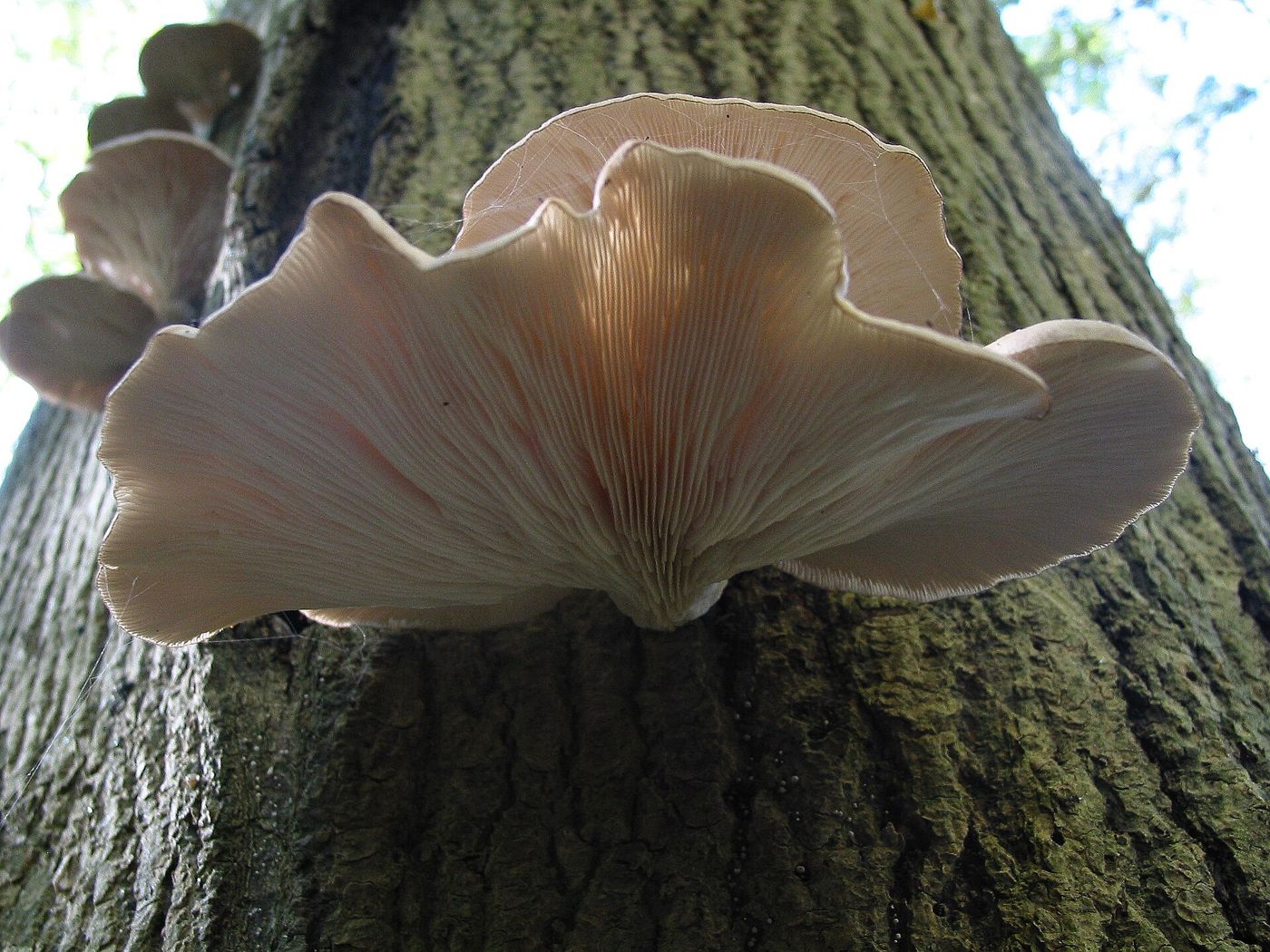
If you live in Australia and find pale, fan-shaped mushrooms stacked on a stump or the base of a tree in autumn, there is a good chance someone will tell you they are oyster mushrooms. They might be. But they might also be ghost fungus, Omphalotus nidiformis, a poisonous species famous for glowing faintly green at night. The two share an overall growth form so closely that confusion between them is a recognised cause of mushroom poisoning in Australia, and the mistake usually happens because the finder is expecting oysters and sees what they expect. This profile explains where and when each grows, which features are worth checking, and why none of those features is a licence to eat a wild mushroom.
Oyster mushrooms belong to the genus Pleurotus. The best known, Pleurotus ostreatus, is widespread across the Northern Hemisphere and is cultivated worldwide, and Australia has both native and introduced oyster species. Typical oysters grow on dead or dying hardwood as overlapping, shell- or fan-shaped caps in shades from off-white and cream to grey-brown or bluish grey. The gills are whitish to cream and run down onto a short, off-centre stem, or straight into the point of attachment when there is barely any stem at all. The spore print is white to pale lilac-grey. Oysters often fruit in cool, damp weather, and in many regions they appear from autumn into winter, which is exactly when ghost fungus is at its peak too.
Ghost fungus is found mainly in southern and eastern Australia, including Tasmania, where it grows in overlapping clusters on dead or dying wood, often on the stumps and bases of eucalypts and also on introduced pines and other trees. It usually fruits in autumn and early winter. Its caps are fan- or funnel-shaped and can be fairly large, typically cream to white but often washed with tints of brown, orange, purple or blue-grey, especially toward the centre. Like oysters, it has whitish, strongly decurrent gills and a white spore print, which is one reason a spore print alone cannot separate the two. It is a close relative of the jack-o'-lantern mushrooms of the Northern Hemisphere, and like them it contains illudin compounds that cause severe vomiting and gastrointestinal illness.
There are features that experienced identifiers look at. The most famous is bioluminescence: the gills of ghost fungus give off a soft green light that can be seen in true darkness once your eyes have adjusted, while oyster mushrooms do not glow. However, the light can be faint, older or dried specimens may barely glow, and a photo taken in daylight shows nothing at all, so the absence of a glow you noticed is not proof of anything. Ghost fungus also tends to have a more distinct, if short, stem, and the stem base is often described as having a darker stain where it meets the wood, though this is not always present. Colour tints of orange, purple or brown in the cap centre lean toward ghost fungus, but oysters vary in colour too, and weathering blurs everything.
This is where rules of thumb become dangerous. Smell is not a reliable separator, and neither is the fact that an animal or insect has been nibbling the caps, since many creatures eat mushrooms that are toxic to people. Peeling the cap, testing with a silver spoon or checking whether the mushroom grows on a particular tree tells you nothing about safety. Cooking does not destroy the toxins in ghost fungus. Any decision about edibility can only be made by an expert who has examined the actual specimen, and it is worth remembering that the broader group of pale, shelf-like gilled mushrooms also includes species such as angel wings and small brown wood-rotters like Galerina, some of which are far more dangerous than ghost fungus. If anyone has eaten a mushroom suspected to be ghost fungus or any other wild species, call poison control or emergency services immediately and keep a sample of the mushroom for identification; do not wait for symptoms to appear.
If you come across a cluster like this, the safest approach is to treat it as a fascinating find to document rather than a meal. Photograph the top of the cap, the gills underneath, the point where the cap or stem joins the wood, and the stem base, and note the type of tree, the date and whether you saw any glow after dark. Shroomly can use those photos to suggest likely species, including ghost fungus and other toxic look-alikes, which helps you understand what you might be looking at. Then confirm with a local mycological society or an experienced expert who can examine the specimen in person, because a photo or an app result can never establish that a wild mushroom is safe to eat.