


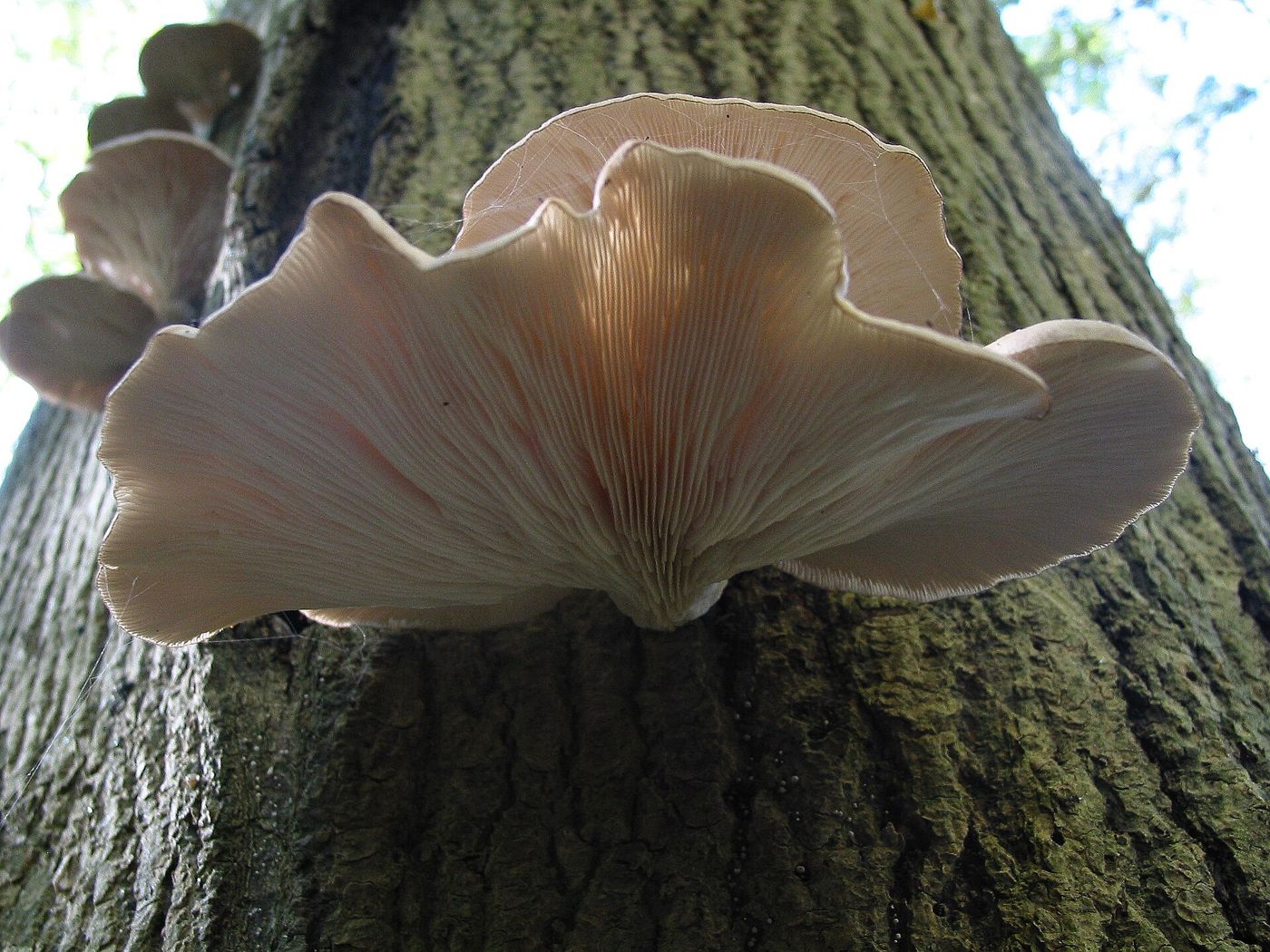
Pale, fan-shaped mushrooms on a rotting log grab the attention of almost anyone who walks past, and many people's first thought is oyster mushroom. Oysters, mainly Pleurotus ostreatus and its close relatives such as Pleurotus pulmonarius, are among the best-known wood-decaying fungi in North America, the UK, Europe and Australia. In cooler, wetter parts of the Northern Hemisphere, though, a similar fungus called angel wings, Pleurocybella porrigens, grows in the same kind of habitat at the same time of year. For a long time it was treated as a harmless look-alike. That changed after a cluster of serious poisonings in Japan, and today it is widely treated as a mushroom to avoid.
The oyster mushroom forms shelf-like or overlapping clusters on dead or dying wood, mostly broadleaf trees such as beech, oak, poplar, willow and maple. The caps are shaped like an oyster shell or fan and range from greyish-brown and slate to cream or almost white, depending on species, age and weather. The flesh is fairly thick and firm when young. The gills are white to cream and run down onto a short, off-centre stem, or onto the point where the cap joins the wood. A spore print is usually white to pale lilac-grey. Pleurotus ostreatus is mainly a cool-season fungus, appearing from autumn into winter and sometimes in early spring, while Pleurotus pulmonarius tends to show up in warmer months.
Angel wings look more delicate. Pleurocybella porrigens has pure white to slightly ivory caps that are thin, almost papery and often translucent at the edge. The caps are usually smaller than a large oyster cluster, commonly a few centimetres across, and they are shaped like an ear, a tongue or a narrow fan. There is little or no stem. The gills are narrow, crowded and white, and the spore print is also white, so a spore print alone will not separate it from an oyster. The most useful clue is the substrate: angel wings grow almost always on well-rotted conifer wood, such as hemlock, pine, spruce or fir logs and stumps. They often grow in dense rows in late summer and autumn, especially in northern and mountain forests of North America, Europe and Japan.
The concern about angel wings goes back to 2004. That autumn, a number of people in Japan developed acute encephalopathy, a serious brain illness, after eating Pleurocybella porrigens, and several of them died. Most of those affected had chronic kidney disease, but cases were also reported in people without known kidney problems. Researchers have proposed several possible toxins, and the exact mechanism is still not fully settled. Symptoms reportedly appeared days to weeks after eating, which makes the link hard to spot. Because of this history, most field guides and mycological societies now advise that angel wings should not be eaten, and older books that list it as edible should be treated with caution.
Angel wings are not the only pale fungus on wood that people mistake for oysters. In North America and Europe, the jack-o'-lantern (Omphalotus species) can form shelving clusters on buried roots or stumps, although it is usually orange. Small white or brownish oysterlings in the genus Crepidotus grow on twigs and wood but give a brown spore print. Lentinellus species look similar but have sawtooth gill edges and often a sharp, peppery taste. Some Australian Omphalotus species, including Omphalotus nidiformis, the ghost fungus, are pale cream to whitish and grow in overlapping fans on wood. They can look strikingly like oysters, they are poisonous, and they often glow faintly at night. Taken together, these look-alikes show why the rough description 'white fan on a log' is not a safe basis for identification.
Some features do help separate the two main species. Thickness of the flesh, whether the wood is broadleaf or conifer, cap colour, size, the presence of even a short stem, and the time of year all point one way or the other. None of these traits is reliable on its own, however. Oysters sometimes grow on conifers, young oysters can be thin and white, and weathered angel wings can look thicker than usual. Folk tests such as checking whether insects or animals have eaten the mushroom, peeling the cap, using a silver spoon or relying on smell do not tell you anything about safety. Only an expert who has examined the actual specimen, including the wood it was growing on, can confirm what it is. Remember too that some deadly species look like popular edible ones. If anyone becomes unwell after eating a wild mushroom, call poison control or emergency services immediately and keep a sample of the mushroom for identification.
If you find pale fan-shaped mushrooms on a log, take a few clear photos before you disturb them. Photograph the top of the cap, the gills underneath, and the point where the cap or stem base attaches to the wood. Also take a wider shot of the log or stump, and note whether it came from a broadleaf or conifer tree. Shroomly can use those photos to suggest likely species, including oysters, angel wings and the toxic look-alikes described above, and show you which features to check next. Treat the app result as a starting point, not a verdict. Before anyone even considers eating a wild mushroom, have the actual specimen confirmed by a local mycological society or an experienced expert.