


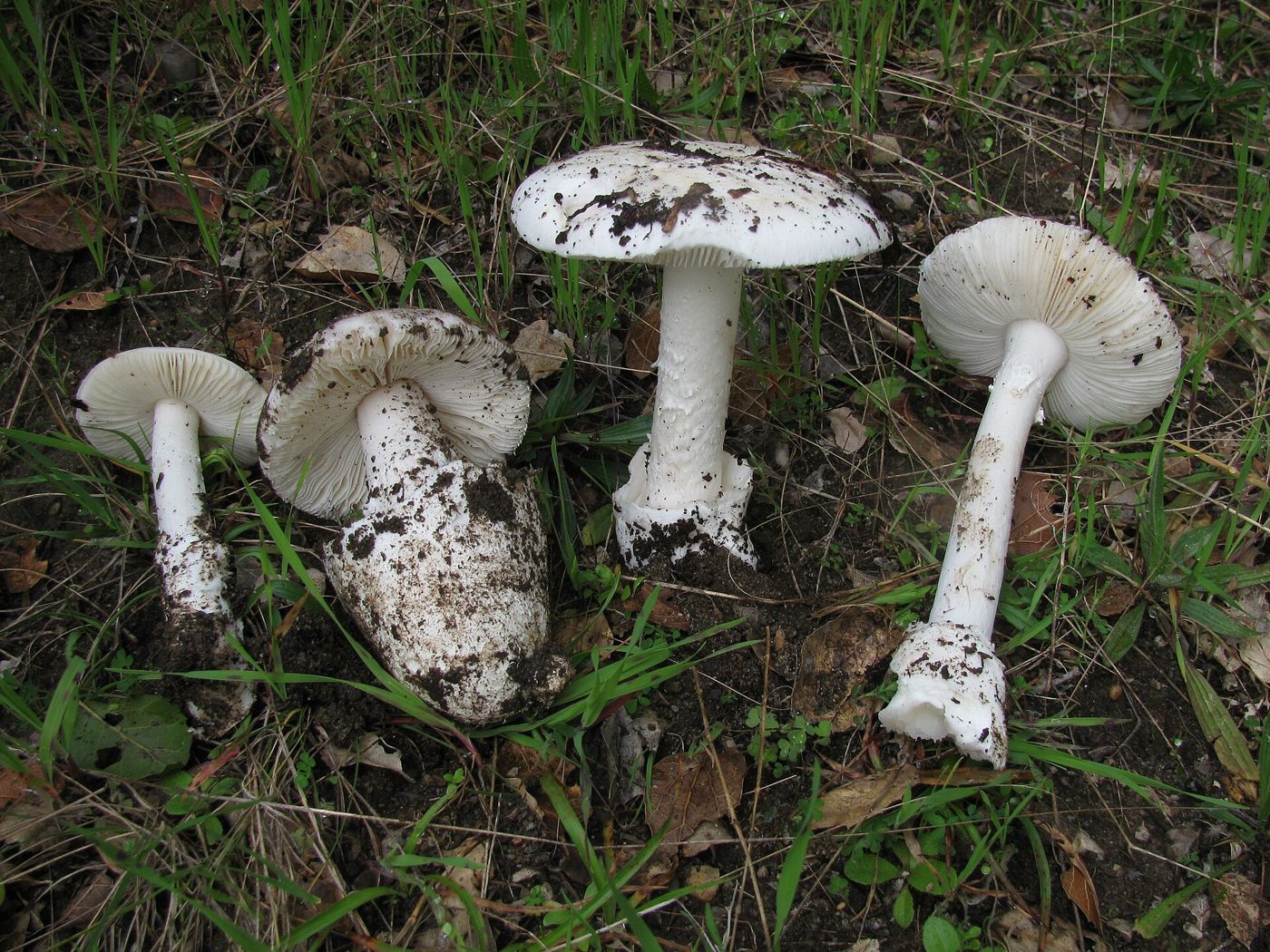
When people photograph or pick a wild mushroom, attention tends to go straight to the cap. The cap is the colorful, eye-catching part, but it is also the part that changes most with age, weather and light. The stem, which mycologists call the stipe, is often more consistent and carries several features that separate whole groups of mushrooms from one another. Field guides and experienced identifiers routinely check the stem before reaching any conclusion, and learning to do the same will make your observations far more useful, whether you are writing notes, asking an expert or using an identification app.
The single most important part of the stem is the very bottom, and it is the part most often lost. Many Amanita species, including the death cap (Amanita phalloides) and the destroying angels (Amanita virosa and Amanita ocreata), grow from a cup-like sac or a swollen bulb called a volva, which frequently sits below the soil or leaf litter. If a mushroom is snapped or cut off at ground level, that evidence stays in the ground. This is why identifiers dig gently around the base and lift the whole mushroom out. Other bases are informative too: the yellow stainer (Agaricus xanthodermus) often shows chrome-yellow flesh when the base is cut, while some species, such as the rooting shank (Hymenopellis radicata), have a long tapering root-like extension that reaches deep into the soil.
Next, look at the surface of the stem along its length. Some stems are smooth, others are covered in fine fibres, scales, powdery granules or a velvety coat. The velvet shank (Flammulina velutipes) is named for its dark, velvety lower stem. Many boletes have a raised net pattern called a reticulum on the upper stem; porcini (Boletus edulis) typically shows a pale, fine net, while the bitter bolete (Tylopilus felleus) usually has a coarser, darker net. Look also for rings and ring zones. A full skirt-like ring, a faint band of fibres, or a cobweb-like veil called a cortina all leave different traces. In webcaps (Cortinarius), the cortina often collapses into a few rusty-brown fibres on the stem once spores fall onto it, which is easy to overlook but highly informative.
The inside of the stem and the way it breaks are equally revealing. Some stems are solid and firm, some are stuffed with soft pith, and others are hollow like a straw. The shaggy ink cap (Coprinus comatus) has a hollow stem that often contains a thin, loose strand running down the middle. Brittlegills (Russula) have stems that snap cleanly, almost like a piece of chalk, because of rounded cells in their flesh, whereas many other mushrooms tear into long fibres. The fairy ring champignon (Marasmius oreades) has a notably tough, flexible stem that can be twisted without snapping. Milk caps (Lactarius) may release latex when the stem or gills are broken. Each of these traits narrows the possibilities, but none of them identifies a mushroom on its own.
Position and proportion matter as well. Most mushrooms on the ground have a central stem, but many wood-growing species, such as oyster mushrooms (Pleurotus ostreatus), have a short off-center stem or almost none at all. Note how the stem relates to the cap and gills: whether the gills stop short of the stem, attach to it, or run down it, and whether the stem is thicker at the base, the top, or evenly cylindrical. Record its color and any color changes when handled or cut, since bruising and staining reactions often appear first on the stem. Measuring the stem's length and width against the cap gives an expert a sense of the mushroom's overall shape that a top-down photo simply cannot show.
It is worth being clear about what stem features cannot do. A missing volva does not mean a mushroom is not an Amanita, because the volva may be buried, fragile or already broken away. A ring can wear off in rain. Hollow, solid, snapping or fibrous stems occur in both harmless and dangerous species, and some deadly mushrooms look very much like popular edible ones in nearly every respect. No stem trait, and no folk test such as whether a cap peels, whether an animal has nibbled it or whether it tarnishes a silver spoon, can tell you a mushroom is safe to eat. Only an expert who has examined the actual specimen can confirm edibility. If anyone has eaten a wild mushroom and you are unsure what it was, call poison control or emergency services immediately and keep a sample of the mushroom.
To get the most from the stem when identifying a find, dig the whole mushroom out rather than cutting it, then photograph it from several angles: the top of the cap, the gills or pores underneath, the full length of the stem, and a close-up of the base with any bulb, sac or root intact. A lengthwise cut through one specimen can show whether the stem is hollow and whether the flesh changes color. With those photos, Shroomly can suggest likely species and flag toxic look-alikes, giving you a much better starting point than a single cap shot. Treat that result as a lead rather than a verdict, and confirm any identification with a local mycological society or an experienced expert who can examine the specimen in person.