


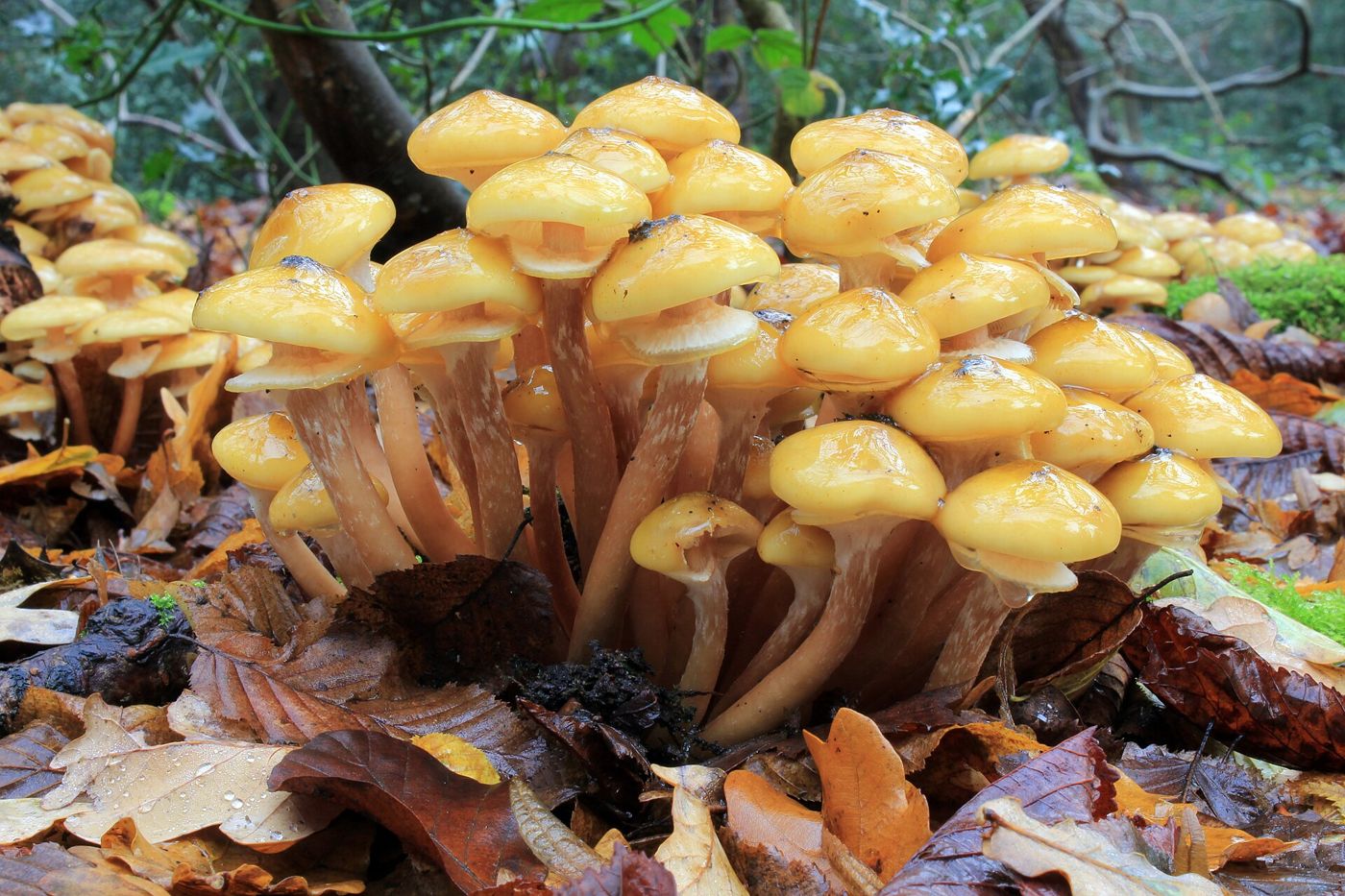
When people try to identify a mushroom, they usually focus on the mushroom itself: the cap color, the gills, the stem. Experienced mycologists look at those features too, but one of the first questions they ask is where it was growing. The material a fungus grows from, called its substrate, and the wider habitat around it are among the most informative clues available. Many fungi are specialists that only fruit on particular types of wood, in association with particular trees, or on unusual materials such as dung or burnt ground. Knowing the setting can rule out large groups of species before you even turn the cap over. It cannot, however, tell you on its own what a mushroom is or whether it is safe, and that limitation matters as much as the clue itself.
The broadest split is between mushrooms that grow on wood and those that grow from soil. Wood-decay fungi include bracket fungi such as turkey tail (Trametes versicolor) and artist's conk (Ganoderma applanatum), clustered gilled mushrooms such as honey fungus (Armillaria species) and sulphur tuft (Hypholoma fasciculare), and oyster mushrooms (Pleurotus ostreatus). Within this group it helps to note whether the wood is a living tree, a standing dead trunk, a fallen log, a stump or scattered twigs, and whether it comes from a broadleaf tree or a conifer. A common trap is buried wood: a mushroom that appears to be growing from soil may actually be attached to dead roots or a buried branch below the surface. Gently digging around the base often reveals this, and it can completely change which species are plausible.
Ground-dwelling mushrooms in woodland are frequently mycorrhizal, meaning their mycelium forms a partnership with the roots of living trees. Many of these partnerships are specific enough to be useful. Slippery jack (Suillus luteus) and saffron milk cap (Lactarius deliciosus) are associated with pines, while the death cap (Amanita phalloides) is most often linked with oaks and other broadleaf trees in Europe, and in parts of North America where it has been introduced it is commonly found with oaks and some other hosts. Because tree roots spread far beyond the trunk, note every tree species within a generous radius, not just the closest one. Learning to recognize a handful of common trees by their leaves, needles and bark is one of the most valuable skills a beginner can add to their mushroom identification toolkit.
Lawns, parks and pastures host their own set of fungi. The fairy ring champignon (Marasmius oreades), meadow and field mushrooms (Agaricus species), and puffballs are familiar grassland species, but so are dangerous ones. The ivory funnel (Clitocybe dealbata) can grow in the same rings as the fairy ring champignon, and the green-spored parasol (Chlorophyllum molybdites) is one of the most common causes of mushroom poisoning from lawns in warmer parts of North America and elsewhere. Grassland mushrooms may also be growing from buried wood or roots of nearby trees, so a mushroom in a lawn is not automatically a grassland species, and a mushroom growing in grass is never safer simply because it is in an open, familiar place.
Some fungi are found on very particular materials. Dung-loving species, such as Panaeolus and Protostropharia semiglobata, appear on or around animal droppings and manured fields. Wood chip mulch in gardens supports its own community, including Agrocybe and Stropharia species, and occasionally toxic species that arrive with the chips. Burnt ground after fires produces specialists that rarely appear elsewhere, mossy bogs host many small species tied to sphagnum, and a few fungi grow only on the rotting remains of other mushrooms. If a mushroom is on an unusual substrate, recording it carefully can be the single most helpful detail for anyone trying to name it.
Habitat narrows the possibilities, but it is never proof. The deadly funeral bell (Galerina marginata) grows on decaying wood in clusters, the same setting as the edible sheathed woodtuft (Kuehneromyces mutabilis) and alongside honey fungus, and the two can look strikingly similar. Deadly Amanita species share woodland with chanterelles and boletes. No habitat, tree association or season makes a mushroom edible, and no rule of thumb based on where something grows, whether it is on wood, in grass or near a particular tree, can rule out poisonous species. Only an expert who has examined the actual specimen can confirm what it is. If anyone has eaten a wild mushroom and you are unsure what it was, call poison control or emergency services immediately and keep a sample of the mushroom for identification.
To make the most of habitat as a clue, photograph the setting before you touch anything: a wide shot showing the substrate, nearby trees and ground cover, then close-ups of the leaves or bark of the closest trees. Then photograph the cap from above, the gills or pores underneath, and the full stem including the base, carefully excavated so any volva or root-like attachment is visible. With those images, Shroomly can suggest likely species and highlight toxic look-alikes that share the same habitat, giving you a much better starting point than a cap photo alone. Treat any app result as a lead rather than an answer, and confirm the identification with a local mycological society or an experienced expert who can examine the specimen in person.