


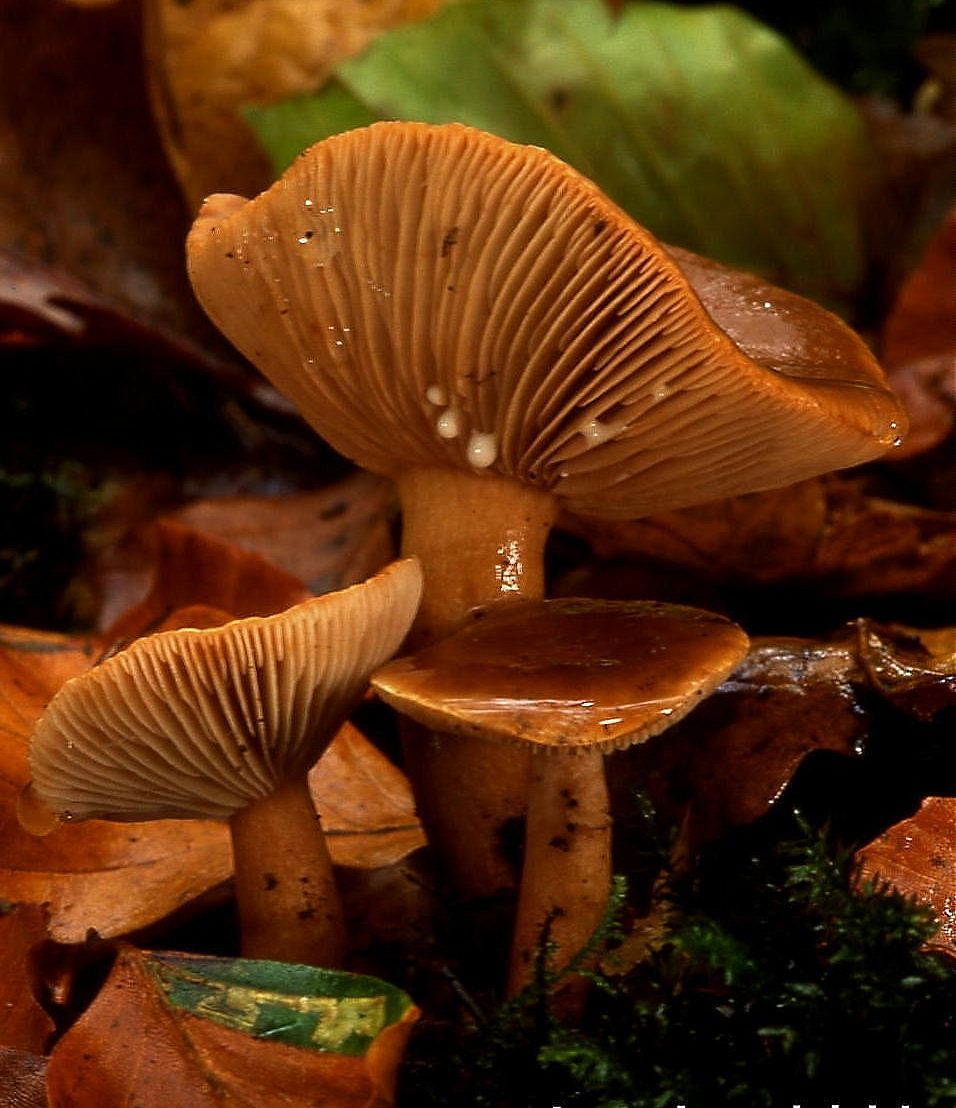
Most people turn a mushroom over, see gills and move on. To a mycologist the underside is full of detail. Gill colour, attachment to the stem and spore print colour get most of the attention. Yet several quieter features often decide between two similar species: how tightly the gills are packed, whether short gills fill the gaps, what the gill edges look like, how thick and brittle the gills are, and whether they fork or join. This guide covers each of those features, with real species as examples. None of these clues, alone or together, can tell you a mushroom is edible.
Gill spacing is usually described on a scale from crowded, through close and subdistant, to distant. Crowded gills are packed so tightly you can barely see between them. Distant gills leave obvious gaps, and you can count them easily. The fairy ring champignon, Marasmius oreades, is a classic example of distant, fairly thick gills. The toxic ivory funnel, Clitocybe dealbata, which can grow in the same lawns, has noticeably closer gills that run slightly down the stem. Many waxcaps (Hygrocybe and related genera) also have widely spaced, thick, waxy-feeling gills. Spacing changes a little as a cap expands, so compare mature specimens. It also helps to count roughly how many gills reach the stem rather than guessing.
Between the full-length gills many mushrooms have shorter gills that start at the cap edge and stop partway to the stem. Mycologists call these lamellulae. Some species have several tiers of short gills, some have very few, and some have almost none. Russula species, the brittlegills, often have few short gills, so their gills look neat and evenly spaced. Many other genera are densely packed with short gills of different lengths. This is easiest to judge by looking straight up at the underside in good light. A photograph from that angle makes it far easier for anyone helping with an identification to see the pattern.
Gill edges deserve a close look with a hand lens. In some species the edge is a different colour from the gill face. Several Mycena species have edges outlined in reddish-brown or another contrasting colour, a feature used to separate otherwise similar small bonnets. Some genera, such as Lentinellus, have edges that are distinctly saw-toothed or ragged rather than smooth. Hebeloma crustuliniforme, commonly called poison pie, often bears tiny watery droplets along its gill edges in damp weather. The weeping widow, Lacrymaria lacrymabunda, is named for the same habit. Finely fringed or whitish edges can show up even when the gills themselves are brown, so photograph them close up as well as from a distance.
Forking and cross-veining are another set of clues, and they are easy to misread. True gills are separate, blade-like plates that can usually be split from the cap. In a few groups they divide into two as they run toward the cap edge. The false chanterelle, Hygrophoropsis aurantiaca, has true gills that fork repeatedly, and some Russula species fork near the stem. True chanterelles (Cantharellus) have something different: blunt, shallow ridges that fork and are often joined by cross-veins. These ridges are part of the cap flesh rather than separate plates. Gill texture matters too. Russula gills tend to shatter like chalk when rubbed. Lactarius gills usually release latex when cut. The brown roll-rim, Paxillus involutus, has soft decurrent gills that peel away from the cap easily and bruise brown.
These features are valuable because they shrink the list of possibilities, but they have limits. Deadly species such as the death cap, Amanita phalloides, and the destroying angel, Amanita virosa, have entirely ordinary-looking white, free, fairly crowded gills. No combination of spacing, edges or forking marks a mushroom as safe. Folk ideas such as 'mushrooms with pink gills are fine' or 'forked gills mean it is a chanterelle' have led people into serious mistakes. Gills also change with age, weather and handling. Old caps can look more spaced out, wet weather can blur the edges, and slugs often chew the gills away. Only an expert who has examined the actual specimen, ideally with a spore print and its habitat noted, can confirm whether a wild mushroom is edible. Some deadly species look strikingly like popular edible ones. If anyone may have eaten a wild mushroom and you are worried, call poison control or emergency services immediately and keep a sample of the mushroom.
If you want help working out what you have found, photograph the gills properly. Take one shot straight up at the underside so the spacing and short gills are visible. Take a close-up of the gill edges, and a side view showing how the gills meet the stem. Then add clear photos of the top of the cap and the whole stem, including the base, dug out gently rather than snapped off. Shroomly can use those images to suggest likely species and flag toxic look-alikes, which helps you know which details to check next. Treat the result as a starting point, not a verdict. Confirm any identification with a local mycological society or an experienced expert who can examine the mushroom in person.