


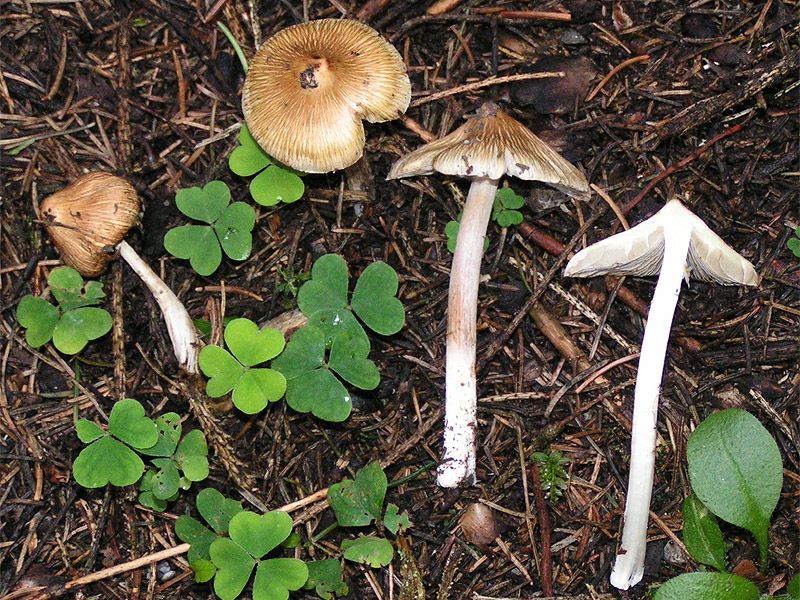
Open any field guide or mushroom identification key and one of the first questions you will meet is about the shape of the cap. Mycologists use a small, fairly standard vocabulary for this: convex, plane (flat), conical, campanulate (bell-shaped), umbonate, depressed and infundibuliform (funnel-shaped), along with a few finer terms. Learning these words makes field guides much easier to use. It also helps you describe a find clearly to an expert or a local mycological society. Cap shape alone almost never identifies a species, but combined with gills, stem, spore print, habitat and smell it rapidly cuts down the list of candidates.
The most common shape is convex, a gently domed cap like an upturned bowl, seen in young field mushrooms (Agaricus campestris) and many boletes such as porcini (Boletus edulis). Plane or flat caps are level across the top and are typical of many mature gilled mushrooms. Conical caps rise to a point, like a cone or witch's hat, and are characteristic of many fibrecaps (Inocybe species) and waxcaps such as Hygrocybe conica. Campanulate caps are bell-shaped, rounded at the top and flaring at the edge, as seen in many bonnets (Mycena) and the ink caps. Each term describes the overall profile, so it helps to look at the mushroom from the side at eye level rather than from above.
Several shapes are defined by what happens in the centre of the cap. An umbonate cap has a raised bump, or umbo, in the middle. This is a well-known feature of the parasol mushroom (Macrolepiota procera), which keeps a dark, rounded umbo even when the cap has opened out wide. A papillate cap has a smaller, sharper nipple-like point. A depressed cap sinks in the centre, and when the depression deepens until the whole cap forms a cone pointing downward it is called infundibuliform, or funnel-shaped. Funnel shapes are common in Clitocybe species, including the toxic ivory funnel (Clitocybe dealbata), and in many milk caps (Lactarius). Chanterelles (Cantharellus cibarius) often become shallowly funnel-shaped with a wavy edge as they mature.
The biggest trap with cap shape is that it changes as a mushroom grows. Many species start out egg-shaped or rounded, become convex, and finally open out flat or even turn upward at the edges. A parasol begins as a closed drumstick shape before expanding into its broad, scaly umbrella. Death caps (Amanita phalloides) and destroying angels (Amanita virosa) emerge from an egg-like universal veil, are rounded when young and flatten with age. If you only look at one stage you can easily be misled. Where you can, examine several specimens of different ages from the same patch, and record the shape you see rather than forcing it into the shape a guide says it should have.
The cap margin, or edge, carries useful detail too. Some margins are inrolled, curled under toward the gills, which is common in young milk caps and some Paxillus species. Others are striate, showing fine radial lines where the gills are visible through a thin cap, a feature of many Amanita and Mycena species. An appendiculate margin has ragged remnants of the partial veil hanging from it, and a rimose cap splits radially, as many fibrecaps do. Surface texture also matters, whether dry, slimy, scaly, fibrous or warty, as in the white patches on fly agaric (Amanita muscaria), though warts and patches can wash off in rain. None of these traits is a shortcut to safety. Small conical lawn mushrooms, for example, include Pholiotina rugosa, which contains the same amatoxins found in the death cap. Deadly and edible species frequently share the same cap shape, which is why no single feature or rule of thumb can confirm that a mushroom is edible. Only an expert who has examined the actual specimen can make that call.
For a reliable identification, treat cap shape as one entry in a full description, not the answer. Photograph the mushroom from the side so the profile is clear. Then photograph the cap from above, the gills or pores underneath, and the whole stem down to the base, carefully dug out so any volva is visible. Shroomly can use those photos to suggest likely species and flag dangerous look-alikes that share the same shape. Confirm anything you are unsure about with a local mycological society or an experienced expert who can examine the specimen in person, and never eat a wild mushroom on the strength of a photo or app result. If anyone has eaten a mushroom you cannot identify, call poison control or emergency services immediately and keep a sample of the mushroom.