


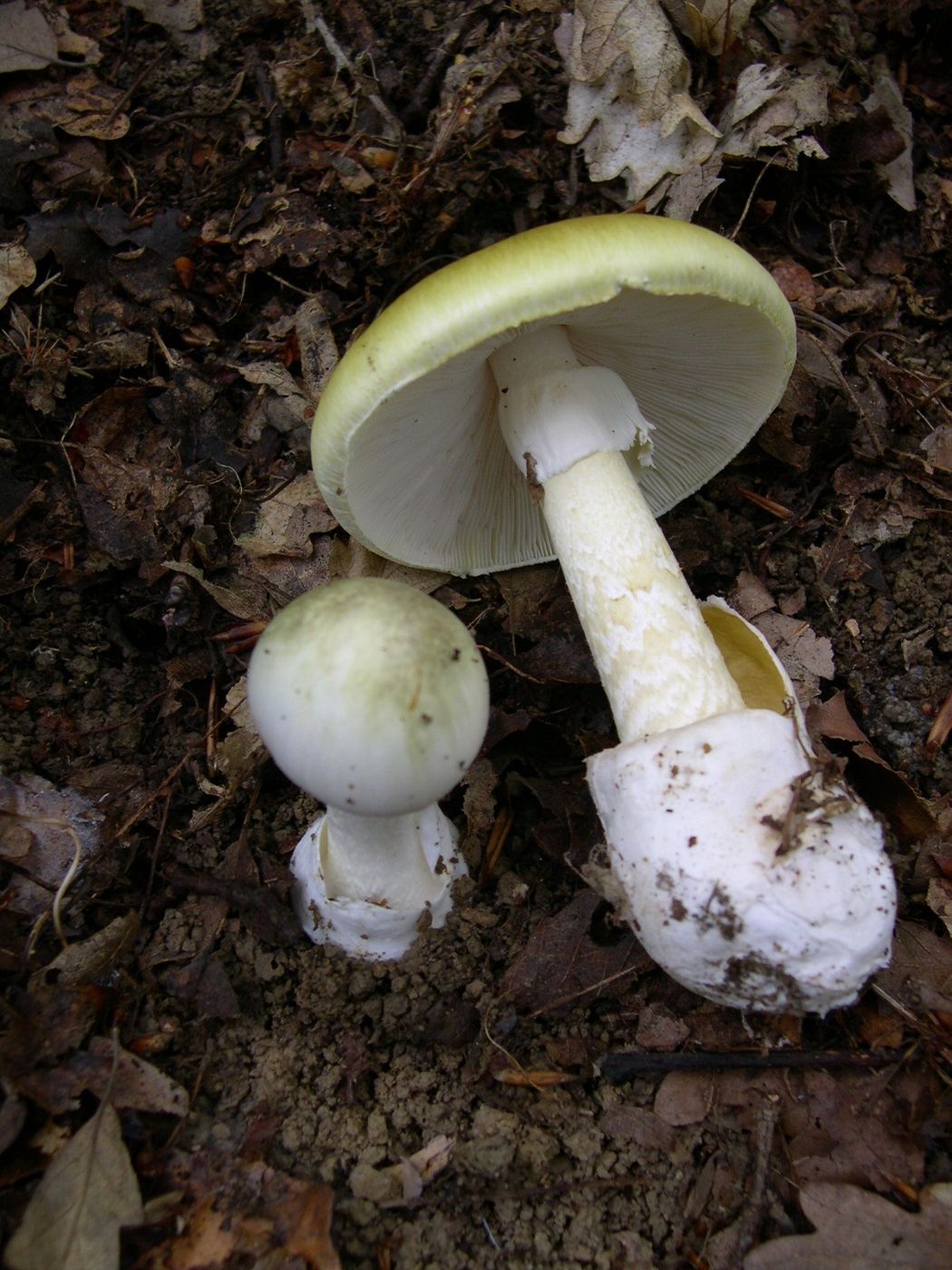
Britain has thousands of species of larger fungi, and the great majority are harmless if left alone. Only a small number are truly deadly, but those few are responsible for nearly all serious mushroom poisonings in the UK, and several of them grow in exactly the places people walk, forage and let their children and dogs play. Knowing which species carry the greatest risk, where they grow and what they can be mistaken for is one of the most useful pieces of knowledge anyone in the UK can have about fungi, whether or not they ever intend to pick a mushroom.
At the top of the list is the death cap, Amanita phalloides. It is found across much of England, Wales and parts of Scotland and Ireland, usually under oak and beech, and appears mainly from late summer through autumn. Its cap is typically olive green to yellowish or bronze, though pale and almost white forms occur, with white gills, a skirt-like ring on the stem and a bulbous base sitting in a sac-like volva that is often hidden in soil or leaf litter. It contains amatoxins, which damage the liver and kidneys, and a single cap can be enough to cause life-threatening poisoning in an adult. Its close relative the destroying angel, Amanita virosa, is pure white and carries the same toxins. It is more frequent in northern and upland areas, particularly in birch and conifer woodland, and it can be mistaken for white Agaricus mushrooms or for young puffballs when still in the egg stage.
The second deadly group in Britain is the webcaps, especially Cortinarius rubellus (sometimes called the deadly webcap) and Cortinarius orellanus (the fool's webcap). These are orange-brown to rusty, often in mossy coniferous woods for C. rubellus, and they contain orellanine, a toxin that attacks the kidneys. Their danger lies partly in delay: symptoms may not begin for several days, sometimes much longer, by which time kidney damage may already be serious. Webcaps have been mistaken for chanterelles and other orange woodland mushrooms, which is why a rusty-brown spore print and the fine cobweb-like veil on young specimens are such important warning features.
Several small brown mushrooms also contain amatoxins. The funeral bell, Galerina marginata, grows on rotting wood, often in clusters, and has been confused with edible species such as velvet shank and with psilocybin mushrooms. A number of small Lepiota dapperlings, including Lepiota brunneoincarnata and related species, also contain amatoxins; they are modest-looking mushrooms with scaly caps that turn up in gardens, parks and woodland edges, and children can easily pick them. Because these species are small and unremarkable, many people never consider them dangerous, yet they belong in the same risk category as the death cap.
Beyond the deadly species lies a larger group that causes serious, sometimes hospitalising, poisoning. The panther cap, Amanita pantherina, contains ibotenic acid and muscimol and is generally regarded as more potent than the familiar fly agaric, Amanita muscaria. Fibrecaps (Inocybe species) and the white lawn and grassland funnels Clitocybe dealbata and Clitocybe rivulosa contain muscarine, which causes heavy sweating, salivation, blurred vision and slowed heart rate, and the white funnels often grow alongside the edible fairy ring champignon. Other well-known offenders include the livid entoloma (Entoloma sinuatum), the yellow stainer (Agaricus xanthodermus), sulphur tuft (Hypholoma fasciculare) and the brown roll-rim (Paxillus involutus), which can trigger a dangerous immune reaction after repeated meals. The false morel, Gyromitra esculenta, is found mainly in Scottish pinewoods and is also seriously toxic.
None of these species can be ruled out using folk tests. A silver spoon will not blacken, a peelable cap means nothing (the death cap peels easily), a pleasant smell or mild taste proves nothing, and the fact that slugs, squirrels or rabbits have nibbled a mushroom says nothing about its safety for people, dogs or cats. Cooking, drying and freezing do not destroy amatoxins or orellanine. Only an experienced expert who has examined the actual specimen, including the stem base and spore colour, can judge whether a mushroom is edible, and even then several of the deadliest British species closely resemble popular edibles. If anyone, including a child or a pet, may have eaten a wild mushroom, call 999 or NHS 111 immediately, or contact a vet for an animal, and keep a sample of the mushroom, ideally whole and wrapped in paper, to help with identification. Do not wait for symptoms to appear.
If you want to know what is growing in your garden or local woods, start by photographing it carefully: the top of the cap, the gills or pores underneath, the full stem and especially the base, gently uncovered from the soil so any volva is visible, along with the surrounding trees or wood it is growing on. Shroomly can use those photos to suggest likely species and flag toxic look-alikes such as the death cap, destroying angel or webcaps, which helps you understand what you might be dealing with. Treat that result as a starting point, not a verdict on edibility, and confirm any identification with a local fungus group, a member of the British Mycological Society network or another qualified expert who can examine the mushroom in person.