


North America has thousands of mushroom species, and the great majority are not deadly. A small group, however, is responsible for most of the serious poisonings and nearly all of the fatal ones in the United States and Canada. Most of the deadliest share one chemical feature: they contain amatoxins, heat-stable toxins that damage the liver and kidneys. Cooking, drying and freezing do not destroy amatoxins, and symptoms typically do not begin until roughly six to twelve hours or more after eating, by which time the toxin has already been absorbed. Knowing which species to fear, where they grow and what they get mistaken for is one of the most useful pieces of safety knowledge anyone in North America can have, whether they forage, garden or simply have children and pets who play outdoors.
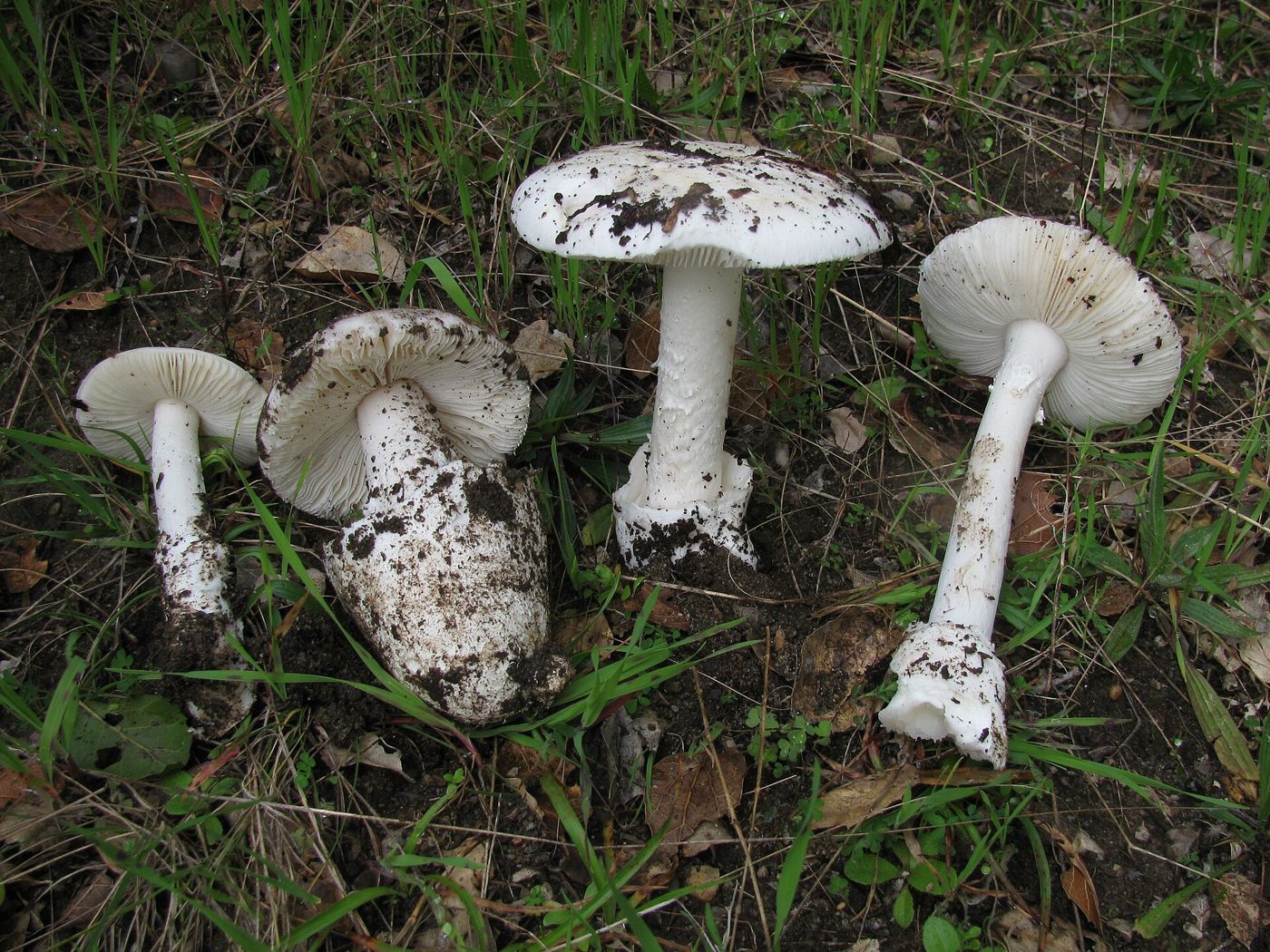
The death cap, Amanita phalloides, is the most notorious. It is not native to most of North America; it appears to have arrived on the roots of imported trees and is now well established along the Pacific coast, especially in California and parts of the Pacific Northwest and British Columbia, with scattered records in the Northeast. It usually grows under oaks and other hardwoods, including planted trees in parks and yards. The cap is often greenish to yellowish olive but can be pale or almost white, the gills are white, there is usually a skirt-like ring on the stem, and the base sits in a white, sac-like volva that is frequently buried in soil or leaf litter. Death caps have been confused with paddy straw mushrooms, field mushrooms and young puffballs, and poisonings in the West have repeatedly involved people who recognised similar-looking edible species from elsewhere in the world.
The destroying angels are just as dangerous and are native. In eastern North America the pure white Amanita bisporigera and its close relatives grow in mixed woods from summer into autumn, while the western destroying angel, Amanita ocreata, appears mainly in California and nearby areas in late winter and spring, often under coast live oak. Both are white or nearly white with white gills, a ring that may be fragile or missing, and a cup-like volva at the base. Young unopened specimens can resemble button mushrooms or puffballs, which is why cutting any white egg-shaped mushroom lengthwise is an important check rather than a guarantee. The funeral bell, Galerina marginata, is a small brown mushroom that grows on rotting wood across the continent and contains the same amatoxins; it is easily mixed up with edible wood-growing species and with psychoactive Psilocybe mushrooms. Several small Lepiota species, sometimes called dapperlings, also contain amatoxins and turn up in lawns, gardens and woodland edges.
Other North American mushrooms are dangerous in different ways. False morels in the genus Gyromitra, including Gyromitra esculenta, contain gyromitrin, which breaks down into a compound that can affect the nervous system and liver; they grow in spring alongside true morels and have caused serious and occasionally fatal poisonings. In the Pacific Northwest, Amanita smithiana has caused kidney damage in people who mistook it for the prized matsutake. Some webcaps (Cortinarius) contain orellanine, a kidney toxin with an especially long delay before symptoms, although confirmed poisonings from these are less common in North America than in Europe. The green-spored parasol, Chlorophyllum molybdites, is not usually deadly, but it is a very common lawn mushroom in many warmer regions and is frequently reported as a cause of severe vomiting and diarrhoea, sometimes requiring hospital care, particularly when mistaken for edible parasols.
A further group causes fast-onset but generally less lethal illness. The jack-o'-lantern mushrooms (Omphalotus illudens in the East and Omphalotus olivascens in the West) are bright orange clusters on wood or buried roots that are regularly mistaken for chanterelles and cause intense gastrointestinal upset. Small white Clitocybe species such as Clitocybe dealbata and many fibrecaps (Inocybe) contain muscarine, which can cause sweating, salivation, tears and slowed heart rate. Amanita muscaria and Amanita pantherina contain ibotenic acid and muscimol, which can cause confusion, agitation, drowsiness and other neurological effects, and are especially concerning for children and pets. None of these should be treated as harmless simply because they are not usually fatal.
Folk tests will not protect you from any of these species. A silver spoon does not darken in the presence of toxins, peeling the cap tells you nothing, a pleasant smell or mild taste is no guide, and the fact that a squirrel, slug or deer has eaten part of a mushroom says nothing about its safety for people. Death caps are reported by some survivors to have tasted good. The only reliable approach is to never eat a wild mushroom unless an experienced expert has examined the actual specimen in hand and confirmed its identity, remembering that some deadly species closely resemble popular edible ones. If anyone, child or adult, may have eaten a wild mushroom, call poison control (in the US, Poison Help at 1-800-222-1222; in Canada, your provincial poison centre) or emergency services immediately, even if they feel fine, and keep a sample of the mushroom, ideally whole and wrapped in paper. For pets, contact a veterinarian or animal poison helpline right away. Do not attempt home treatment and do not wait for symptoms to appear.
If you find a mushroom in your yard, a park or the woods and want to know whether it could be one of these dangerous species, start with good photographs. Capture the top of the cap, the gills or pores underneath, and the full stem including the base, carefully dug up so any volva or bulb is visible, along with notes on what it was growing on and which trees were nearby. Shroomly can analyse those photos and suggest likely species, along with the toxic look-alikes you need to rule out, which helps you understand what you are looking at and how much caution it deserves. An app result is a starting point, not a verdict on edibility, so take the specimen to a local mycological society or a qualified expert for confirmation, and treat any mushroom you cannot positively identify as potentially deadly.