


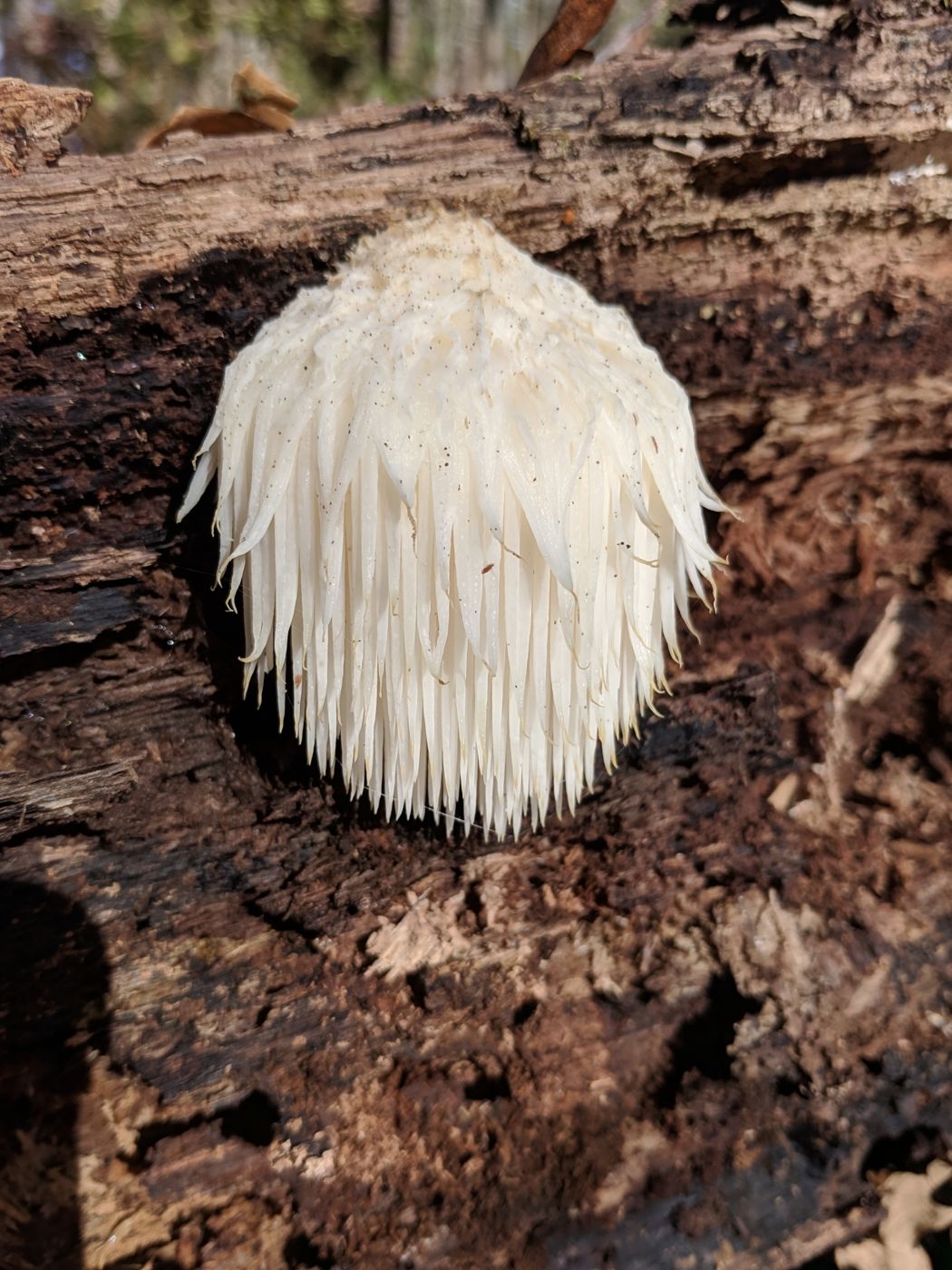
Few fungi are as striking as the tooth fungi in the genus Hericium. Instead of gills or pores, they release spores from soft, icicle-like spines that hang downward from the fruiting body. Because these white, shaggy growths appear on dead or wounded trees and are hard to miss, people often photograph them and search for names like lion's mane, bear's head or coral tooth. These are related species that share the same basic design but differ in how their spines are arranged, and learning those differences is a good exercise in reading the overall structure of a mushroom rather than relying on color alone.
Lion's mane, Hericium erinaceus, is the species most people have heard of. It forms a single rounded or teardrop-shaped mass attached to the wood at one point, with no visible branches. From this cushion hang long, crowded spines that can reach several centimeters, giving the whole thing the look of a white pom-pom, a beard or a frozen waterfall. It usually grows on hardwoods, especially oak and beech, often from wounds, cracks or old pruning cuts high on a trunk as well as on fallen logs. Fruiting is mostly late summer through autumn in temperate regions. Fresh specimens are white to cream and become yellowish or tan with age. It is found in North America, Europe and parts of Asia, but in the United Kingdom it is considered rare and is legally protected, so picking it there is not permitted.
Bear's head tooth, Hericium americanum, is found mainly in eastern North America and looks quite different on close inspection. Rather than a single solid cushion, it grows from a branching base, and its long spines hang in clusters from the ends of the branches, a bit like a bundle of white tassels. From a distance a large specimen can resemble lion's mane, which is why the two are often confused, but if you look underneath or from the side you will usually see the branched framework. In the western United States and Canada, Hericium abietis plays a similar role on conifers such as fir and hemlock, forming large branched clusters with fairly long spines.
Coral tooth fungus, Hericium coralloides, sits at the other end of the spectrum. It is an intricate, delicate structure of many fine branches, with short spines lining the undersides of the branches rather than hanging in long clumps at the tips. The overall effect is lacy and coral-like rather than shaggy. It grows on dead hardwood logs and stumps, often beech in Europe, and occurs across much of the Northern Hemisphere. In Europe, the tiered tooth, Hericium cirrhatum, adds another variation, forming overlapping shelf-like tiers with spines hanging from the underside, which can make it look more like a bracket fungus than its relatives.
Beyond the Hericium species themselves, a few other fungi can cause confusion. Some tooth fungi, such as the northern tooth Climacodon septentrionalis, form tough, overlapping shelves with spines underneath on living maples and other hardwoods, and they feel leathery rather than soft. Old, weathered polypores or crust fungi can also look pale and shaggy in a blurry photo. Checking whether the fungus is soft and fleshy or tough and woody, whether it has true spines rather than pores or gills, and whether it is branched or unbranched will narrow things down considerably. A white spore print is consistent with Hericium but is not proof on its own, because many unrelated fungi also drop white spores.
Hericium species have a reputation for being easy to recognize, and lion's mane is widely grown commercially and sold as a supplement, but that reputation should not translate into casual foraging. Edibility can never be confirmed from a photograph, an app result, a single trait or a rule of thumb such as whether animals have nibbled it. Only an expert who has examined the actual specimen can confirm an identification, and it is worth remembering that across the fungal world some deadly species closely resemble popular edible ones. Wood-growing fungi can also be old, waterlogged or colonized by other organisms, and specimens in the UK and some other regions may be protected by law, so leaving them in place is often the right choice. If anyone becomes unwell after eating a wild mushroom, call poison control or emergency services immediately and keep a sample of the mushroom for identification.
If you come across a white, spiny fungus on a tree or log and want to know what it is, a few good photographs make all the difference. Shroomly can suggest likely species from a picture, so photograph the whole fruiting body from the side, the underside where the spines hang, and the point where it attaches to the wood, and note the type of tree if you can. Shroomly will show likely matches along with look-alikes worth ruling out, including toxic ones where relevant. Treat the result as a starting point for learning, then confirm it with a local mycological society or an experienced expert who can examine the specimen in person.