


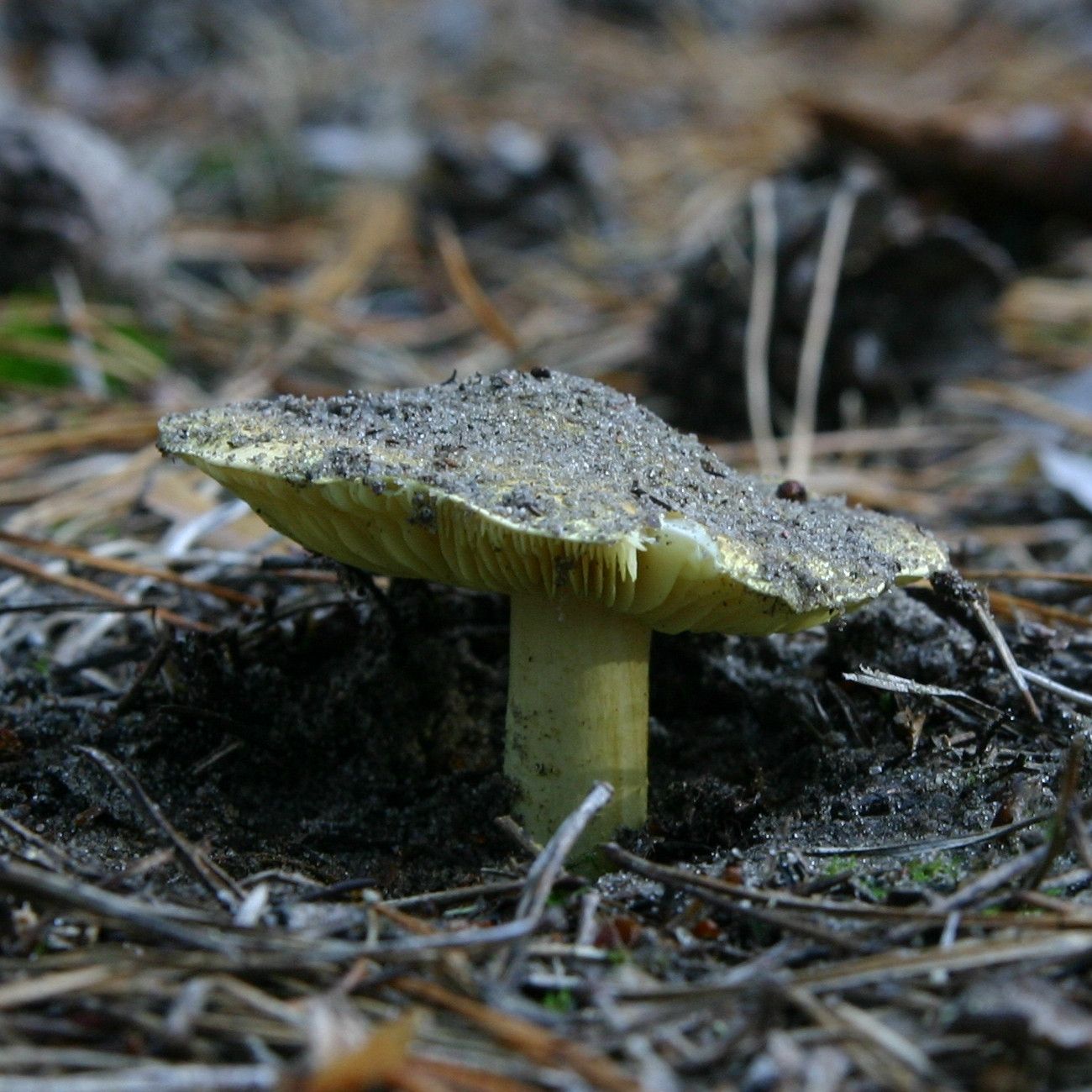
Tricholoma equestre, commonly called the Yellow Knight, is a yellow‑colored gilled mushroom that for decades was collected and eaten in parts of Europe. Interest and controversy around this species grew after case reports in the late 1990s and 2000s described people developing severe muscle damage (rhabdomyolysis) and, in rare instances, kidney injury after eating large quantities. Those reports prompted many mycologists and public health bodies to recommend caution or avoidance, even though the mechanism and frequency of dangerous reactions are not fully understood.
In the field, the Yellow Knight is usually medium‑sized with a convex to slightly depressed yellow cap, yellow gills that may bruise slightly darker, and a stipe that is the same general color as the cap. It typically grows in coniferous or mixed woodlands in late summer and autumn, often in fairy rings or scattered on the forest floor. However, appearance alone is not reliable for determining identity; several other Tricholoma species and unrelated yellow brown mushrooms share similar color and shape, and regional taxonomy can be confusing. Spore print color, microscopic features and habitat details are commonly used by experts to separate look‑alikes.
Because of the poisoning reports, modern guidance is conservative: do not assume a mushroom is safe to eat based on traditional use, bright color, animals eating it, or simple tricks like peeling the cap. Some countries have effectively removed Tricholoma equestre from recommended edible lists, while others note that individual susceptibility, preparation, or misidentification could explain past poisonings. Importantly, there is no widely accepted, simple field test that proves a Yellow Knight is safe to eat, and some people may react unpredictably even to species generally regarded as edible.
If you find a yellow Tricholoma or a similar mushroom, take careful notes and photographs rather than tasting. Record the cap shape and surface, gill attachment and spacing, any bruising or color change when handled, the stem base (volva or rooting), odors, surrounding trees, and whether they appear in rings. A complete identification ideally includes a spore print and, for tricky groups, microscopic examination of spores and tissues. Even with good documentation, only a local expert or mycologist who can examine the actual specimen should confirm identity and edibility.
When edibility is discussed, be explicit: an app, a photo, or a single trait cannot guarantee safety. Never rely on folk tests such as checking whether insects eat a mushroom, tasting a tiny bit, or using household items to test for toxins. Because some species can cause delayed, serious effects (like rhabdomyolysis) that require hospital care, anyone who suspects mushroom poisoning—after eating or even handling a wild mushroom—should contact emergency services or poison control immediately and keep a sample of the mushroom for identification.
If you want help narrowing down what you found, photograph the cap from above, a close-up of the gills or pore surface, the stem including the base (pull gently or excavate if it’s safe to do so), and the habitat and surrounding trees. Upload those images to Shroomly for likely species suggestions and possible toxic look‑alikes, then confirm any identification and edibility questions with your local mycological society or an experienced forager who can inspect the physical specimen.