


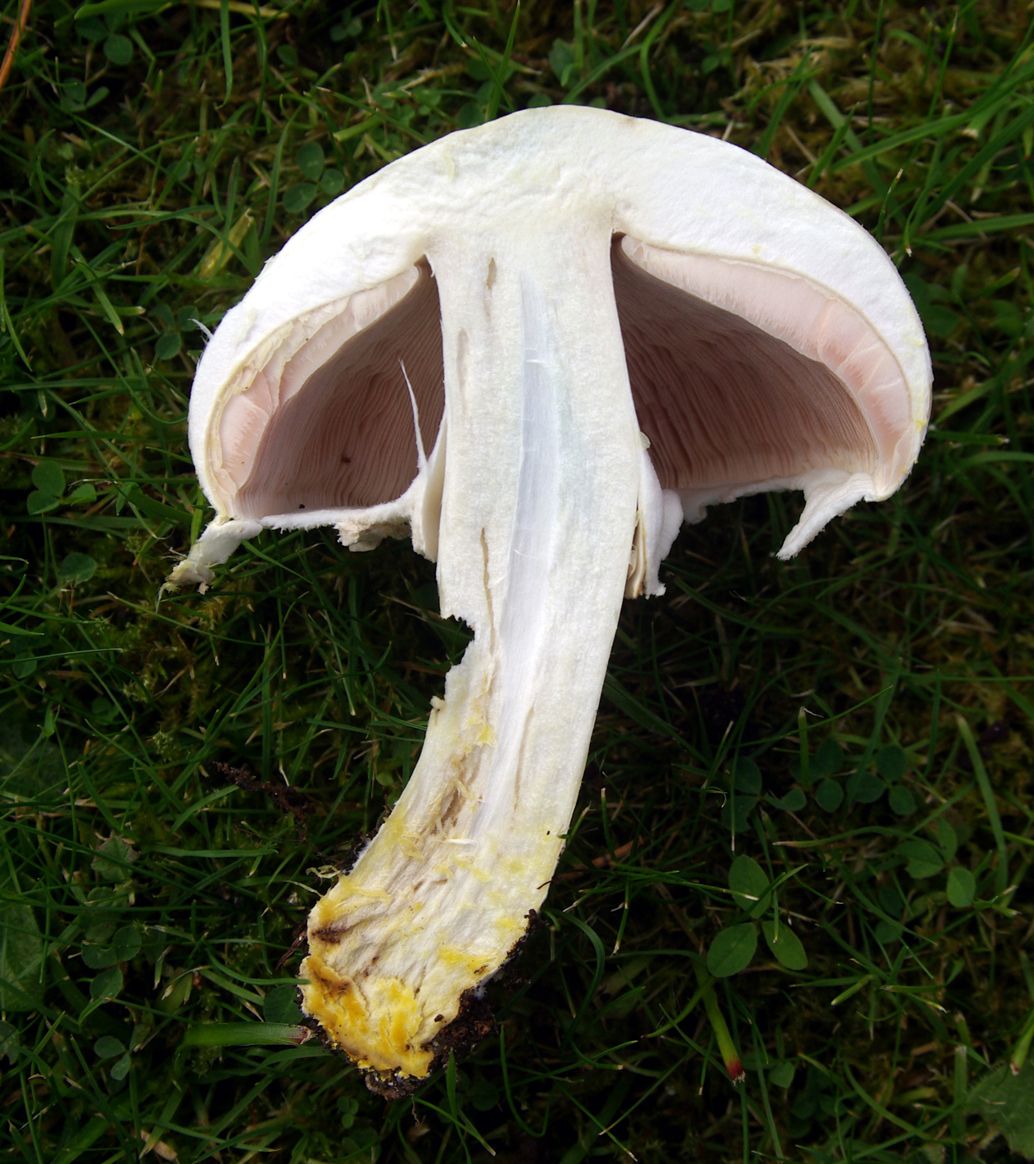
The yellow stainer, known scientifically as Agaricus xanthodermus, is a widely distributed mushroom that regularly catches foragers and suburban homeowners off guard. Across North America, Europe, Australia, and New Zealand, this species thrives in manicured environments where people least expect to encounter hazardous fungi, including backyard lawns, public parks, roadsides, and landscaped garden beds. Its appearance strongly mimics popular edible species within the Agaricus genus, such as the wild field mushroom (Agaricus campestris) and the horse mushroom (Agaricus arvensis), as well as common store-bought button mushrooms. Because it grows abundantly in open grassy areas where edible field mushrooms often appear, it consistently accounts for a significant percentage of wild mushroom poisoning calls received by emergency rooms and poison centers every autumn.
Ingesting the yellow stainer leads to acute gastrointestinal illness caused by toxic phenolic compounds and diazo derivatives present in the fungal tissues. Symptoms generally develop rapidly, usually appearing between thirty minutes and two hours after consumption. Affected individuals experience violent stomach cramps, persistent nausea, profuse vomiting, and watery diarrhea. In some cases, victims also report severe headaches, dizziness, profuse sweating, and visual disturbances. While poisonings from Agaricus xanthodermus are rarely fatal in healthy adults, the dehydration, electrolyte loss, and physical strain can cause serious complications, especially in young children, elderly adults, or individuals with pre-existing gastrointestinal conditions. Individual susceptibility varies, meaning two people eating the same preparation can experience different levels of discomfort, but the mushroom contains genuine toxins and must never be considered edible.
Distinguishing the yellow stainer from harmless white mushrooms requires inspecting the entire fungal fruiting body, particularly the base of the stem. When the yellow stainer is scratched or bruised, its flesh turns a vibrant, vivid chrome-yellow. While some edible Agaricus species can show faint, slow-developing yellow blushes across the cap surface, the yellow stainer exhibits an immediate, intense yellow stain concentrated at the extreme bulbous base of the stipe. To observe this reaction accurately, one must carefully excavate the intact mushroom from the ground and slice cleanly through the bottom of the stem. Within seconds, the inner tissue of a fresh yellow stainer flashes bright canary yellow, though this vivid color frequently fades to a dull, muddy brown after several minutes of exposure to air.
Scent provides another critical diagnostic warning sign when evaluating Agaricus xanthodermus. While edible field and horse mushrooms carry a mild, pleasant fungal fragrance, often accompanied by sweet notes of aniseed or fresh almond, the yellow stainer produces a harsh, chemical odor. Mycologists frequently describe this smell as reminiscent of carbolic acid, hospital disinfectant, ink, or tar. The chemical aroma may be subtle in fresh, damp outdoor air, but heating makes it unmistakable. When cooked, the heat volatizes the phenolic compounds, filling the kitchen with an overwhelming, acrid medicinal stench that ruins the dish. Unfortunately, relying on the stove as a safety filter is dangerous because cooking does not neutralize or destroy the gastrointestinal toxins, and breathing concentrated fumes can trigger nausea on its own.
Widespread folk rules regarding mushroom safety fall completely apart when applied to the yellow stainer. Popular myths claim that any mushroom consumed by snails, slugs, or insects is safe for humans, yet wild wildlife routinely feeds on Agaricus xanthodermus without showing any adverse effects. Other folklore suggests that peeling the outer skin of the cap removes poisonous properties or that boiling fungi with a silver coin will reveal toxins by tarnishing the metal, but both claims are scientifically baseless and dangerously misleading. The chemical irritants in the yellow stainer saturate every layer of the fungal cap, gills, and stem. If you or someone you know has consumed a mushroom suspected of being a yellow stainer, do not wait for symptoms to manifest and do not attempt home treatments. Contact poison control or your local emergency medical services immediately, and preserve a whole, fresh raw sample in a dry paper bag so a toxicologist or hospital mycologist can make an accurate identification.
Learning to identify wild fungi safely requires a rigorous, systematic process that examines every single physical feature of a specimen rather than a casual glance. Before drawing conclusions about any wild Agaricus, take sharp, detailed photographs showing the top of the cap, the color and spacing of the gills, and the fully excavated base of the stem. Uploading clear photos to Shroomly allows the app to analyze key anatomical details, provide likely species matches, and flag toxic look-alikes such as the yellow stainer. Because subtle physiological differences can mean the difference between an ordinary specimen and a severe poisoning, always confirm any wild mushroom find with an experienced local mycologist or regional mycological society before handling or eating any wild harvest.