


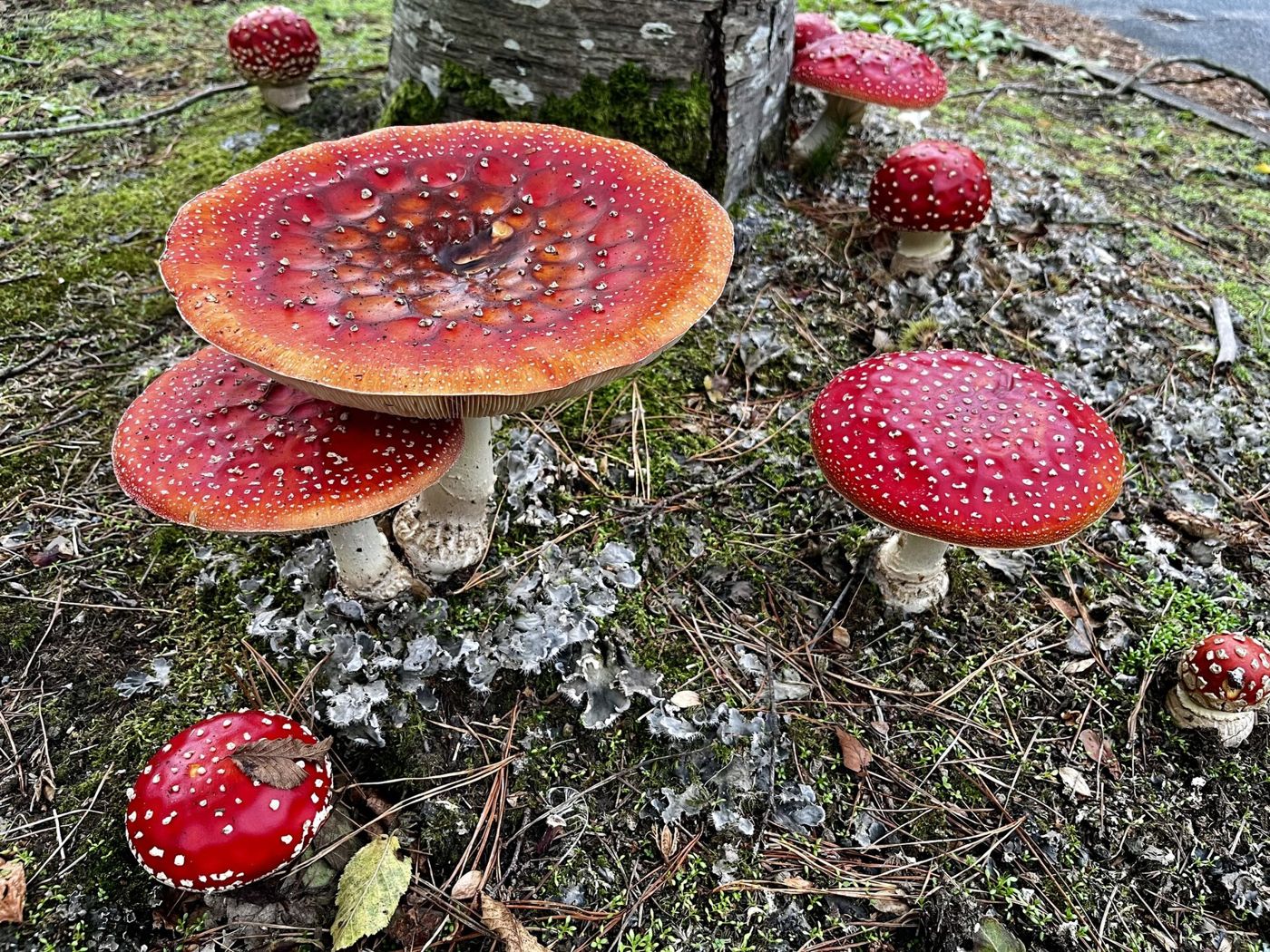
The panther cap, Amanita pantherina, is one of the more dangerous mushrooms in temperate woodlands, yet it gets far less attention than its famous red relative, the fly agaric. Both belong to the genus Amanita and share the same main toxins, ibotenic acid and muscimol, which act on the brain and nervous system. In the panther cap these compounds are usually more concentrated, so poisonings tend to be more severe. It is not in the same category as the death cap, whose amatoxins destroy the liver, but it can make a person or pet seriously ill, and severe cases need hospital care. Searches for this mushroom often come from people who have found a brown, white-spotted toadstool in a park or garden and want to know whether it is a threat to children or dogs. The short answer is that it should be treated as poisonous.
Typical panther caps have a cap that is brown to olive-brown or greyish-brown, usually a few centimetres to around ten centimetres across, scattered with small, pure white warts that are remnants of the universal veil. The margin is often finely grooved. The gills are white and free from the stem, the spore print is white, and the white stem carries a thin ring that can be fragile or slip away with age. The most telling feature is at the very base: a rounded bulb topped by a neat, narrow rim, sometimes described as a collar or gutter, with one or two faint rings just above it. Because this detail sits underground, people who snap a mushroom off at soil level lose one of the best clues. The species grows in association with trees, especially beech, oak and conifers, and fruits from summer into autumn. It is widespread in Europe and parts of Asia, while many brown, white-warted Amanitas in North America that were once called panther caps are now treated as separate but similarly toxic species.
The danger lies partly in its look-alikes. The blusher, Amanita rubescens, is collected for the table by some experienced European foragers, and the grey spotted amanita, Amanita excelsa, is also brown with pale patches. The blusher's flesh and bruises slowly turn pinkish-red, and its warts tend to be greyish or pinkish rather than bright white, while the grey spotted amanita has a grooved ring and a less defined bulb. These differences are real but subtle, they vary with age and weather, and rain can wash warts off any of these caps entirely. A washed-out panther cap can even resemble other brown mushrooms with no obvious Amanita features. This is exactly why mycologists advise beginners to avoid brown Amanitas altogether, and why only an expert who has examined the actual specimen, including the intact stem base, can confirm an identification. Some deadly Amanitas, such as the death cap, also share the white gills and bulbous base, so any Amanita-like mushroom deserves serious caution.
Symptoms of panther cap poisoning usually begin relatively quickly, often within thirty minutes to a few hours of eating it. People may experience dizziness, poor coordination, confusion, agitation, hallucinations or delirium, sometimes alternating with heavy drowsiness or a sleep-like state. Nausea and vomiting can occur but are not always prominent. In more serious cases, particularly in children and in people who have eaten a large amount, there can be muscle twitching, seizures and loss of consciousness. Deaths are rare, but they have been reported, and the unpredictability of the toxin levels from one mushroom to the next means there is no such thing as a safe amount. Because the effects resemble intoxication, some poisonings come from people deliberately experimenting, which is a genuinely risky choice with this species.
Dogs are especially vulnerable. Panther caps and their relatives grow in parks, woodland edges and wooded gardens where dogs roam, and veterinary reports describe dogs with tremors, wobbling, disorientation, vomiting and seizures after eating them. Cats and other pets can be affected as well. If you know or suspect that a person has eaten a panther cap or any wild mushroom, call poison control or emergency services immediately, and for a pet call your vet or an animal poison line straight away. Do not wait to see whether symptoms develop and do not attempt home treatment. If possible, keep a sample of the mushroom, ideally a whole one including the base, wrapped in paper, as this can help professionals work out what was eaten.
Folk rules offer no protection here. Peeling the cap, checking whether a silver spoon darkens, smelling the mushroom or noticing that slugs or squirrels have nibbled it will not tell you whether it is safe; animals regularly eat fungi that are poisonous to humans, and the panther cap has no reliable warning smell or taste. Cooking does not make it safe either. The practical approach is to treat any brown mushroom with white warts, white gills and a bulbous base as a probable toxic Amanita, keep children and pets away from it, and remove fruiting bodies from play areas while wearing gloves if you are concerned.
If you want to know what is growing in your garden or local woods, a careful photo is a good place to start. Dig up the whole mushroom so the bulb and its rim are intact, then photograph the top of the cap, the gills underneath, the ring and the stem base in good light. Shroomly can suggest likely species from those photos and flag toxic look-alikes such as the panther cap, blusher and death cap, helping you understand what you might be dealing with. Treat that result as a starting point rather than a verdict on edibility, and confirm any identification with a local mycological society or an experienced expert who can examine the specimen in person.