


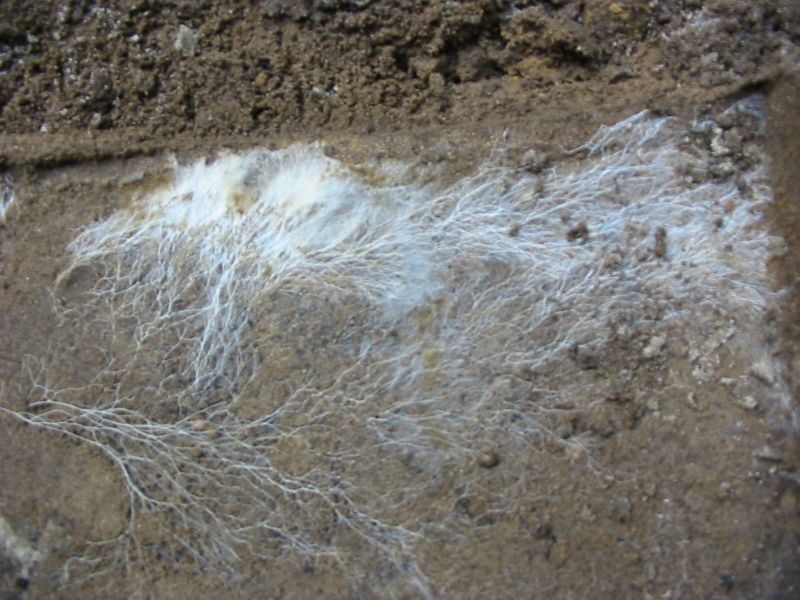
If you have ever found fuzzy green patches on a forgotten loaf of bread and, a few days later, spotted a mushroom pushing up through the lawn, you have met two members of the same kingdom. Mold and mushrooms are both fungi, organisms that are neither plants nor animals and that feed by releasing digestive enzymes into their surroundings and absorbing the dissolved nutrients. The word mold is not a formal scientific category, though. It is an everyday label for fungi that grow as visible, often fuzzy or powdery colonies on surfaces such as food, damp walls, leather or leaf litter. Mushroom is also an informal term, used for the larger, fleshy fruiting bodies that certain fungi produce to release spores. Understanding where the two overlap, and where they part ways, explains a great deal about how fungi live.
The deepest similarity is the way both grow. Almost all molds and mushroom-forming fungi are built from hyphae, microscopic tubular threads that branch and spread through whatever they are feeding on. A mass of these threads is called mycelium. When you see a mold colony, you are largely looking at mycelium growing on the surface, along with the spore-bearing structures it raises into the air. With a mushroom-forming fungus, the mycelium usually stays hidden inside soil, wood or compost, and you may never notice it until conditions are right for it to fruit. The cell walls of both are strengthened with chitin, the same tough material found in insect shells, which is one of the features that sets fungi apart from plants, whose cell walls are made mainly of cellulose.
The biggest visible difference lies in reproduction. Common molds such as species of Penicillium, Aspergillus and the black bread mold Rhizopus stolonifer typically produce enormous numbers of spores on tiny stalks or in small sacs right on the colony surface. Many of these spores are made asexually, essentially clones of the parent, and they are so small and light that they drift through the air almost everywhere, which is why mold appears on food so readily. Mushroom-forming fungi invest instead in a larger, organized structure. The cap, gills, pores or spines of a mushroom are elaborate spore-producing surfaces, and a single cap can release spores in vast quantities, often after two compatible mycelia have joined in a sexual process. In other words, a mold colony is mostly the fungus itself on display, while a mushroom is a temporary reproductive organ of a fungus whose main body lies out of sight.
The family tree is more tangled than the everyday words suggest. Most familiar mushrooms with gills or pores, such as Agaricus and Boletus species, belong to the group called Basidiomycota. Many molds, including Penicillium and Aspergillus, belong to Ascomycota, but so do morels, truffles and cup fungi, so some molds are more closely related to a morel than a morel is to a field mushroom. Rhizopus sits in a different lineage again. To complicate things further, a few organisms called molds are not fungi at all. Slime molds are amoeba-like organisms in a separate group, and water molds, including the organism behind the Irish potato famine, Phytophthora infestans, are oomycetes, which are more closely related to certain algae. So while all true molds are fungi, not everything nicknamed a mold is one.
These overlaps show up in practical ways. Mold can grow on mushrooms themselves, both store-bought ones and wild ones. Shop-bought mushrooms that have turned slimy or developed fuzzy growth are best thrown away rather than salvaged. In the wild, some fungi parasitize other mushrooms; species of Hypomyces, for example, can cover a bolete or a milk cap in a yellow, white or orange crust, changing its colour and texture so much that the original host can no longer be reliably identified. A mushroom altered this way should never be treated as safe simply because the host was thought to be a familiar species. Indoors, the two often point to the same underlying cause: mold on walls and mushrooms sprouting from carpets or skirting boards both signal persistent moisture, and the lasting fix is to find and correct the damp rather than just wiping away what you can see.
It is also worth remembering that molds and mushrooms both play essential roles outdoors. Together with bacteria, fungi are among the planet's main recyclers, breaking down fallen leaves, dead wood and other organic matter and returning nutrients to the soil. Many mushroom-forming fungi also live in partnership with tree roots, trading minerals and water for sugars. Molds gave medicine penicillin, first noticed by Alexander Fleming in a Penicillium contamination, and fungi of various kinds are used to make bread, cheese and other foods under controlled conditions. That usefulness does not extend to the wild, however. Neither molds nor wild mushrooms can be judged safe by appearance, smell, or by the fact that animals or insects have nibbled them, and some deadly mushrooms closely resemble popular edible ones. Only an expert who has examined the actual specimen can confirm whether a wild mushroom is edible.
If a mushroom has appeared in your garden, your house or on a woodland walk and you want to know what it is, start with good photographs. Capture the top of the cap, the underside showing the gills, pores or spines, and the full stem right down to its base, digging gently if needed so any cup or sac at the bottom is visible. Shroomly can then suggest likely species and flag toxic look-alikes, helping you understand what you are looking at and how fungi like it live. Treat any app result as a starting point for learning, not a verdict on edibility, and confirm identifications with a local mycological society or an experienced expert who can examine the specimen in person. If anyone may have eaten a wild mushroom, call poison control or emergency services immediately and keep a sample of the mushroom for identification.