


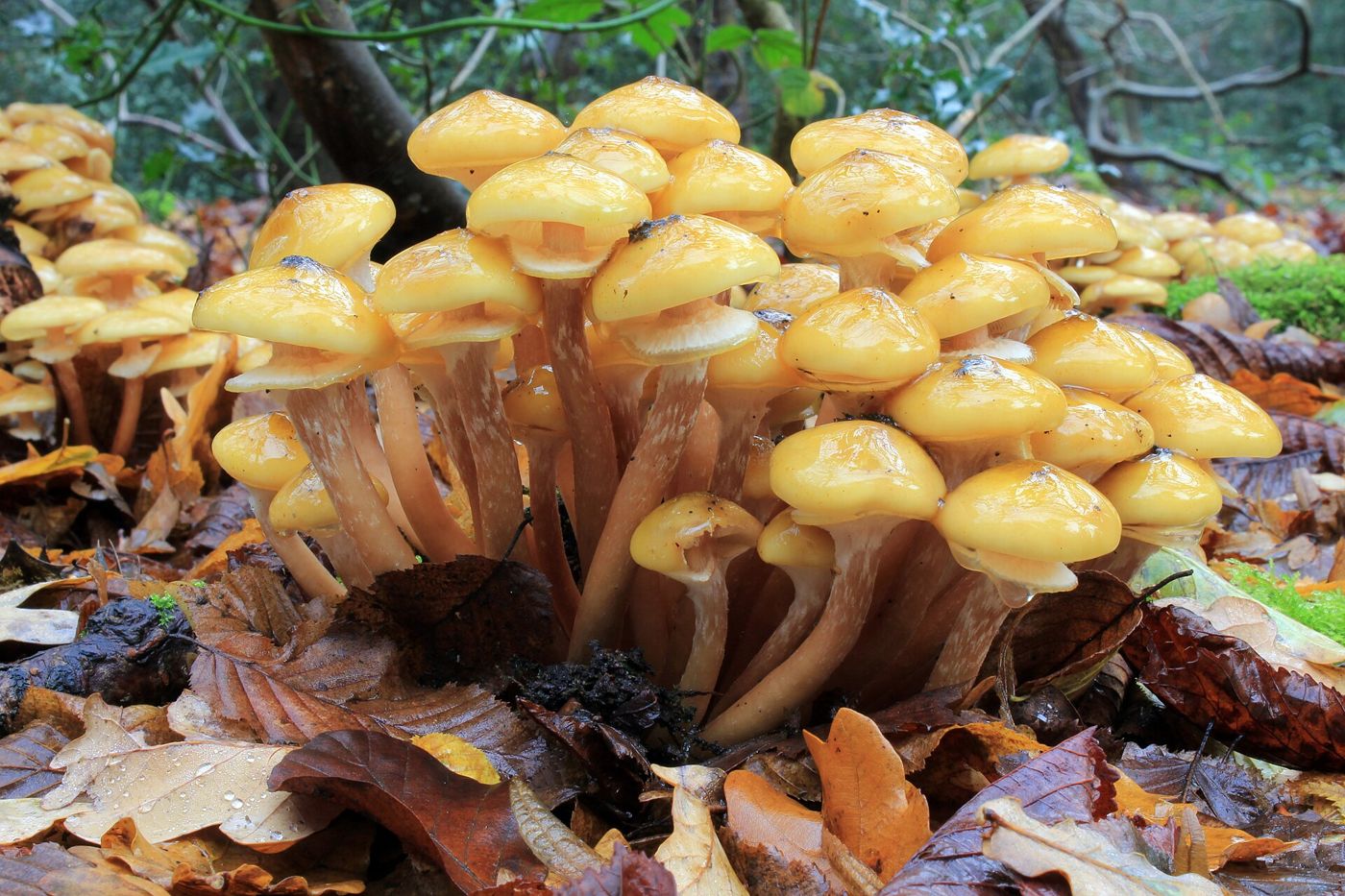
Honey fungus is one of the most frequently searched mushrooms in autumn. That makes sense, because it is hard to miss: dense clusters of honey-yellow to tawny-brown caps erupt from stumps, dead roots and the bases of living trees, often by the dozen. Gardeners know it as a destructive root-rot pathogen. Foragers know it as a mushroom that appears in some traditional cuisines. So is it poisonous? The honest answer is that it sits in an uncomfortable middle ground. It is not considered deadly in the way the death cap is, but it is well documented to make some people ill. It also grows in the same places and the same shapes as species that can kill.
The name honey fungus covers more than one species. Armillaria mellea is the classic one in Europe and parts of North America. Close relatives include Armillaria gallica, Armillaria ostoyae and the ringless Desarmillaria tabescens (formerly Armillaria tabescens), and Australia has its own native Armillaria luteobubalina. Typical features include a convex to flattening cap, often with fine darker scales or hairs concentrated near the centre. The gills are whitish to cream and often become spotted with age, and many species have a cottony ring on the stem. The spore print is white to pale cream. Under loose bark or in the soil you may find black, bootlace-like cords called rhizomorphs, which the fungus uses to spread from root to root. Fruiting is usually late summer through autumn in the Northern Hemisphere and roughly autumn to early winter in Australia, typically after rain.
On edibility, the problem is reliability. Honey fungus is widely reported to cause gastrointestinal reactions such as nausea, vomiting, cramps and diarrhoea in some people. This is especially true when it is eaten raw or undercooked, but some people react even when others at the same table do not. Because several closely related species are lumped under the common name, and because individual sensitivity varies, there is no simple way to predict who will react. Field guides that list it as edible usually attach warnings, and many mycologists advise beginners to leave it alone entirely. That caution is not a judgement on the fungus. It reflects how often people get it wrong or react badly.
The far greater risk is misidentification. The funeral bell, Galerina marginata, is a small brown mushroom that also grows in clusters on wood, can have a ring on the stem, and contains amatoxins, the same liver-destroying toxins found in the death cap. Symptoms of amatoxin poisoning are often delayed by many hours, by which time serious damage may be under way. The key difference is spore print colour: Galerina leaves a rusty brown print, while honey fungus leaves a white to cream one. Even so, a mixed basket can contain both, and a single deadly mushroom among dozens of harmless ones is enough to cause tragedy. Other look-alikes include sulphur tuft (Hypholoma fasciculare), which has greenish-yellow gills, a purple-brown spore print and causes gastrointestinal poisoning. There is also shaggy scalycap (Pholiota squarrosa), with coarse upturned scales and a brown spore print. In North America, the orange jack-o'-lantern mushrooms (Omphalotus species) also grow in clusters at tree bases.
Folk tests do nothing to separate these species. A silver spoon will not change colour near a toxic mushroom, and a cap that peels easily proves nothing. A pleasant smell is no guarantee, and slugs, squirrels or deer eating a mushroom tell you nothing about its safety for people. Cooking does not destroy amatoxins. Nor does growing on wood make a mushroom safe, since the funeral bell is a wood-rotter too. If anyone has eaten a wild mushroom and you are unsure what it was, call poison control or emergency services immediately, even if they feel fine. Keep a sample of the mushroom, or what is left of it, to help with identification.
For gardeners, honey fungus brings its own concerns. Its appearance around a tree or shrub can signal Armillaria root rot, which kills many woody plants, especially those already stressed. Removing the mushrooms will not stop the infection, because the main body of the fungus lives in the roots, stumps and soil as mycelium and rhizomorphs. White fan-shaped sheets of mycelium under the bark at the base of a dying plant are a strong clue. An arborist or plant health specialist can confirm a diagnosis and advise on managing affected trees.
If you come across a cluster of brown mushrooms on a stump or at the foot of a tree, the most useful thing you can do is document it well. Photograph the top of the cap and the gills underneath. Include the stem with any ring, and the very base where it meets the wood, along with the whole cluster in its setting. Shroomly can then suggest likely species, including honey fungus and dangerous look-alikes such as the funeral bell, so you know which features to check next, such as a spore print. An app suggestion is a starting point, not a verdict on edibility. Before anyone even considers eating a wild mushroom, take the actual specimen to a local mycological society or an experienced expert who can examine it in person.