


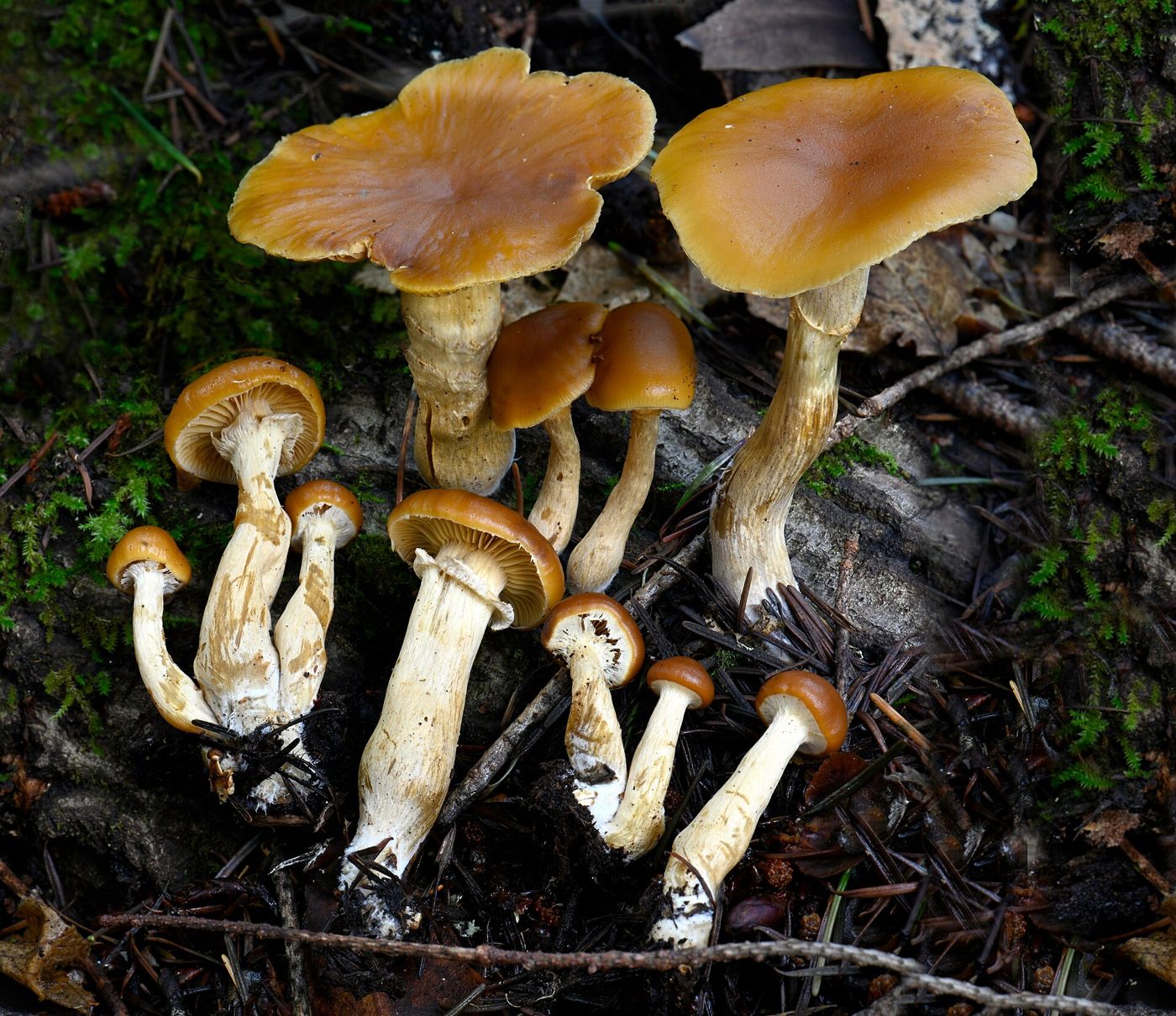
Most people picture deadly mushrooms as large, striking species like the death cap. Yet one of the more worrying toxic fungi in gardens across North America, Europe and other temperate regions is a tiny, fragile brown mushroom that is easy to step over without noticing. Long known as Conocybe filaris and now generally placed in the genus Pholiotina as Pholiotina rugosa, it contains amatoxins, the group of toxins responsible for most fatal mushroom poisonings worldwide. Because it fruits in lawns, flower beds, mulch and landscaped wood chips, it turns up exactly where toddlers play and dogs sniff around, which is why it deserves far more attention than its size suggests.
Pholiotina rugosa is small and slender. The cap is usually only a centimetre or two across, conical to bell-shaped when young and flattening with age, and coloured in shades of tan, ochre or rusty brown, often paler as it dries. The gills are pale at first and turn rusty brown as the spores mature, and the spore print is rusty brown. The thin, fragile stem is the most useful clue: unlike many tiny lawn mushrooms, it typically carries a small membranous ring partway up, which can be movable or can wear away in older specimens. It tends to appear in damp weather in spring and autumn, often in scattered groups in mulch, wood chips, rich soil and grass.
The trouble is that this description fits many other little brown mushrooms. In a typical lawn you might find Conocybe species such as the white dunce cap (Conocybe apala), mottlegills in the genus Panaeolus, Psathyrella species, haymakers (Panaeolina foenisecii) and Galerina species, some of which also contain amatoxins. People searching for psilocybin mushrooms in grass or wood chips have been warned by mycologists about exactly this kind of confusion, since a rusty-spored mushroom with a ring can be mistaken for something else by an inexperienced eye. Separating these species reliably often requires spore prints, microscopy and specialist knowledge, and even experienced amateurs routinely treat small brown lawn mushrooms as unidentifiable without closer study.
Amatoxins are dangerous because of how they act and when symptoms appear. They damage liver and kidney cells by blocking a key step in protein production, and cooking, drying or freezing do not destroy them. Symptoms usually do not begin until roughly six to twenty-four hours after eating, starting with severe vomiting, diarrhoea and abdominal pain. These can ease for a while, creating a false sense of recovery while liver damage continues. Because Pholiotina rugosa is so small, how much it takes to cause serious harm is not well established, but children and pets are much smaller than adults and the toxin is potent, so any suspected ingestion should be treated as an emergency. If a child, adult or animal may have eaten one, call poison control, a vet or emergency services immediately, do not wait for symptoms, and keep a sample of the mushroom, ideally wrapped in paper, so it can be identified.
For households with young children or dogs, the practical approach is vigilance rather than panic. Walk the garden after rain, especially in fresh mulch and wood chip beds, and remove small mushrooms wearing gloves, bagging them for the bin rather than the compost if you want to keep them away from curious pets. Teach children never to put any wild mushroom in their mouth, and supervise dogs that tend to graze. Fungicides are rarely effective because the fungus lives as mycelium spread through organic material, and new mushrooms can reappear whenever conditions are damp. No folk test will tell you whether a little brown mushroom is safe: silver spoons, peeling caps, smell, taste or seeing an animal eat it say nothing about amatoxins. Only an expert who has examined the actual specimen can confirm what it is, and no small brown lawn mushroom should ever be eaten on the strength of a guess.
If you find small brown mushrooms in your lawn or mulch and want to know what they might be, a good photograph makes all the difference. Capture the cap from above, the gills underneath, the full stem including any ring, and the very base where it emerges from the soil or wood chips, then let Shroomly suggest likely species and flag toxic look-alikes such as amatoxin-containing Pholiotina and Galerina. Treat the result as a starting point for caution, not a verdict on safety, and confirm any identification with a local mycological society or an experienced expert who can examine the mushroom in person.