


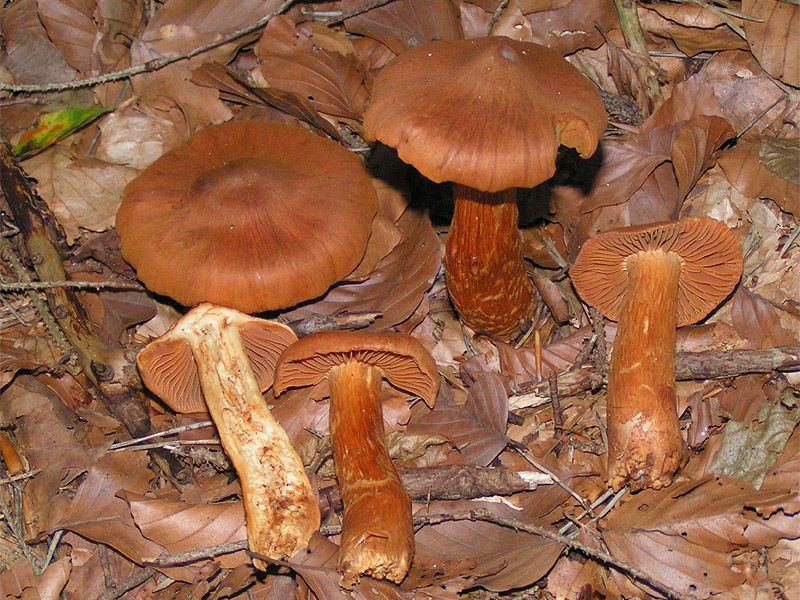
If you walk through almost any woodland in autumn, in North America, Britain, Europe or Australia, you will probably pass a webcap. The genus Cortinarius is the largest group of gilled mushrooms known. It contains thousands of described species, and mycologists keep naming new ones. They range from small brown caps hidden in moss to sturdy, slimy, violet or yellow mushrooms several inches across. Most are mycorrhizal, meaning they form partnerships with the roots of trees such as birch, pine, spruce, oak, beech and eucalyptus, so you usually find them on soil near trees rather than on wood. Because webcaps are so common and so varied, learning to recognise the genus is one of the most useful skills in mushroom identification. Some of the most dangerous mushrooms in the world are webcaps.
The single most important feature is the one that gives the group its name: the cortina. This is a partial veil made of fine, silky threads that looks like a cobweb. It stretches from the cap edge to the stem in young mushrooms and protects the developing gills. As the cap expands, the cortina tears and largely disappears. It often leaves only a faint ring of fibres around the upper stem, or a few threads hanging from the cap margin. Mature spores drop onto those fibres and stain them rusty brown, and that rusty zone on the stem is a strong clue even after the veil itself has gone. The catch is that you need young specimens to see a cortina clearly. An older mushroom with no visible veil can still be a webcap.
The second key feature is spore colour. Cortinarius species produce a rusty brown to cinnamon brown spore print. The gills often show this change as the mushroom matures. Young gills can be pale, violet, yellow, olive or reddish. As the spores ripen, they turn a characteristic rust or cinnamon brown. A purple mushroom with violet gills may therefore look nothing like a webcap at first glance, yet develop rusty gills and drop a rusty print a few days later. A spore print taken on white paper, or on paper that is half white and half black, takes only a few hours. It is one of the best ways to separate webcaps from similar-looking mushrooms with white, pink, purple-brown or black spores.
Beyond the veil and spores, webcaps vary enormously, and experienced foragers use several other features to sort them into broad groups. Some have slimy or sticky caps and stems. Some have a stem base swollen into a bulb with a distinct rim, called a marginate bulb. Many smaller brown species are hygrophanous, meaning the cap changes colour noticeably as it dries out. Colour of the cap, gills and flesh matters, and so do any colour changes when the mushroom is cut, the smell, and which trees are nearby. Even with all of this, many webcaps cannot be named to species in the field. Specialists frequently need a microscope to examine spores, and some species can only be separated reliably with DNA sequencing. That is not a failing of the forager. It is simply the reality of this genus.
This difficulty matters because some webcaps are seriously toxic. Cortinarius rubellus, the deadly webcap, and its relative Cortinarius orellanus contain orellanine. This toxin damages the kidneys, and symptoms are notoriously delayed: they often do not appear until several days after eating, sometimes two or three weeks later. By then serious kidney damage may already have happened, and some victims have needed long-term dialysis or a kidney transplant. These rusty orange-brown mushrooms have been mistaken for chanterelles and other edible species. Other webcaps are confused with wood blewit (Lepista nuda), which has a pale pinkish spore print rather than a rusty brown one. Webcaps also have look-alikes with similar brown spores. These include the deadly funeral bell (Galerina marginata), which grows on wood, the toxic fibrecaps (Inocybe species), the poisonous poisonpies (Hebeloma species) and the rusty-spored Gymnopilus species found on wood. Because of these overlaps, no webcap should ever be eaten on the strength of a photo, an app result or a single feature. Cutting a mushroom open, smelling it or seeing an animal nibble it tells you nothing about orellanine. Only an expert who has examined the actual specimen can make any judgement about edibility, and even experts generally treat the whole genus with great caution. If anyone has eaten a mushroom that might be a webcap, call poison control or emergency services immediately, even if they feel completely well. Keep a sample of the mushroom for identification.
To identify a possible webcap safely, start with good observation. Try to find several specimens at different ages, so you can see a young one with an intact cobweb veil as well as a mature one with rusty gills. Photograph the top of the cap, the gills from below, the full stem including any ring zone, and the base of the stem after carefully digging it out, so a bulb or rim is visible. Note the nearby trees as well. Take a spore print, and record any slime, smell or colour change. Then upload your photos to Shroomly, which can suggest likely genera and species and flag toxic look-alikes such as deadly webcaps, funeral bells and fibrecaps so you know what to rule out. Treat that result as a starting point, not a verdict. Confirm any identification with a local mycological society or an experienced expert who can examine the mushroom in person.