


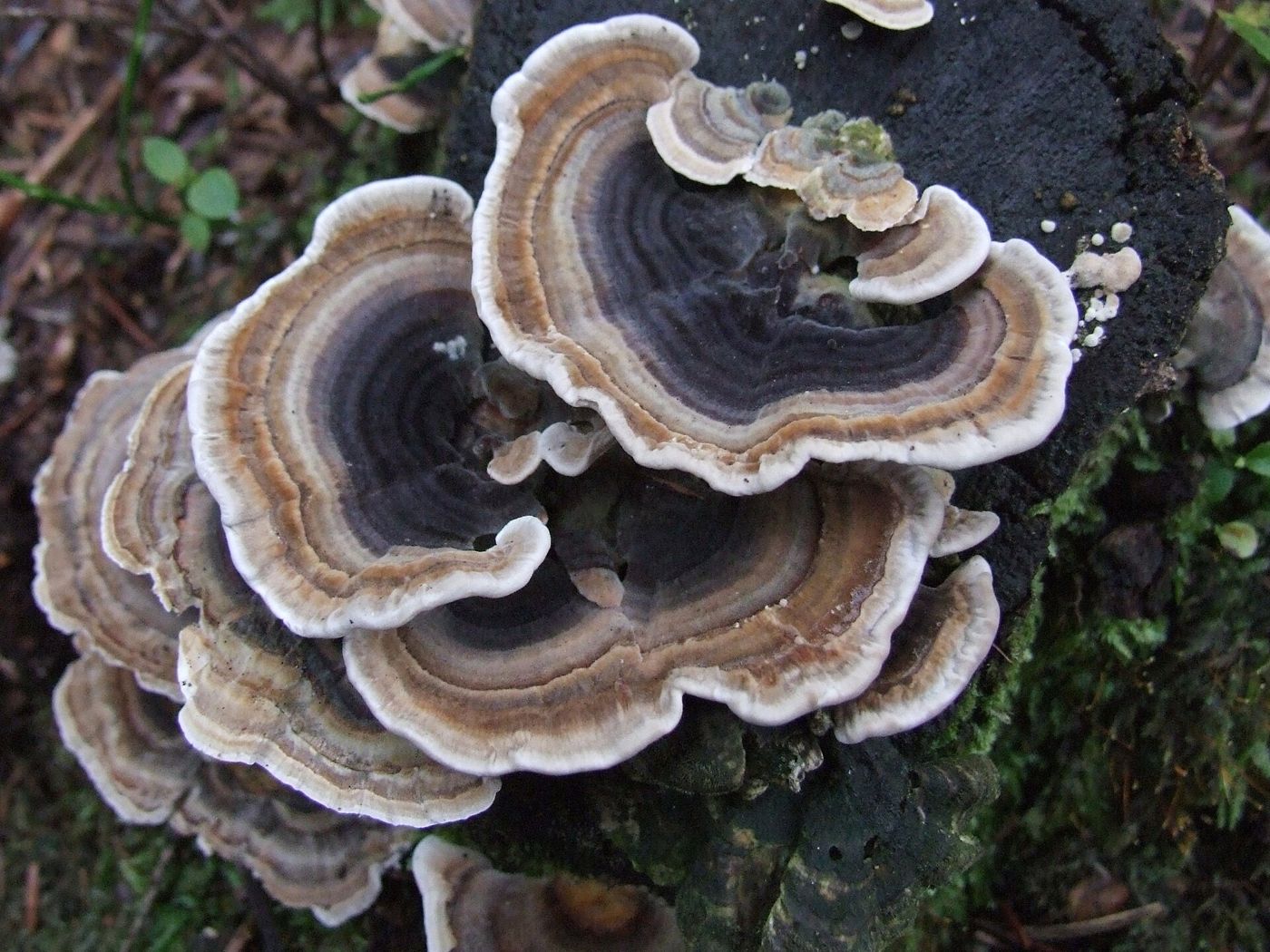
Turkey tail, known scientifically as Trametes versicolor, is one of the most widely distributed and frequently encountered bracket fungi in the world. Found throughout North America, Europe, Asia, and Australasia, this wood-decaying polypore earns its common name from the striking fan of concentric, multicolored bands that spread across its upper cap, closely resembling the spread tail feathers of a wild turkey. Because of its conspicuous beauty and widespread popularity among naturalists and foragers, many woodland walkers are eager to spot it. However, distinguishing true turkey tail from several superficially similar shelf fungi requires careful observation of several distinct physical traits.
The cap of a genuine turkey tail is typically semicircular, fan-shaped, or rosette-like, measuring between two and ten centimeters across, and growing in dense, overlapping tiers along rotting wood. When fresh, the brackets are remarkably thin—usually only one to three millimeters thick—and notably flexible rather than rigid or woody. The upper surface is divided into sharply defined concentric bands displaying an astonishing spectrum of colors, including shades of chestnut brown, buff, cream, cinnamon, rusty orange, slate blue, and grey. Crucially, the surface has a fine, velvety texture composed of tiny hairs, known botanically as tomentum, which alternate in texture across the distinct colored rings, giving the cap a distinctly fuzzy feel under a fingertip.
While the top surface is visually captivating, the most definitive identification feature of Trametes versicolor lies on its underside. Turkey tail is a polypore, meaning its spore-producing surface is comprised of thousands of microscopic, rounded pores rather than gills or a smooth membrane. On a fresh turkey tail, this fertile pore surface is pure white, ivory, or pale cream, discoloring slightly to a light buff or yellowish-grey as it ages, but never turning dark brown or orange. These pores are remarkably tiny—typically numbering between three and eight pores per millimeter—meaning you may need to look closely or use a hand lens to distinguish individual openings. If the underside is completely smooth, has gills, or features tooth-like spines, the fungus is not a true turkey tail.
In terms of habitat and seasonality, turkey tail is a strictly saprotrophic species that feeds on dead organic matter, playing a vital ecological role by breaking down lignin in fallen timber. It grows almost exclusively on decaying broadleaf hardwoods such as oak, beech, birch, and maple, and is only rarely found on coniferous wood. Although Trametes versicolor can be spotted at any time of year because its tough, fibrous fruiting bodies resist winter decay, active growth occurs following wet spells in late summer and autumn. Older specimens lingering into spring often become faded, bleached by sunlight, or colonized by green algae, making seasonal context and fresh growth helpful clues for accurate identification.
Foragers and naturalists must be wary of several look-alikes that share the banded, fan-shaped appearance of turkey tail. The most common doppelganger is false turkey tail (Stereum ostrea and allied Stereum species), which displays similarly zoned, colorful upper caps but belongs to the crust fungus family; turning it over reveals a completely smooth, poreless underside that immediately distinguishes it from Trametes. Another look-alike is the violet toothed polypore (Trichaptum biforme), which features a purple-tinted margin when fresh and an underside that quickly breaks down into jagged, tooth-like serrations rather than clean circular pores. Other related bracket fungi, such as Trametes hirsuta (the hairy bracket) or Trametes ochracea, are noticeably thicker, stiffer, and lack the rich multicolor zoning characteristic of Trametes versicolor.
Whenever people encounter wild bracket fungi, questions about safety and edibility inevitably arise. True turkey tail has a tough, leathery texture that makes it unpalatable for normal culinary use, though many people harvest it for decorative purposes or water extractions. It is critical to understand that folk rules—such as assuming that shelf fungi growing on wood are universally harmless, or that unpleasant smells indicate poison—are dangerous myths with no basis in fungal biology. A variety of wood-inhabiting bracket fungi can cause severe gastrointestinal distress, and ingesting old, moldy, or contaminated wild fungi can lead to serious illness. Never attempt to consume any wild-harvested mushroom based solely on photographs or generalized descriptions; only an experienced expert who has physically inspected the fresh specimen can confirm its identity. If you or someone else experiences illness or suspects an accidental ingestion of an unknown wild fungus, contact poison control or your local emergency services immediately and preserve the intact mushroom for specialists to examine.
Accurately documenting bracket fungi in the field requires clear, detailed visual evidence from multiple perspectives. If you find a banded shelf fungus on a fallen tree, take sharp photographs of the upper surface to capture the velvety bands, a clear close-up of the underside to record the pore structure and color, and an image of the bracket attached to its host wood. Submitting these photos to the Shroomly app can quickly help you cross-reference likely species and explore known look-alikes. For definitive certainty, always share your specimens and field notes with an experienced local mycologist or your regional mycological society before drawing conclusions.