


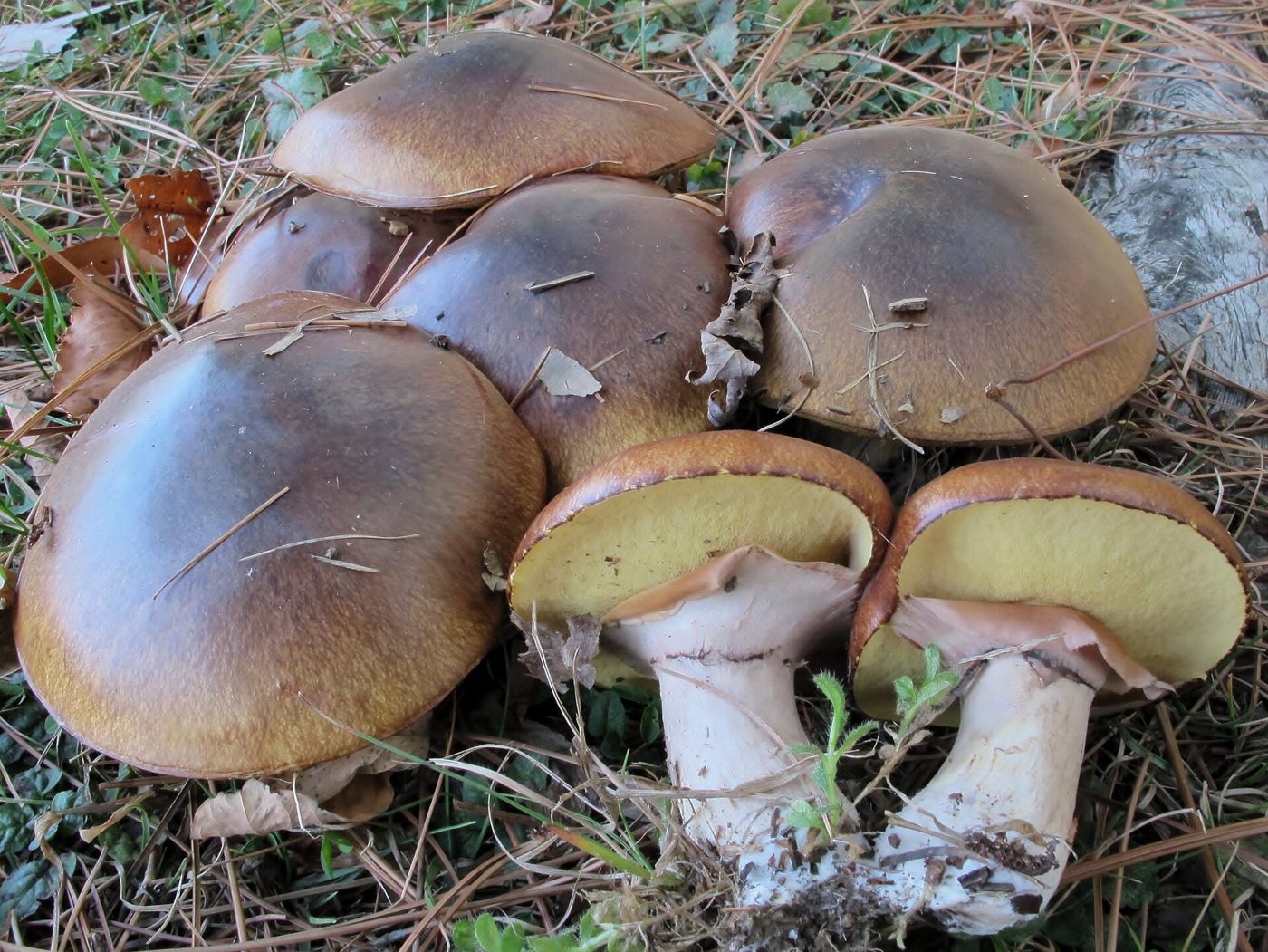
The slippery jack, scientifically known as Suillus luteus, is one of the most widely distributed boletes across temperate regions of the Northern Hemisphere, and it has also established itself in pine plantations across parts of Australia and New Zealand. The common name comes directly from the mushroom's most striking tactile feature: a thick, gelatinous cuticle that coats the cap surface, making it noticeably slick and slimy whenever rain or heavy dew is present. In dry conditions, this sticky layer can dry out to a polished, leathery sheen, often with dried pine needles and forest debris glued firmly to the cap surface.
Recognizing the slippery jack begins with understanding its overall bolete architecture. Rather than having vertical bladed gills underneath the cap, Suillus luteus possesses a dense layer of vertical tubes that open to the outside as tiny pores, creating a soft, sponge-like underbelly. These pores begin pale yellow in young specimens before deepening into an ochre or dull olive-yellow as the spores mature. The cap itself typically measures between five and twelve centimeters across, starting out convex or domed before flattening with maturity, and its coloration ranges from warm chestnut brown and chocolate to dull yellowish-brown.
A key feature that sets Suillus luteus apart from many other members of the genus Suillus is the presence of a prominent partial veil. In immature specimens, a whitish or pale purplish membranous tissue stretches from the cap margin to the stem, protecting the developing pore layer underneath. As the cap expands, this veil tears open, leaving behind a persistent, floppy ring or collar around the upper half of the stem. The stem above the ring is pale and dotted with fine glandular specks that darken with age, while the stem below often takes on a dingy brown or purplish cast. Unlike the deadly members of the Amanita family, the base of the stem lacks any cup-like sac or volva, though careful excavation is always necessary to inspect the entire fungal structure.
The slippery jack is an obligate mycorrhizal fungus, meaning it cannot survive without a symbiotic partnership with specific living trees. Suillus luteus associates almost exclusively with two-needle pines, such as Scots pine (Pinus sylvestris) in Europe and North America, as well as Monterey pine (Pinus radiata) in introduced southern regions. You will almost never encounter this mushroom in purely deciduous broadleaf woods or open fields without pines nearby. The fruiting bodies emerge predominantly from late summer through the autumn months, frequently appearing in substantial groups along woodland paths, clearings, and the grassy borders of conifer plantations following periods of sustained rain.
Foragers and nature enthusiasts often compare the slippery jack to related species like the weeping bolete (Suillus granulatus), which shares a similar pine habitat but completely lacks a stem ring and tends to secrete milky droplets from its young pores. While boletes as a group include fewer deadly species than gilled fungi, toxic varieties such as Rubroboletus satanas do exist in nature, and some individuals experience intense gastrointestinal distress from consuming misidentified wild fungi or failing to remove the slimy skin of certain Suillus species. Never rely on dangerous folk myths—such as checking whether wild animals have nibbled the cap, boiling a silver spoon alongside the mushroom, or assuming all mushrooms with pleasant smells are harmless—as these rules have caused severe hospitalizations. Only a qualified mycologist who physically examines a specimen in hand can verify edibility, and if you ever suspect someone has consumed a toxic wild mushroom, contact poison control or emergency medical services immediately and keep an intact specimen for diagnostic identification.
When documenting a prospective slippery jack in the field, careful observation and clear photography are essential for accurate identification. Capture high-resolution images showing the top of the cap, the color and texture of the pore layer beneath, the presence of the stem ring, and the fully excavated base of the stem, while taking note of the surrounding pine trees. Using the Shroomly app can help you compare these details against reference profiles and toxic look-alikes to narrow down candidate species. Before making any assumptions about wild fungi, always share your findings with your local mycological society or an experienced regional expert for definitive confirmation.