


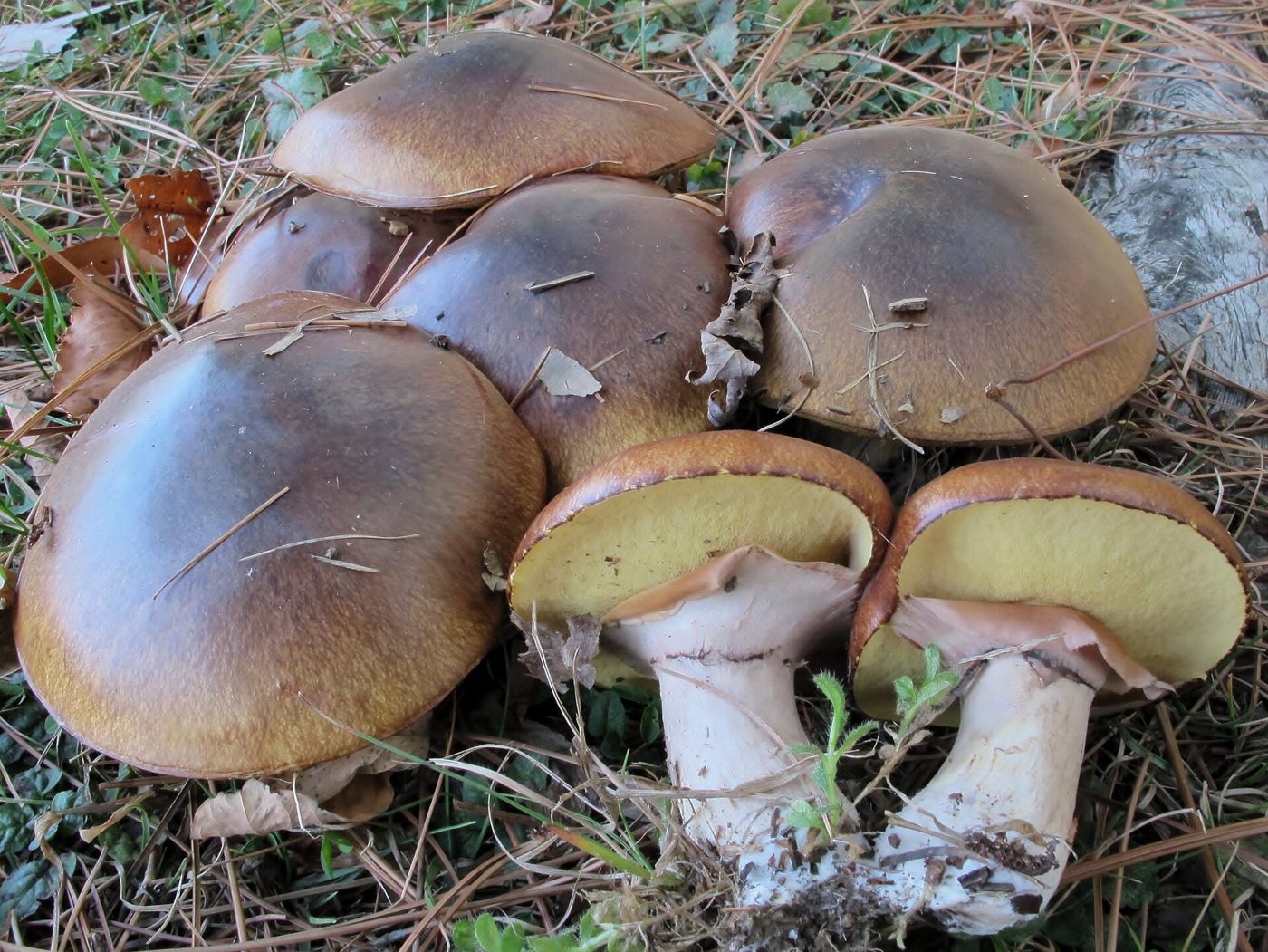
The slippery jack, known scientifically as Suillus luteus, is one of the most distinctive and widespread members of the bolete order. Classified within the Suillaceae family, this mushroom earns its evocative common name from the thick, gelatinous slime layer, or pellicle, that covers its cap in damp weather. Slippery jacks are strictly mycorrhizal fungi, forming obligate partnerships with coniferous trees, predominantly two-needle pines such as Scots pine (Pinus sylvestris) and black pine (Pinus nigra). They are native across Europe and Asia and have been widely introduced alongside pine plantations in North America, Australia, and New Zealand, where they fruit in abundance from late summer through late autumn.
Recognizing a slippery jack begins with its cap and under-surface anatomy. The cap typically measures between five and twelve centimeters across, starting out rounded or hemispherical before flattening into a broad cushion shape with age. Its color ranges from rich chestnut and chocolate brown to purplish-brown, often drying to a glossy, leather-like sheen in sunny conditions. When you look beneath the cap, you will not find gills. Like true boletes, Suillus species produce their spores inside a vertical layer of tightly packed tubes that open into tiny pores. In young specimens, these pores are pale lemon-yellow, gradually deepening into a dull ochre or olive-yellow as the spores mature. Unlike several toxic boletes, the pore layer of Suillus luteus does not bruise deep blue when pressed, although it may turn slowly dingy brown.
The stem of Suillus luteus provides one of the most crucial identification checkpoints separating it from its close relatives. Rising from four to ten centimeters tall, the stem features a prominent, whitish-to-purplish membranous ring, or annulus, which is the remnant of a partial veil that shielded the young pores during early development. Above this ring, the stem surface is pale yellow and dotted with minute, brownish glandular specks; below the ring, it often becomes streaked with dull brown or purplish fibrils. Inspecting the entire stem down to the soil line is critical, because weathered or older specimens can occasionally lose the skirt-like ring, leaving only a faint dark band or trace residue that could easily mislead a careless observer.
Several closely related fungi can be mistaken for the slippery jack, particularly other species in the genus Suillus that share the same coniferous habitat. The weeping bolete (Suillus granulatus) also forms mycorrhizal ties with pines and features a sticky brown cap, but it lacks a stem ring entirely and often exudes milky droplets from its young pores. The larch bolete (Suillus grevillei) possesses a persistent ring and a slimy cap, but it displays a vivid golden-yellow to rust-orange cap and associates almost exclusively with larch trees (Larix species). Beginners can also confuse Suillus species with more dangerous mushrooms, including red-pored boletes like the toxic Rubroboletus satanas, which can induce severe, debilitating gastrointestinal poisoning.
Widespread foraging folklore often claims that any mushroom with pores instead of gills is safe to eat, or that a mushroom whose cap skin peels off easily is inherently harmless. These assertions are completely untrue and dangerously misleading. Cap peelability is merely a mechanical trait of the gelatinous cuticle and bears no relationship to biochemical toxicity, and several pore-bearing species contain potent toxins capable of causing severe vomiting, dehydration, and abdominal pain. Never determine whether a wild fungus is safe to consume based on rules of thumb, smell tests, or app matches. Only an experienced mycologist who has physically examined the intact specimen can confirm identification and edibility. If you or someone you know ever suspect accidental ingestion of a toxic wild mushroom, call local poison control or emergency medical services immediately and preserve a physical sample for laboratory identification.
Accurately documenting wild fungi in the field requires patience, clear observations, and attention to detail. When you encounter a suspected slippery jack, take clear, well-lit photographs that capture the cap surface, the color and attachment of the pore layer, the complete stem showing the presence of any ring, and the base where the stem meets the ground, alongside the surrounding tree species. You can photograph the cap, pores, and stem base and let Shroomly suggest likely species and toxic look-alikes to help narrow your search. Always treat digital identifications as an educational guide, and confirm your findings with a local mycological society or regional expert before reaching any conclusions.