


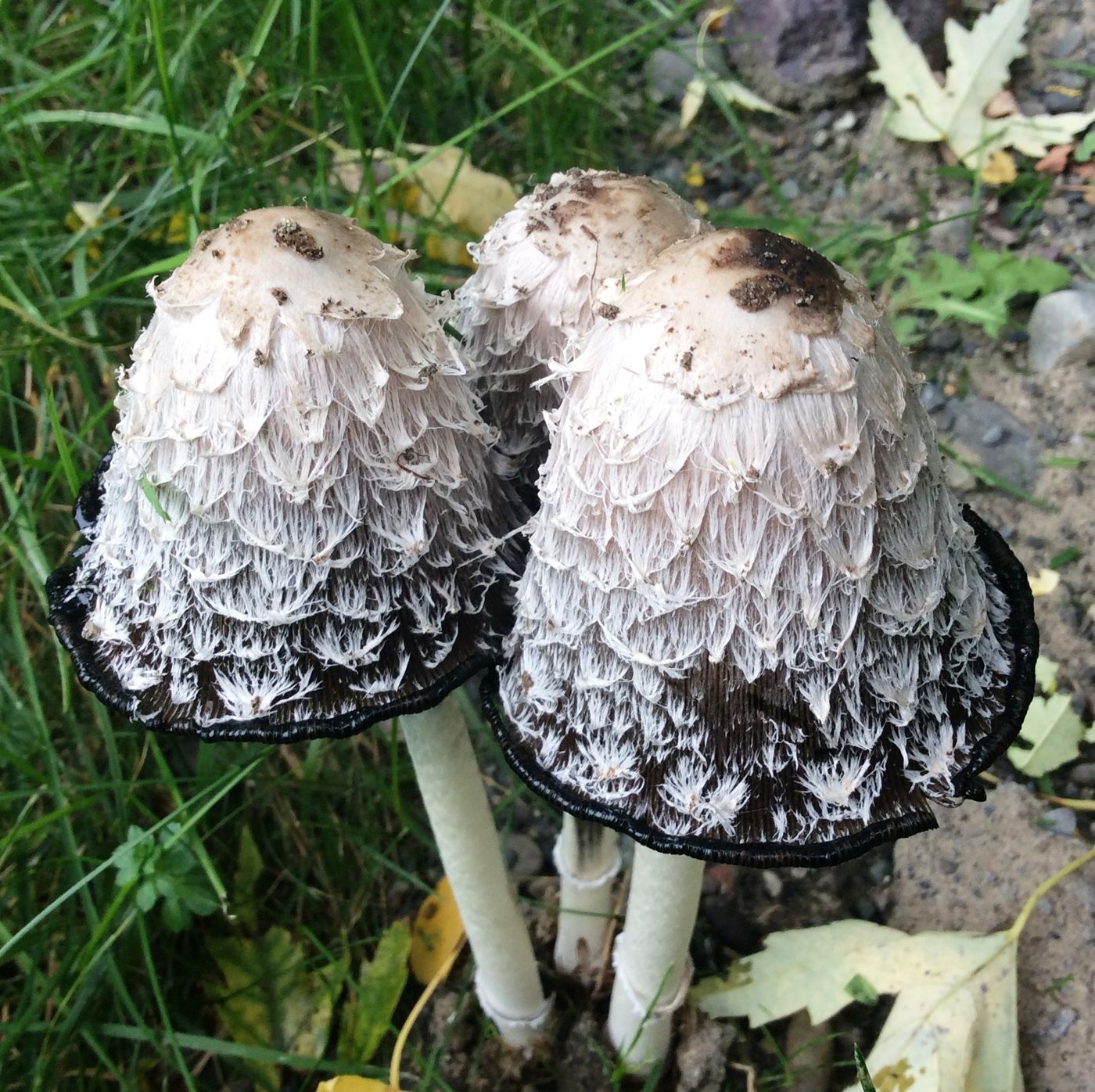
If you find a tall white mushroom that looks like a skinny shaggy bottle or candle, you may have encountered a shaggy ink cap, Coprinus comatus. Young specimens are erect and cylindric with a cap densely covered in shaggy, upturned scales; as the mushroom ages the cap margin frays and the gills turn from white to gray-black and begin to liquefy — a process called deliquescence. Those life-cycle changes are among the easiest field cues to separate Coprinus comatus from look‑alikes that stay intact.
Start your identification with cap shape and surface. Coprinus comatus has a noticeably cylindrical to bell-shaped cap when young, covered in loose, concentric scales that give a shaggy or flaky appearance. The cap margin is often inrolled at first and later unfurls. Other white to pale mushrooms can be smooth, slimy, or fibrillose rather than distinctly scaly; note whether the cap surface peels, bruises, or changes color where handled — Coprinus comatus normally stays white until the gills begin to turn inky.
Gills and the deliquescence process are diagnostic. The gills of shaggy ink caps start out white, become pinkish then gray and finally turn black and dissolve into an inky liquid from the edge backward. That progressive self‑digestion distinguishes true ink caps from many other species. Observe the gills from beneath the cap and check whether they remain clean and separate from the cap edge, or whether they are actively going inky; but beware that environmental factors (very dry or cold conditions) can slow or alter deliquescence.
Examine the stem and ring closely. Coprinus comatus typically has a long, hollow white stem with a loose, movable ring — the remnant of an annulus that can slide up and down the stem. The base often shows a slight rooting bulb but lacks the sac-like volva of Amanita species. Take care to dig up the whole base because some toxic look‑alikes can have different base structures. Also check the stem surface for scales or fibrils and note whether it bruises or stains when handled.
Habitat and timing help narrow possibilities. Shaggy ink caps commonly appear in grassy places such as lawns, pastures, along roadsides, and in disturbed ground or mulch, often in the cooler months of spring and autumn depending on your region. They frequently grow singly or in small scattered groups rather than large dense clusters. If you find many clustered small brown or yellow caps on wood or roots, you are likely looking at a different genus such as Coprinellus or Coprinopsis, which can look superficially similar but have different ecology and sometimes different toxicity profiles.
Be cautious about edibility and look‑alikes. While Coprinus comatus is widely reported as edible by foragers when collected young, never treat a photo or a single trait as proof that any wild mushroom is safe to eat. Some inky caps and other white mushrooms can cause adverse reactions, and certain Coprinus relatives can interact with medications or alcohol. Only a qualified expert who examines the actual specimen can confirm edibility, and some deadly species resemble common white mushrooms, so if there's any doubt do not eat it.
For a confident identification, photograph the whole mushroom from several angles: the cap from above and the margin, a clear view under the cap showing the gills, and the stem base dug up with surrounding soil or grass. Upload those images to Shroomly to get likely species suggestions and side‑by‑side toxic look‑alikes, and then confirm with a local mycological society or experienced expert who can examine the specimen in person.