


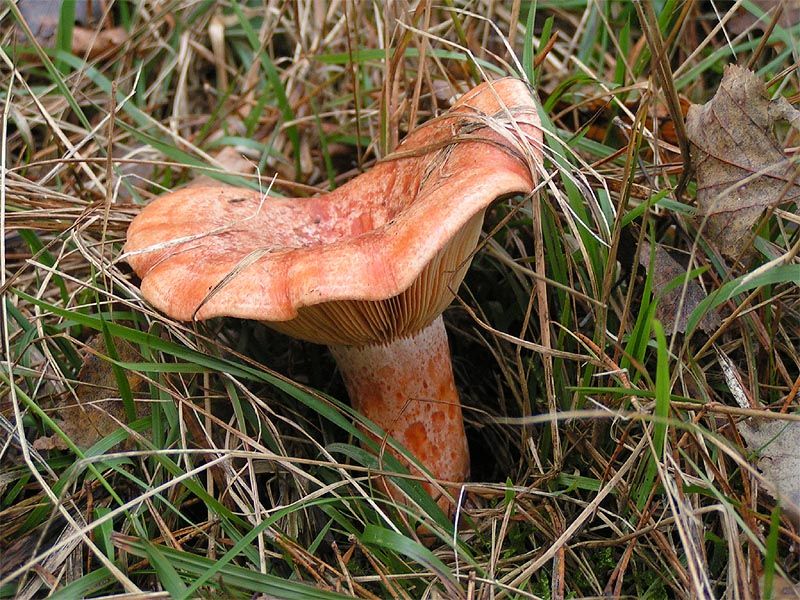
The saffron milk cap, botanically classified within the Lactarius deliciosus species group, is one of the most widely recognized wild mushrooms across Europe, parts of North America, Australia, and New Zealand. It forms an obligate mycorrhizal partnership with conifers, meaning its underground mycelium lives in close symbiosis with the root systems of trees. Foragers commonly encounter it beneath pines, particularly Monterey pine (Pinus radiata) and Scots pine (Pinus sylvestris). Because of this strict ecological bond, you will virtually never find a genuine saffron milk cap growing on dead wood or under broadleaf hardwoods like oaks and maples. In temperate regions of North America and Europe, fruiting bodies appear from late summer through late autumn after seasonal soaking rains, whereas in Australia and New Zealand, pine plantations frequently yield flushes between March and June.
Recognizing the saffron milk cap starts with examining the cap geometry and surface markings. When young, the cap is convex with an inrolled margin, but as it matures, it expands and forms a shallow, funnel-shaped central depression. Its surface is smooth, slightly greasy in damp conditions, and patterned with concentric circular bands of darker apricot-orange and paler peach tones. The flesh of the genus Lactarius is famously brittle rather than fibrous, snapping cleanly like chalk due to clusters of rounded cells called sphaerocysts within the tissue. Beneath the cap, the closely spaced gills share the same bright orange shade, run slightly down the stalk in a subdecurrent attachment, and snap crisply when pressed rather than peeling away smoothly.
The most defining feature of any milk cap is the liquid, known as latex, that exudes from the gills and flesh when cut or bruised. A true saffron milk cap bleeds an immediate, vivid carrot-orange milk. Within minutes to hours of exposure to air, both the damaged flesh and the orange latex oxidize, developing patches of dull, verdigris-green staining that often give older specimens an unappealing, moldy appearance. Novice foragers often rely on old folklore tests to evaluate mushrooms, such as assuming that boiling with silver will reveal toxins, that mushrooms nibbled by squirrels or slugs are universally harmless, or that easy peeling signifies an edible species. None of these folk rules have any scientific validity; toxins are complex chemical compounds that do not react to silver cutlery or parallel human digestive physiology in other animals.
Several species can easily confuse an untrained eye. Within the same genus, the woolly milkcap (Lactarius torminosus) also possesses an orange-pink, zoned cap, but its margin is distinctly shaggy with coarse hairs, and its latex is pure white and violently acrid, causing severe gastrointestinal poisoning if consumed. Another species, Lactarius chrysorrheus, bleeds white milk that rapidly turns bright sulphur-yellow. Outside the milk cap family, casual observers might mistake toxic orange woodland fungi, such as certain Cortinarius species containing deadly orellanine or the poisonous jack-o'-lantern mushroom (Omphalotus illudens), simply because they share a bright orange palette. However, these unrelated genera never produce milky latex when sliced and grow in completely different ecological contexts.
Although saffron milk caps have a long cultural history of wild harvesting across the Mediterranean and Australia, wild foraging carries inherent risks that no internet guide can fully eliminate. Mistaking a toxic look-alike for an edible mushroom can lead to severe nausea, violent cramps, and prolonged vomiting. Only a trained mycologist or local identification authority who has physically examined your intact specimen can verify its identity with certainty. If you or someone around you ever suspect mushroom poisoning, do not attempt home remedies, induce vomiting, or wait for symptoms to deteriorate; instead, immediately contact emergency services or your national poison control helpline, and keep leftover pieces of the mushroom safely refrigerated in a paper bag for clinical identification.
Whenever you encounter an unfamiliar fungus in the pine needles, the safest first step is careful documentation in its natural habitat. Take sharp, well-lit photographs showing the top of the cap, the attachment of the gills, the stem with any pitting, and a fresh cross-section that shows the color of any weeping latex. You can then upload these images to Shroomly to quickly explore likely species matches and study known toxic look-alikes. Once you have narrowed down the fungal group, bring your physical specimen or clear photos to a regional mycological society meeting or a local expert to confirm the finding before you do anything else.