


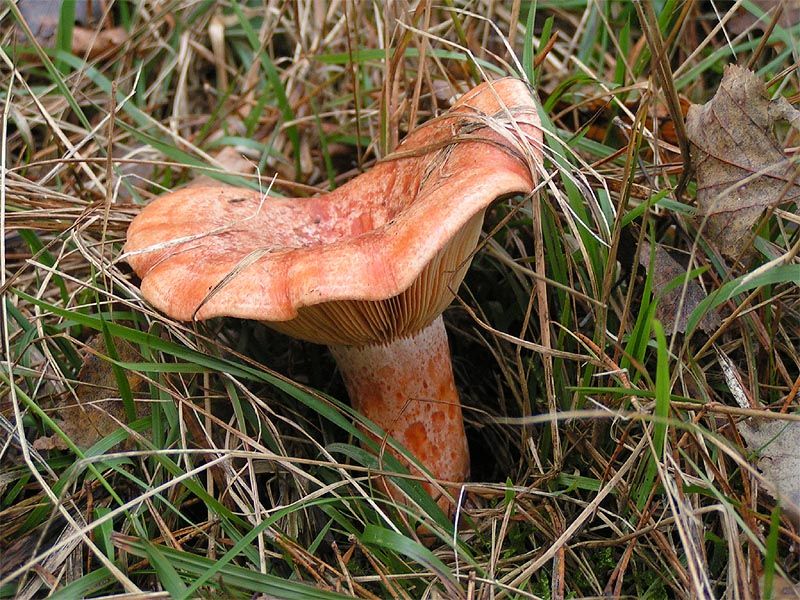
The saffron milk cap, known scientifically as Lactarius deliciosus, is one of the most widely recognized wild fungi across temperate regions of the Northern Hemisphere, as well as parts of Australia and New Zealand where it was introduced alongside foreign conifer plantings. Belonging to the family Russulaceae, this mushroom is famous for its warm carrot-orange coloration and its characteristic exudation of vivid orange latex, often referred to as milk, whenever the gills or flesh are sliced or damaged. As with all members of the genus Lactarius, this milky liquid is a primary identification feature, but correctly identifying the saffron milk cap requires examining several other distinctive botanical traits in detail.
A typical saffron milk cap features a cap measuring roughly five to fifteen centimeters across, which starts convex with a distinctly inrolled margin when young before expanding and eventually flattening into a broad, funnel-like depression at full maturity. The upper surface is smooth, slightly sticky when damp, and marked by noticeable concentric bands or rings of deeper orange alternating with lighter peach or apricot tones, a pattern botanists describe as zonate. Beneath the cap, the gills are brittle, closely spaced, and run slightly down the upper part of the stem in a subdecurrent fashion. Over time, or following mechanical injury, both the orange flesh and the gills will slowly oxidize and develop patchy, dull green or verdigris stains, which can alarm beginners but is entirely normal for this species.
Habitat provides essential context when evaluating a potential saffron milk cap, as Lactarius deliciosus is an obligate mycorrhizal partner that forms symbiotic relationships almost exclusively with two-needle and three-needle pines (Pinus species). In places like the United Kingdom, continental Europe, and parts of North America, it thrives beneath Scots pine (Pinus sylvestris) and other native pines, while in pine plantations across Australia, it frequently fruits under Monterey pine (Pinus radiata). You will rarely find this mushroom growing away from pine root zones, and fruiting generally occurs from late summer through late autumn, especially following periods of heavy soaking rain and dropping nighttime temperatures.
Despite its relatively distinctive appearance, several look-alikes exist in the wild, including other milk caps and completely unrelated orange fungi. Other species within the genus Lactarius also produce latex, but their sap may run white, yellow, or clear rather than vivid orange. For example, the woolly milkcap (Lactarius torminosus) has a pinkish-orange cap, but it features heavily shaggy, bearded margins and exudes an acrid white milk that causes severe stomach cramps, nausea, and vomiting. Beginners may also mistake deadly webcaps (Cortinarius species) or toxic jack-o'-lantern mushrooms (Omphalotus species) for edible orange varieties from above, even though they lack milky sap altogether. Relying on folklore or dangerous rules of thumb—such as assuming that insects nibbling a cap proves it is harmless, or that unpleasant tastes can reliably warn of toxins—must be avoided, as some of the deadliest fungal poisons have pleasant smells and cause no immediate irritation. Only an experienced mycologist who has physically handled and examined the intact specimen can confirm a species' true identity and determine whether it is safe.
Whenever wild mushrooms are handled, safety should always remain the top priority. If anyone accidentally consumes an unknown mushroom or experiences symptoms such as nausea, dizziness, sweating, or abdominal pain, contact your national poison control center or emergency medical services immediately rather than waiting for symptoms to worsen. Keeping an intact, refrigerated sample of the mushroom in a paper bag or container is critical, as toxicologists and hospital staff rely on physical remnants to identify the toxin and administer the correct medical intervention.
To build your identification skills safely, always take clear, well-focused photographs before disturbing a mushroom in the wild. Capture sharp images of the top of the cap, the attachment of the gills beneath, and the entire stem down to where it enters the pine needles or soil, as well as a clean cross-section showing any latex and color changes. You can then submit your photos to Shroomly: Mushroom Identifier to narrow down likely candidates and learn about potential toxic look-alikes in your area. Use these digital results as an educational starting point, and always have your findings verified by a local mycological society or professional expert before drawing any firm conclusions.