


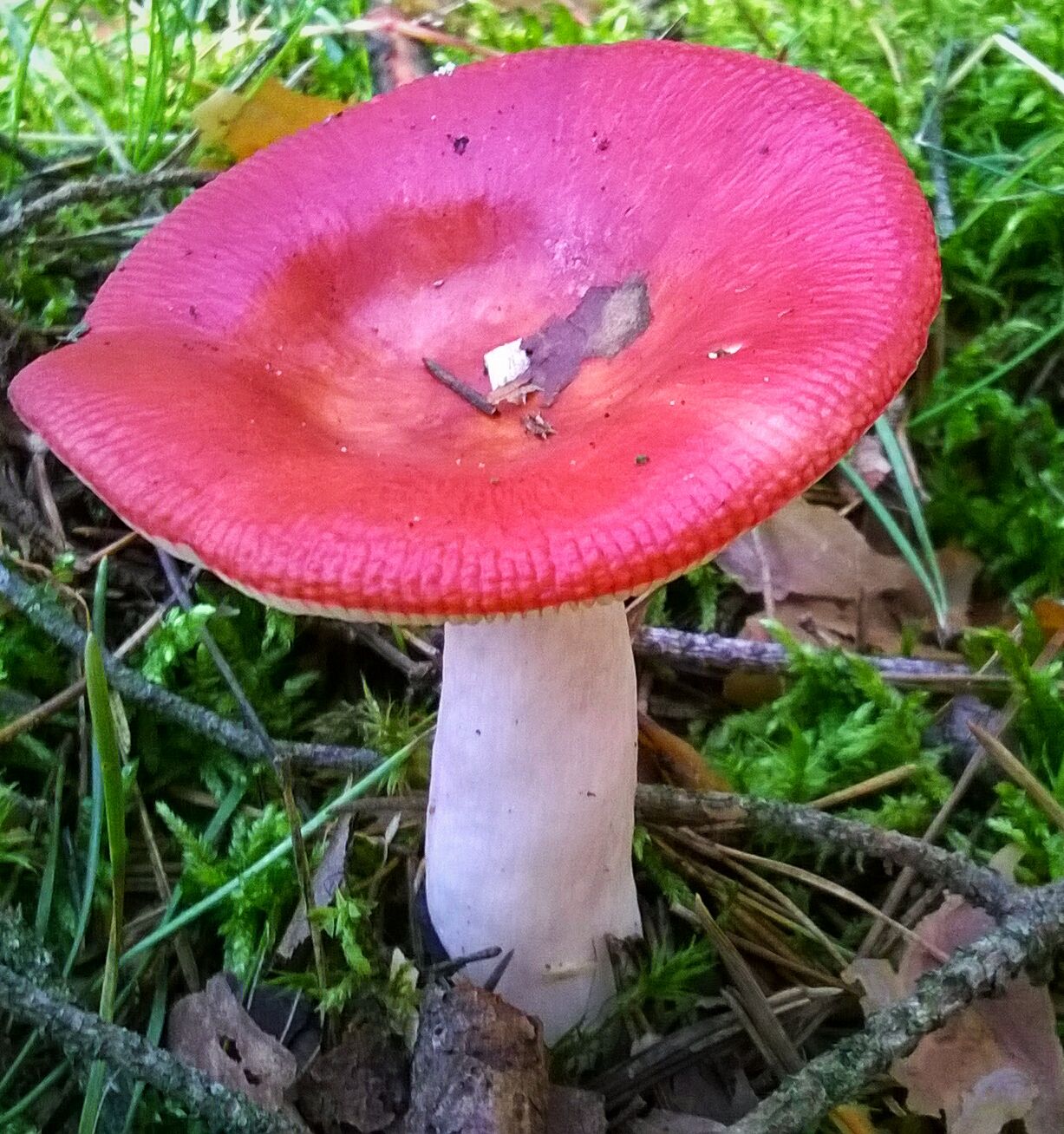
Russula is one of the most common and widely distributed mushroom genera in temperate woodlands, easily catching the eye of foragers and nature lovers with its vivid cap colors that range from ruby red and deep purple to bright yellow and olive green. What truly defines a Russula, however, is not its color, but its unique microscopic anatomy. Unlike most gilled mushrooms, which are composed entirely of elongated, filamentous fungal threads called hyphae, Russula mushrooms contain clusters of round, spherical cells known as sphaerocysts. This unusual cellular architecture gives the entire fruiting body a distinctively brittle, chalk-like consistency. When you bend the stem of a mature Russula, it snaps cleanly across like a fresh stick of blackboard chalk or a raw carrot, rather than bending, peeling, or splitting into stringy, fibrous strands.
Examining the individual features of a specimen helps confirm whether you are looking at a brittlegill. The caps typically start convex before flattening and eventually developing a shallow central depression as they mature, often with a cuticle that can be peeled partway from the margin toward the center. Beneath the cap, the gills are white, cream, or pale buff, remarkably brittle to the touch, and usually attached narrowly to the stem or free from it. Brushing your thumb gently across the gills will cause them to crumble or flake rather than flex. The stem is stout, solid, typically white or flushed with pale color, and entirely bare of ornamental structures: it bears no annulus or skirt-like ring, and there is never a sac-like cup or volva at the base. This combination distinguishes brittlegills from their close relatives in the genus Lactarius, which share brittle flesh but exude a milky latex when damaged, a feature true Russula species never exhibit.
Despite their distinctive texture, Russula species are notorious for misleading foragers, and several dangerous folk identification tests surround them. Older guidebooks sometimes suggested the so-called nibble-and-spit test, claiming that if a tiny piece of a Russula cap tasted mild rather than acrid, peppery, or bitter, it was safe. Modern mycologists strongly warn against this practice for beginners. Tasting wild mushrooms is inherently hazardous because novice foragers frequently confuse pale, yellow, or greenish brittlegills with deadly species such as the destroying angel (Amanita bisporigera or Amanita virosa) or the death cap (Amanita phalloides), both of which can cause fatal liver and kidney damage from minuscule ingested amounts. Furthermore, common folk tests like assuming animals eat safe fungi, peeling the cap skin, or boiling specimens with a silver coin are completely baseless myths that offer no protection against fungal toxins.
Toxicity within the genus Russula is widespread and can result in severe gastrointestinal distress. Species such as Russula emetica, aptly named the sickener, contain potent stomach irritants that cause debilitating nausea, abdominal cramps, vomiting, and diarrhea within hours of ingestion. Because many red-capped brittlegills look nearly identical to one another in the field, separating mildly toxic species from harmless ones is virtually impossible by eye alone. Even more critically, green-capped Russula species such as Russula virescens or Russula aeruginea can bear an unsettling superficial resemblance to the deadly Amanita phalloides. The critical difference lies in the stem and base: death caps have fibrous, non-brittle stems, a prominent hanging ring, and a fragile, cup-like volva hidden beneath the leaf litter, features that brittlegills entirely lack.
Determining a Russula down to the exact species level typically requires advanced laboratory methods, including microscopic inspection of spore ornamentation and chemical spot testing with reagents like iron sulfate. Russula spore prints range from pure white to deep ochre, but because the genus contains hundreds of closely related species with overlapping features, visual identification in the field remains an exercise in broad categorization rather than precision. Because several species cause painful poisoning and because fatal Amanita species grow in the same forest soils, no wild mushroom should ever be assumed safe to eat based on an app result, a photograph, or a single trait. Only a qualified local expert who has physically inspected the fresh specimen can confirm its identity and edibility.
If you ever suspect that someone or a pet has swallowed an unidentified wild mushroom, do not wait for symptoms to appear; immediately contact your regional poison control center or emergency medical services, and preserve an intact specimen in a paper bag for toxicologists to analyze. When documenting wild brittlegills in your local woods or yard, capture clear photographs of the cap surface, the attachment and spacing of the gills underneath, and the very base of the stem carefully excavated from the surrounding soil. Submitting these detailed angles to Shroomly can help you pinpoint the genus, explore likely species, and learn to distinguish brittlegills from dangerous look-alikes, after which you can continue your learning alongside your local mycological society.