


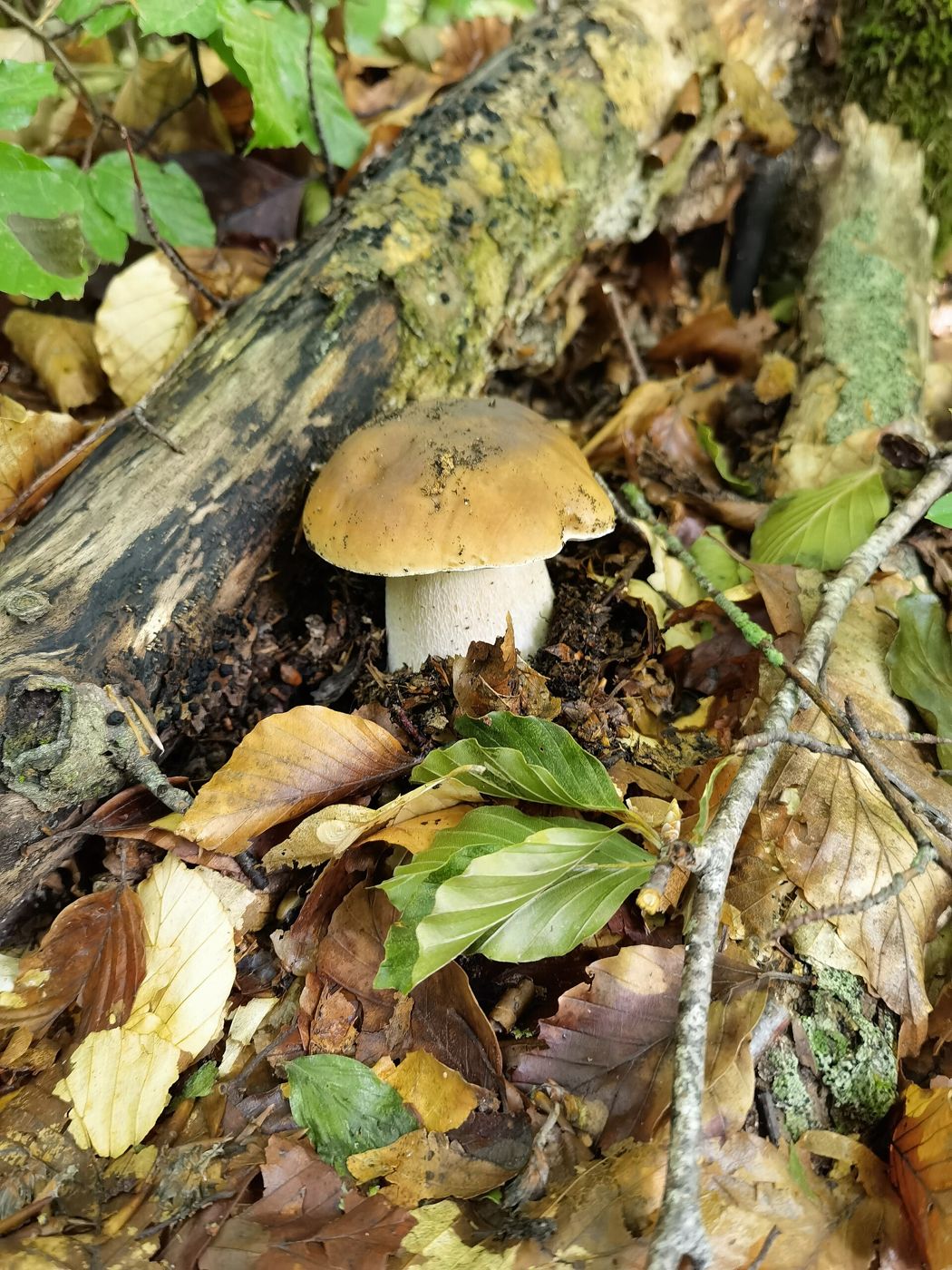
Porcini is the common name for Boletus edulis and a group of closely related boletes prized by foragers across Europe, North America and Asia. The classic porcini has a convex to broadly rounded brown cap, a chunky, often club-shaped stem that is pale to tan, and a porous underside made of tiny tubes that form a sponge-like surface rather than gills. They can grow quite large, the flesh stays firm when cut, and mature specimens often have a pleasant nutty or mushroomy aroma.
You’ll most often find porcini from late summer through autumn, after warm rainy periods; the exact window varies by region and local weather. Porcini form mycorrhizal partnerships with trees, meaning you’ll find them at the base of or a short distance from broadleaf trees like oak, beech and chestnut and with conifers such as spruce and pine. Look in mixed woodlands, parklands with established trees, and sometimes near hedgerows; they rarely fruit in open lawns away from trees.
Key field features to look for are the brown cap (often smooth or slightly velvety), the white to cream stalk that can develop a fine net-like pattern (reticulation) near the apex, and the sponge-like pore surface on the cap underside that is white to yellowish when young, becoming olive to greenish-brown with age. Unlike gilled mushrooms, boletes release spores from those pores. The flesh of true porcini typically does not change drastically in color when cut, though slight darkening with age can occur.
Several look-alikes deserve attention. The bitter bolete (Tylopilus felleus) can appear similar at a glance but has pinkish pores and a distinctly bitter taste if sampled; bitter boletes are not deadly but are inedible. More concerning are boletes that bruise blue or have red tones on the stem, such as Rubroboletus species (sometimes called Satan’s bolete), which can cause gastrointestinal distress and should be avoided. Color changes, pore color, stem patterns and taste (used only as a last-resort characteristic by experienced mycologists) are among the traits experts use to separate species—but taste testing wild mushrooms is risky and should not be done by casual foragers.
Common folk tests—like checking whether a silver spoon discolors, peeling the cap, or seeing whether insects have eaten a mushroom—do not reliably indicate safety or edibility. Scientific identification relies on a suite of characters including cap and pore color, stem texture and reticulation, bruising reactions, habitat, and often microscopic features or DNA for confident species-level ID. Because some toxic species can resemble edible boletes, never assume a mushroom is safe to eat based on a single trait or anecdotal test.
If you plan to forage porcini, learn the local species and their poisonous look-alikes from reliable field guides and, when possible, go with an experienced forager or mycological society. Remember that only an expert who has examined the actual specimen can confirm edibility; never eat a wild mushroom based solely on a photo or an app result. If you suspect mushroom poisoning, call emergency services or your regional poison control center immediately and keep a sample of the mushroom for identification.
To get the best help identifying a mushroom, photograph the cap from above, the underside (pores or gills), and the stem base where it meets the ground—also note the trees nearby and the habitat. Upload those images to Shroomly to get likely species suggestions and common toxic look-alikes, then confirm any edible recommendations with a local mycological society or an experienced expert who can inspect the actual specimens in hand.